Cassation Court Orders Reconsideration of Jurisdiction
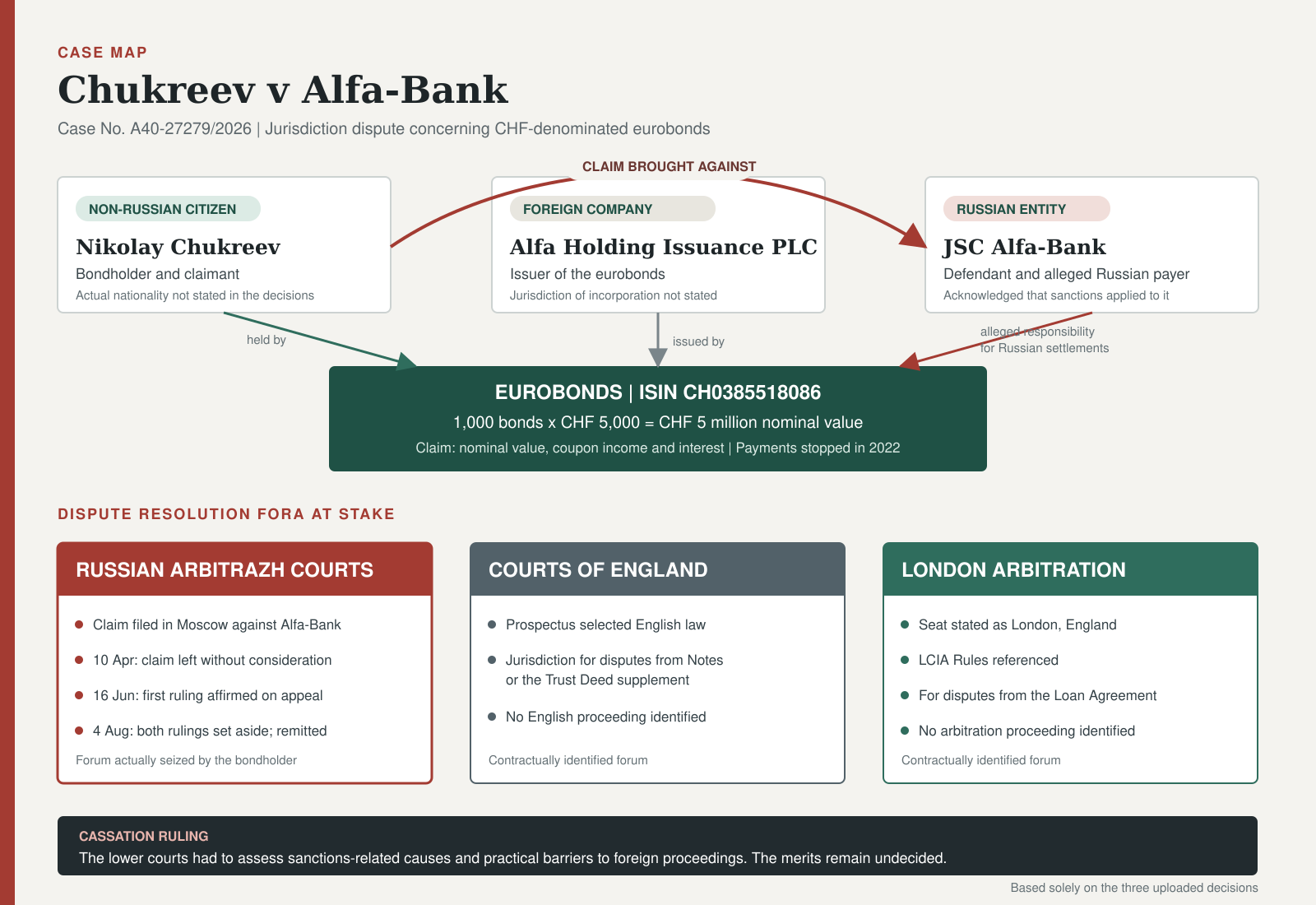
In a decision dated 4 August 2026, the Arbitrazh Court of the Moscow Circuit in case number A40-27279/2026 rendered a judgment on the jurisdiction of Russian courts over a claim concerning Alfa Holding Issuance PLC eurobonds.
The decision clarifies certain elements of art. 248.1 APK, known as “Lugovoy Law”. Wheres this provision is more often used to establish Russian jurisdiction against foreign parties, in this case, it is used against Russian Alfa Bank to allow a claim in a Russian court, despite an LCIA arbitration clause.
The court set aside the decisions of the Moscow Arbitrazh Court and the Ninth Arbitrazh Court of Appeal, which had left the bondholder’s claim without consideration on the basis of provisions referring disputes to the English courts or arbitration in London. The case was remitted to the Moscow Arbitrazh Court for reconsideration. The cassation court did not determine the bondholder’s monetary claims on their merits.
Factual Background
Nikolay Chukreev brought proceedings against JSC Alfa-Bank for payment of the nominal value of eurobonds, accrued coupon income and interest for the use of another person’s funds.
According to the statement of claim, Chukreev held 1,000 eurobonds issued by Alfa Holding Issuance PLC under ISIN CH0385518086. Each bond had a nominal value of CHF 5,000, making the total nominal value of the holding CHF 5 million.
The issuer stopped making payments under the eurobonds in 2022. Chukreev consequently did not receive either the bonds’ nominal value or the relevant coupon income. He asserted that Alfa-Bank had legally acknowledged that it was the entity responsible for settlements relating to these eurobonds in the Russian Federation.
Alfa-Bank requested that the claim be left without consideration under Article 148(1)(5) of the Russian Arbitrazh Procedure Code. It argued that the claim arose from obligations governed by the bond documentation and was therefore subject to the provisions selecting English law and referring disputes to the English courts or arbitration in London.
Chukreev opposed the application. He argued that his claim was brought under Russian law against a Russian legal entity rather than against the foreign issuer. He characterised the claim as a tort claim arising from the alleged infliction of loss and maintained that neither the prospectus nor its dispute resolution provisions applied.
Procedural History
On 10 April 2026, the Moscow Arbitrazh Court left the claim without consideration.
The first-instance court held that the claim was based on the issuer’s failure to perform its obligations under the eurobonds and that the relevant legal relationships were governed by the issuance documentation. In its view, the documentation extended to contractual and non-contractual obligations connected with the bonds.
The court quoted the following wording from the prospectus:
«Ноты, Агентское соглашение, Договор доверительного управления и любые внедоговорные обязательства, возникающие из них или в связи с ними, регулируются и толкуются в соответствии с английским правом. Эмитент передал Договор доверительного управления в исключительную юрисдикцию судов Англии и назначил агента для вручения процессуальных извещений в Англии».
The decision also reproduced the arbitration provision:
«Стороны безоговорочно соглашаются, что любой спор, возникающий из настоящего Соглашения или в связи с ним, включая спор относительно действительности, существования или прекращения действия настоящего Соглашения или последствий его недействительности и/или настоящего пункта 19.2 (“Спор”), подлежит разрешению: в арбитражном порядке в Лондоне, Англия… в соответствии с Регламентом, установленным ЛМАЦ (ранее Лондонским арбитражным судом)».
The first-instance court found no evidence that the dispute resolution agreement was invalid, had ceased to have effect or was incapable of performance. It also noted that Chukreev was not a Russian citizen, was not personally subject to restrictive measures and had not demonstrated that he faced an obstacle to obtaining justice in the agreed foreign forum.
On 16 June 2026, the Ninth Arbitrazh Court of Appeal affirmed that ruling. The appellate court agreed that Articles 247 and 248.1 of the Arbitrazh Procedure Code did not provide a basis for disregarding the foreign forum provisions in the circumstances identified by the lower court. It likewise concluded that the claimant had not shown that his access to the English courts was restricted.
Legal Considerations of the Cassation Court
The Arbitrazh Court of the Moscow Circuit disagreed with the approach taken by both lower courts.
The cassation court interpreted Articles 248.1 and 248.2 of the Arbitrazh Procedure Code as provisions intended to preserve access to judicial protection where the restoration of rights in a foreign jurisdiction has become impossible or substantially more difficult.
According to the court, a Russian arbitrazh court may have jurisdiction despite an agreement providing for foreign litigation or international commercial arbitration where:
- the imposition of restrictive measures against a Russian individual or legal entity was the direct cause of the dispute; or
- the agreed dispute resolution mechanism can no longer operate as originally intended because one of the parties faces evident obstacles to access to justice.
The assessment therefore required the lower courts to determine whether the dispute had arisen in connection with foreign restrictive measures and whether either party faced material barriers to pursuing the case in the agreed forum.
The court stated that an obstacle to access to justice need not amount to an absolute legal impossibility. It may also result from the burdens imposed by the agreed procedure. Relevant circumstances may include difficulties paying court or arbitration fees, the absence of a financial or practical ability to retain foreign counsel, and restrictions affecting physical attendance because of difficulties crossing national borders.
The cassation court referred to paragraph 17 of the Supreme Court’s Thematic Review No. 8/2026 on special economic measures, approved by Resolution No. 11A/2026 of 17 June 2026. According to the principle cited from that review, a dispute falls within the jurisdiction of the Russian arbitrazh courts where it arose in connection with foreign restrictive measures or where such measures created obstacles to access to justice, including where the parties had agreed on arbitration.
In the present case, Alfa-Bank acknowledged that restrictive measures had been imposed on it. The court further found that sanctions and Russian countermeasures made it impossible to perform the bond obligations through the mechanism originally established by the issuance documentation.
The court noted that, if the substantive requirements were established, Alfa-Bank as the Russian debtor would have to discharge bond-related obligations through one of the mechanisms provided by the overriding rules contained in Russian Presidential Decrees Nos. 95, 430, 529 and 198.
It therefore held that the lower courts had incorrectly left the claim without consideration. Their decisions were set aside for incorrect application of procedural law, and the case was returned to the Moscow Arbitrazh Court for a new examination.