
Introduction
In a decision dated 6 October 2026, the Arbitrazh Court of the Moscow District (Russia) in case number А40-98870/2022 (АС Московского округа – Решения и постановления vom 06.10.2026 – А40-98870/2022) in the Siemens v RZD case rendered a judgment on a monetary sanction for non-compliance with a Russian court order prohibiting the initiation of foreign arbitration proceedings.
The cassation court left in force a Moscow Arbitrazh Court order requiring Siemens Mobility GmbH to pay OAO “Russian Railways” (RZD) €1,500,861.95 after Siemens initiated arbitration in Vienna despite an earlier Russian “anti-arbitration” injunction.
Facts
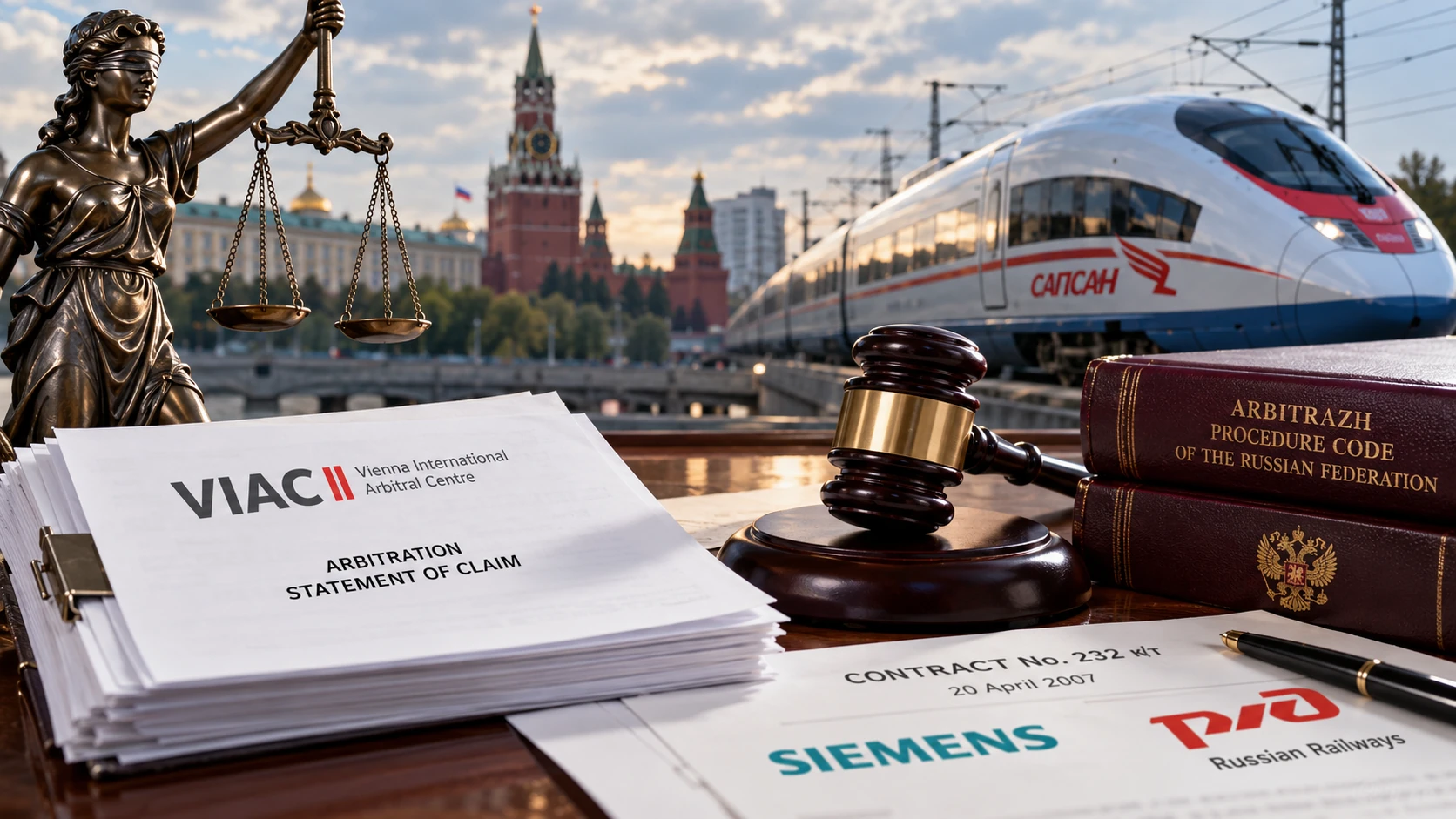
The dispute arises out of a contract between RZD and Siemens Mobility GmbH: contract No. 232 к/т dated 20 April 2007 concerning technical maintenance and repair of the “Sapsan” high-speed trains, including subsequent amendments (the decision refers specifically to an additional agreement No. 9 dated 7 June 2019).
On 8 November 2022, the Moscow Arbitrazh Court (a Russian state commercial court) issued an order in case А40-98870/2022 prohibiting Siemens Mobility GmbH from initiating proceedings at the International Arbitral Centre of the Austrian Federal Economic Chamber in Vienna (the Vienna International Arbitral Centre, VIAC) “for all disputes arising out of” the contract or “in connection with it,” including disputes relating to “breach, termination or invalidity.”
That 8 November 2022 order was upheld on cassation by the Arbitrazh Court of the Moscow District on 8 February 2023, and on 10 May 2023 a judge of the Supreme Court of the Russian Federation refused to refer Siemens’ cassation complaint for hearing by the Supreme Court’s Economic Disputes Chamber.
Despite the prohibition, Siemens initiated VIAC proceedings against RZD. The decision summarises Siemens’ VIAC statement of claim dated 29 November 2023 (as later уточнение/amended on 7 October 2024). The relief Siemens sought in VIAC was largely declaratory, including requests to:
- confirm the arbitration clause (identified as clause 31.2 of the contract) was valid, not terminated and enforceable;
- confirm the arbitral tribunal had exclusive jurisdiction over disputes connected with the contract, including disputes relating to termination, ongoing obligations, alleged breaches and consequences;
- confirm that RZD breached the arbitration agreement by applying to Russian state courts and participating in those proceedings;
- confirm the contract was terminated as of the end of 12 May 2022 by Siemens’ notice dated 21 April 2022, or alternatively terminated on 17 October 2022 or by the end of 16 November 2022 (depending on the tribunal’s findings);
- confirm Siemens had no further service obligations from 13 May 2022 (or alternatively from 17 October 2022 or 17 November 2022);
- order RZD to pay arbitration costs and related expenses (including VIAC fees, tribunal fees, and legal costs).
The Russian cassation decision also notes Siemens’ costs submission dated 16 July 2025, where Siemens asked the tribunal to order RZD to reimburse costs totalling €1,881,314.63.
On 1 December 2025, VIAC issued an award that partially satisfied Siemens’ requests, including an order that RZD pay Siemens arbitration/legal costs in the amount of €1,500,861.95.
RZD then applied to the Moscow Arbitrazh Court seeking recovery of €1,500,861.95 from Siemens as a monetary sanction for non-compliance with the Russian 8 November 2022 prohibition order. On 14 May 2026, the Moscow Arbitrazh Court granted RZD’s application and ordered Siemens to pay €1,500,861.95. Siemens appealed to cassation.
Legal considerations
The statutory basis: Article 248.2(10) APC RF
The cassation decision turns on part 10 of Article 248.2 of the Arbitrazh Procedure Code of the Russian Federation (APC RF). In brief, Article 248.2 allows Russian commercial courts to issue orders prohibiting a party from initiating or continuing proceedings in a foreign court or foreign-seated international commercial arbitration where restrictive measures (sanctions) affect the Russian party. Part 10 provides that, applying principles of fairness, proportionality, and preventing a party from benefiting from unlawful or bad-faith conduct, the court may award a monetary amount payable if the prohibition order is not complied with.
The decision emphasises two limits/criteria found in the text of part 10:
- the amount is a form of judicial penalty (судебная неустойка) for breaching the prohibition; and
- the amount “must not exceed” the size of the claims brought in the foreign proceedings and the applicant’s litigation/arbitration costs.
Siemens’ arguments in cassation
Siemens argued essentially that:
- Lack of Russian court competence due to a valid arbitration clause: The Russian commercial court allegedly lacked competence because the arbitration clause providing for VIAC arbitration was valid and enforceable.
- Non-material nature of the VIAC relief: Siemens contended its VIAC claims were non-monetary (declaratory), and therefore a penalty should not be recoverable.
Cassation court’s reasoning
The Arbitrazh Court of the Moscow District upheld the first-instance order and rejected Siemens’ arguments.
- Competence/exclusive jurisdiction already determined and binding The court held that Siemens’ jurisdictional objection had already been resolved by final Russian judicial acts in cases № А40-98870/2022 and № А40-257889/2022. Those acts had established that disputes connected with contract No. 232 к/т could be heard “only on the territory of the Russian Federation.” Under part 2 of Article 69 APC RF (a rule akin to issue preclusion/res judicata for established facts in Russian commercial procedure), the previously established circumstances did not need to be re-proved in later proceedings involving the same parties. The cassation court also endorsed the first-instance court’s approach to sanctions-related access-to-justice concerns, noting (in substance) that the mere application of restrictive measures can already create obstacles for a Russian party’s access to justice; accordingly, to transfer the dispute to Russian courts it is sufficient for the Russian party to express a unilateral will “in procedural form.” It further relied on the drafting of point 4 of part 2 of Article 248.2 APC RF, reading it as meaning that circumstances showing impossibility to perform an arbitration clause are indicated by the applicant “if available” (при их наличии), i.e., not in every case as a mandatory proof requirement. The decision also states that Russian law treats applications for prohibitions on foreign proceedings (where restrictive measures apply to the Russian party) as falling within the exclusive competence of the arbitrazh court of the Russian region where the Russian legal entity is located.
- Penalty could be based on costs ordered in VIAC despite declaratory relief The cassation court agreed with the first-instance finding that Siemens’ “non-material claims” argument was contrary to law. The court accepted that, as a result of Siemens initiating VIAC proceedings in breach of the Russian prohibition order, RZD had been “wrongfully burdened” with arbitration costs. The amount selected—€1,500,861.95—matched the costs amount awarded against RZD by VIAC, and the Russian court considered that amount proportionate and within the statutory ceiling in Article 248.2(10). The decision also records the lower court’s assessment that Siemens’ VIAC demands were effectively aimed at circumventing Russian judicial acts, obtaining release from obligations under what the Russian court treated as an ongoing contract, and securing compensation for losses and costs incurred in what the Russian court considered an unlawfully initiated process.
- Limits of cassation review The cassation court noted that the remaining arguments largely repeated points made below and amounted to disagreement with the lower court’s evaluation of facts and evidence. Under Articles 286 and 287 APC RF, the cassation instance does not re-assess evidence or re-try the facts; it reviews legality and procedural correctness. No procedural violations requiring unconditional reversal under part 4 of Article 288 APC RF were found.
Outcome
The Arbitrazh Court of the Moscow District held that the 14 May 2026 order was lawful and supported by the record. It therefore left the order unchanged and dismissed Siemens Mobility GmbH’s cassation complaint, maintaining the award of €1,500,861.95 payable to RZD for non-compliance with the Russian anti-arbitration prohibition order.
KDB.legal Koch Boës advises in all kind of disputes (arbitration and litigation) involving sanctions and foreign trade restrictions, especially with regard to Russian and EU sanctions.


