

For decades, restitution claims for Nazi-looted art have often failed not on substance, but on procedural defenses—laches, statutes of limitations, or even acquisitive prescription.The HEAR Act 2025 changes this fundamentally: these defenses are largely set aside, and claims are to be decided on their merits.
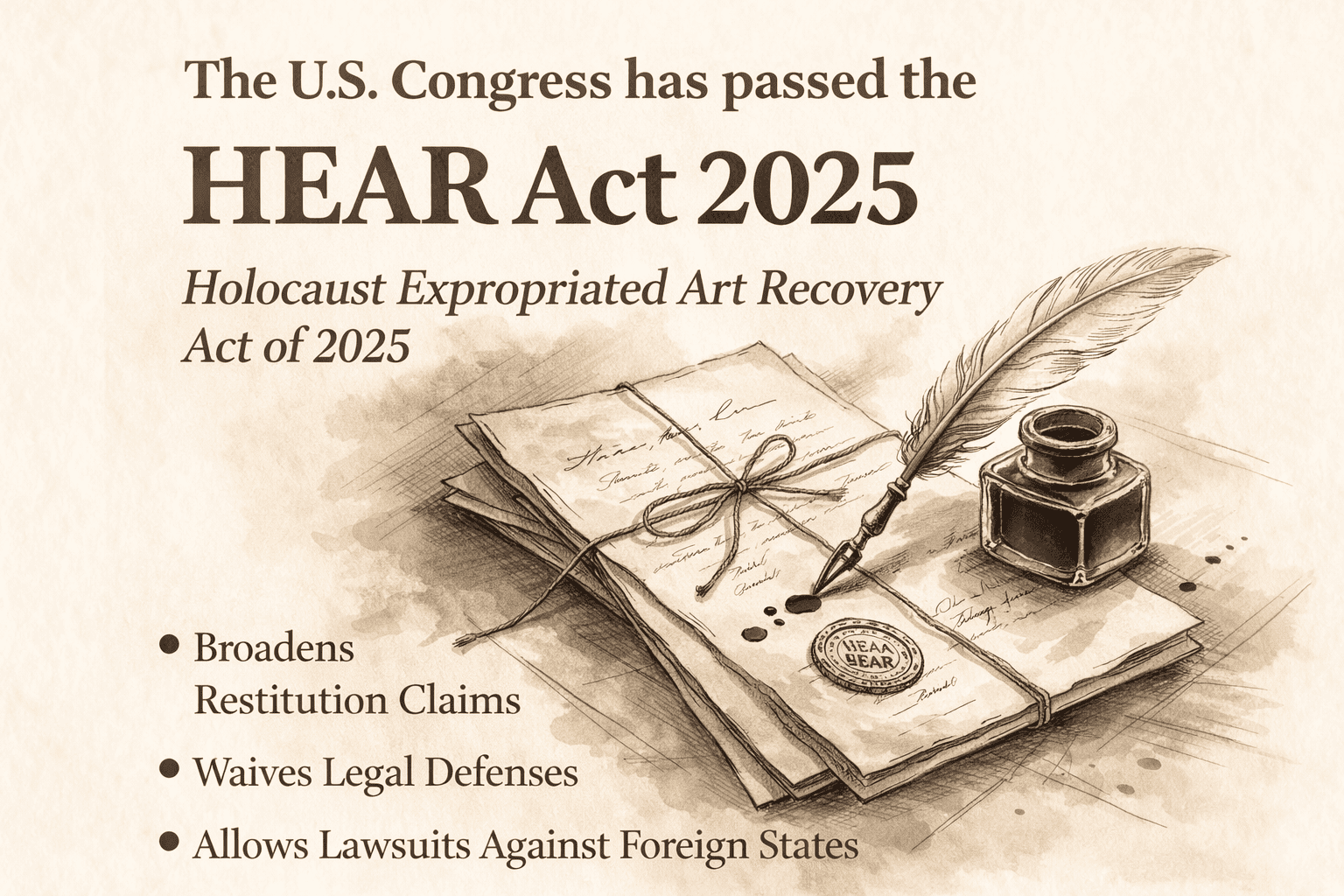
The U.S. Congress has passed the Holocaust Expropriated Art Recovery Act of 2025 (HEAR Act 2025), significantly expanding the legal framework for the recovery of art looted during the Nazi era. The bill now only requires the President’s signature to become law. The new legislation significantly expands the existing framework and is likely to reshape how restitution claims are litigated—both in the U.S. and internationally.
1. Background: The HEAR Act of 2016
The original HEAR Act of 2016 aimed to remove one of the key procedural barriers in restitution cases: statutes of limitations. It introduced a uniform federal limitation period of six years, which begins only when the claimant actually discovers essential facts of the claim, particularly the location and identity of the artwork.
However, its practical effect remained limited. U.S. courts continued to allow various time-related defenses, including:
- the doctrine of laches (unreasonable delay),
- evidentiary disadvantages resulting from the passage of time,
- and broader equitable considerations favoring current possessors, especially museums.
2. Key Features of the HEAR Act 2025
The HEAR Act 2025 adopts a significantly more expansive approach: restitution claims are intended to be decided on their merits, rather than dismissed on procedural grounds.
a) Elimination of Key Procedural Defenses
The new law largely excludes a number of traditional defenses, including:
- laches (unreasonable delay in bringing a claim),
- defenses based on the passage of time or loss of evidence,
- acquisitive prescription under foreign law,
- the act of state doctrine,
- and judicial abstention based on international comity.
This represents a clear paradigm shift: procedural and time-based defenses give way to a substantive assessment of ownership rights.
b) Expanded Jurisdiction over Foreign States
One of the most significant changes concerns sovereign immunity:
- Nazi-era expropriations are expressly defined as violations of international law.
- This triggers an exception under the Foreign Sovereign Immunities Act (FSIA).
- As a result, foreign states may now be subject to lawsuits before U.S. courts, even where the taking occurred within their own territory.
This provision directly responds to U.S. Supreme Court case law, in particular Philipp v. Germany (Welfenschatz/Guelph Treasure), where the claim was dismissed for lack of a violation of international law.
c) Permanent Extension of the Limitation Framework
The HEAR Act 2025:
- retains the six-year discovery-based limitation period,
- but removes the sunset clause, making the regime permanent.
This ensures a lasting and stable legal basis for restitution claims.
3. Practical Implications
a) Strengthening of Claimants’ Position
Heirs of victims of Nazi persecution will benefit significantly:
- key procedural obstacles are removed,
- claims remain viable even decades after the events,
- and new avenues are opened for litigation against foreign state entities.
Pending and previously unsuccessful cases may gain renewed momentum.
b) Increased Risks for Museums and Collectors
Museums and other holders of artworks face a considerably more challenging legal environment:
- reduced availability of defenses,
- increased litigation risk,
- and growing pressure to conduct thorough provenance research and ensure transparency.
c) International Legal Tensions
The extraterritorial reach of the legislation raises sensitive issues:
- states such as Germany emphasize the importance of sovereign immunity as a core principle of international law,
- European countries maintain their own restitution frameworks (e.g. advisory and arbitration bodies),
- and the new U.S. approach may lead to jurisdictional conflicts between domestic and U.S. proceedings.
4. Conclusion
The HEAR Act 2025 significantly shifts the balance in restitution proceedings in favor of claimants. The reform is likely to increase both the number and complexity of cases, intensify international legal debates and place additional pressure on cultural institutions worldwide.