

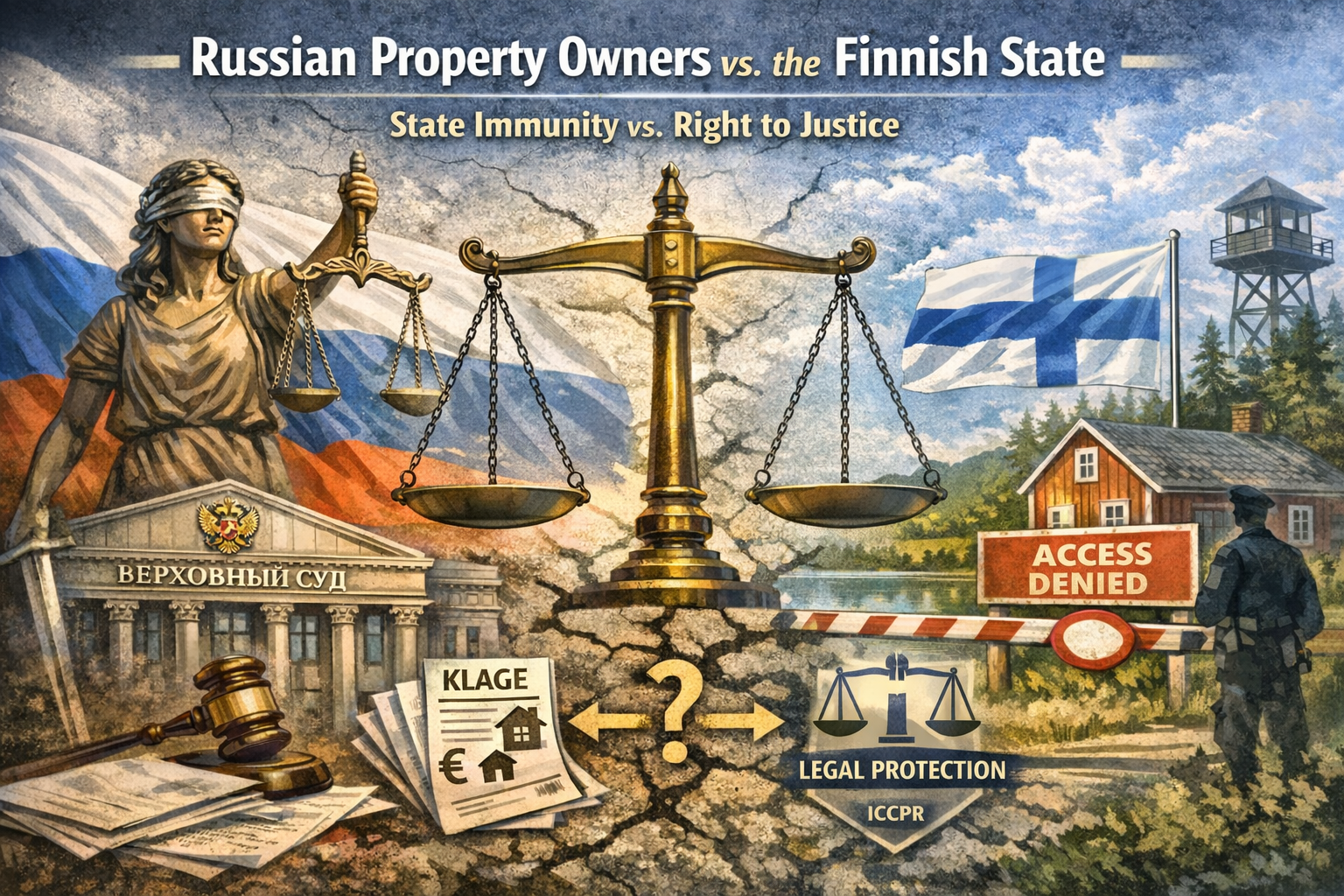
On the decision of the Supreme Court of the Russian Federation of 24 March 2026, No. 78-КГ25-37-КЗ
In two recent decisions, Russian courts dealt with claims against souvereign states. In the one case, (Supreme Court, case no. No. 78-КГ25-37-КЗ – provided below since the website of the Russian Supreme court is inaccessible from abroad), it was a claim against Finland, the other one (Arbitrazh Court of Kursk, case no. A35‑6794/2023) concerned a case against Norway. In the first decision, all lower instances had rejected the case due to state immunity and it took the Supreme Court to set aside these decisions and sent back the matter to the first instance to consider whether state immunity applies. In the second case, the arbitrazh court basically confirmed state immunity, but still ruled on the merits.
So, it seems the principle that states are immune against national jurisdictions of other states is not carved in stone any more, at least not in Russia.
A. Background of the Case
Two Russian nationals purchased a plot of land (1.2840 ha) and a residential house in Finland in 2017 under a sale contract for EUR 180,000. Since 2017 they had freely used the property.
On 6 July 2023, when crossing the Finnish border at the Nuijamaa checkpoint, Finnish authorities issued administrative decisions ordering them to leave Finland by 20:00 on 7 July 2023. The decisions were based on Government Decision No. UM/2022/199 of 29 September 2022, under which Finland unilaterally introduced entry and transit restrictions based on nationality: Russian citizens were, with narrowly framed exceptions, barred from entering on Schengen tourist visas and from using Finland as a transit state to other Schengen countries.
One of the exception categories concerns property owners who may enter to maintain their property in proper condition; however, admission still depends on individual interviews at the border and on the production of supporting evidence.
The claimants argued that these measures formed part of an ongoing discriminatory policy against Russian nationals and that their property right was effectively undermined because they could no longer use their property; they also claimed significant moral (non‑pecuniary) damage.
They brought an action in Russia against the State of Finland (represented by the State Council), seeking:
- an order obliging Finland to buy back the plot and house, and
- compensation for moral damage.
B. Procedural History in Russia
I. Commercial Courts (Arbitrage Courts)
The claimants first filed their claim with the Commercial Court of St Petersburg and Leningradskiy Region. The court returned the statement of claim under Article 129(1)(1) of the Russian Commercial Procedure Code, relying on immunity of the Finnish State.
Appeals and cassation in the commercial court system were unsuccessful: the Thirteenth Commercial Court of Appeal and the Commercial Court of the North‑Western Circuit upheld the decision; the Supreme Court (Economic Chamber) then refused to refer the complaint for consideration.
The claimants subsequently turned to the courts of general jurisdiction.
II. Courts of General Jurisdiction
A judge of the Dzerzhinsky District Court of St Petersburg refused to accept the statement of claim. Relying on Article 134(1)(1) of the Russian Code of Civil Procedure, he essentially held that:
- Finland enjoyed state immunity; and
- the claimants had not produced evidence that this immunity was limited on the basis of the principle of reciprocity.
The St Petersburg City Court (appeal) and the Third Court of Cassation of General Jurisdiction confirmed this reasoning.
The claimants filed a cassation complaint with the Supreme Court (Civil Chamber). A judge of the Supreme Court initially refused to refer the case to the Civil Chamber. This decision was set aside by the Deputy President of the Supreme Court, who referred the complaint and file to the Civil Chamber for hearing.
The Civil Chamber then set aside all three lower‑court decisions and remitted the case to the district court for a full hearing on the merits.
C. Core Legal Issues
The decision turns on three main clusters of questions:
- Scope of state immunity in the Russian legal order
- Weight of the constitutionally protected right of access to a court
- Relationship between state immunity, reciprocity and the right to an effective remedy under international law
D. Normative Framework
I. Constitutional Law
The Supreme Court begins by setting out the constitutional baseline:
- The Constitution has supreme legal force, direct effect and applies throughout the Russian territory; all laws must comply with it.
- Generally recognised principles and norms of international law and international treaties of the Russian Federation form part of the domestic legal order.
- The State has an obligation to recognise, respect and protect human rights and to ensure judicial protection of rights and freedoms (Articles 2, 18 and 46 of the Constitution).
- The right of private ownership – including the rights to own, use and dispose of property – enjoys special protection (Article 35). No one may be deprived of their property otherwise than by a court decision.
From these provisions the Court derives that the State – including its courts – must provide effective remedies when fundamental rights are infringed.
II. International Law
The Court places particular emphasis on Article 2(3)(a) of the International Covenant on Civil and Political Rights (ICCPR), to which both Russia and Finland are parties. Under this provision, each State Party undertakes to ensure that anyone whose Covenant rights are violated shall have an effective remedy, even if the violation has been committed by persons acting in an official capacity.
The Court stresses that the right to an effective remedy is not only treaty‑based but also a generally recognised principle and norm of international law.
III. Statutory Law on State Immunity
- Federal Law No. 297‑FZ of 3 November 2015
The Federal Law on Jurisdictional Immunities of a Foreign State and the Property of a Foreign State in the Russian Federation provides that:
- A foreign state enjoys jurisdictional immunities in respect of itself and its property.
- “Judicial immunity” is defined as the duty of a Russian court to refrain from involving a foreign state in judicial proceedings.
- Such immunities may, however, be limited on the basis of the principle of reciprocity if it is established that the Russian Federation and its property are subject to limitations on immunity in that foreign state.
- The assessment whether and to what extent Russia enjoys immunity abroad is based inter alia on opinions issued by the competent federal executive authority in charge of foreign affairs (the Ministry of Foreign Affairs).
The Law also contains:
- rules on express consent by a foreign state to the jurisdiction of Russian courts (Article 5),
- situations in which a foreign state is deemed to have waived immunity (Article 6), and
- categories of disputes in which foreign states do not enjoy immunity in Russia (Articles 7–13).
- Article 417 of the Code of Civil Procedure – Principle of Reciprocity
- The Supreme Court also quoted art. 417 of the Code of Civil Procedure and held that state immunity is subject to reciprocity, that is, that Finnish immunity can only be accepted if it is demonstrated that Finland accepts Russia’s immunity as a state.
- This provision can actually not be found in art. 417 of the Russian Code of Civil Procedure. This provision deals with the recognition of foreign judgements and arbitral awards and introduces reciprocity as a ground to recognise a foreign decision.
- Article 134 of the Code of Civil Procedure – Grounds for Refusing to Accept a Claim
- Under Article 134(1)(1) a judge shall refuse to accept a statement of claim if the matter is subject to constitutional or criminal proceedings or proceedings on administrative offences, or if it does not fall within the jurisdiction of any court at all.
E. Reasoning of the Supreme Court
I. State Immunity is not Absolute and not a Gatekeeping Device at Filing Stage
The Court acknowledges the binding nature of the Law on Jurisdictional Immunities but emphasises that, as ordinary legislation, it must be interpreted in harmony with the Constitution and international law.
The Court draws a clear line:
- The current legal framework does not exclude the possibility of limiting a foreign state’s immunity on the basis of reciprocity.
- The mere absence of evidence of such a limitation (especially at the time of filing, and especially not yet backed by state‑authority opinions) is not a valid basis for refusing to accept a claim altogether.
The Supreme Court criticises the lower courts for two main failures:
- They treated state immunity as an almost absolute procedural bar to court access.
- They declined to examine at all the substantive and evidentiary questions of reciprocity, waiver of immunity and the applicability of statutory exceptions under the Immunities Act.
II. Duty to Examine Effective Remedies in the Foreign State
A striking feature of the decision is the way it connects state immunity with the international‑law requirement of effective remedies:
- The starting point is a presumption that the legal system of a foreign state provides effective means of protection.
- This presumption may be rebutted, for example:
- where domestic norms prevent individuals from accessing administrative or judicial bodies for the protection of their rights, or
- where limitations on access to remedies effectively deprive a person of the right to an effective remedy as required by Article 2 ICCPR.
- If the foreign legal order does provide functioning remedies, a reference to those remedies will normally be acceptable; purely “formal assumptions” of the claimant about the futility of those remedies are not enough to establish their ineffectiveness.
- At the same time, the Court notes that:
- the approach of the foreign state’s authorities to rights protection, and
- the practice of supranational bodies competent to examine individual complaints accepted by that state
- Whether effective remedies are absent in the foreign state must be determined by the Russian court on the basis of the collected evidence; an opinion by the Ministry of Foreign Affairs may be one such piece of evidence.
The Court thus makes clear:
- State immunity and the right to an effective remedy are in tension, and this tension cannot be resolved by a mechanical, immunity‑first approach.
- Russian courts must actively verify whether the claimant has realistic legal avenues in the foreign jurisdiction.
III. Role of the Ministry of Foreign Affairs (MID)
The Court then turns to the role of the Ministry of Foreign Affairs (MID), referring to the Presidential Decree No. 865 (as amended in 2025), which defines the MID’s tasks, including:
- protecting Russia’s sovereignty and other interests by diplomatic and international‑legal means,
- assisting interaction between executive, legislative and judicial authorities to ensure unity of foreign policy and implementation of international rights and obligations,
- participation in designing and implementing measures in response to “unfriendly actions” of foreign states,
- providing explanations on international law in response to requests from state bodies,
- overseeing compliance with diplomatic and consular privileges and immunities.
On this basis, the Court concludes:
- The MID is a necessary actor in assessing the comparative scope of immunities and in determining whether reciprocity calls for limiting a foreign state’s immunity.
- Issues of reciprocity, limitation or non‑application of immunity must be assessed by courts in light of MID opinions.
In this case:
- The MID was not joined as a participant;
- no opinion was requested;
- the courts thus failed to discharge their duty to clarify the relevant circumstances.
IV. Violation of the Right of Access to a Court
By refusing to accept the claim without any factual or legal inquiry, the lower courts infringed the constitutionally guaranteed right of access to a court (Article 46 of the Constitution).
The Supreme Court underlines that questions regarding:
- the possible limitation of immunity on the basis of reciprocity,
- any express or implied waiver of immunity by Finland,
- the applicability of statutory exceptions to immunity (Articles 7–13 of the Immunities Act), and
- the existence or absence of effective remedies in Finland
must be examined in ordinary proceedings, not cut off at the admission stage.
The Court therefore classifies the lower courts’ approach as a “substantial violation” of substantive and procedural law, which can only be remedied by overturning the decisions and ordering a fresh trial.
F. Operative Findings
The Civil Chamber of the Supreme Court:
- sets aside the judgement of the Dzerzhinsky District Court of 9 July 2024,
- the appellate ruling of the St Petersburg City Court of 3 September 2024, and
- the decision of the Third Court of Cassation of General Jurisdiction of 21 April 2025,
- and remits the case to the court of first instance for consideration on the merits.
G. Significance of the Decision
I. For Russian Practice on State Immunity
The decision establishes that state immunity is not a blanket, front‑end ground for rejecting access to courts. Courts must:
- interpret immunity rules in light of the Constitution and international human‑rights obligations,
- apply reciprocity provisions and legislative exceptions concretely, and
- actively examine the factual and legal situation in the foreign state.
Simple, formulaic references to immunity cannot replace a structured assessment of exceptions and limitations.
This seems to be a unique approach and can hardly be based on art. 417 of the Russian Code of Civil Procedure. The reference to “reciprocity” and to the inclusion of the MID makes it clear that state-immunity is at the discretion of the MID.
II. International‑Law Perspective
From an international‑law standpoint, the decision can be read as an attempt to further weaken the rule of law and an established principle – state immunity. Considering the abundance of potential claims against Russia, it seems doubtful that it would really be in Russia’s own interest to weaken this principle.
H. Outlook
The case will now return to the Dzerzhinsky District Court for a full trial. The court, with the MID involved, will have to grapple with several complex questions, including:
- Whether Russia enjoys full state immunity in Finland in comparable situations, or whether Finland limits Russia’s immunity in a way that justifies reciprocal limitations on Finland’s immunity in Russia.
- Whether Finland has expressly or implicitly accepted the jurisdiction of Russian courts for this particular dispute, for example under treaties or by conduct.
- What effective remedies are available to the claimants in Finland – both against the individual entry decisions and against the underlying government decision No. UM/2022/199.
- Whether the alleged discrimination on grounds of nationality can be effectively challenged before Finnish and/or European courts, or whether EU‑law or security considerations justify the restrictions.
Regardless of the eventual outcome on the merits, the decision of the Supreme Court sets an important precedent: The Russian Supreme court established that state-immunity is not absolute. As stated above, it seems doubtful that this would really be in Russia’s own best interest.
I. A Related Case: The Kursk Commercial Court vs. Norway (A35‑6794/2023)
A second recent decision illustrates how Russian courts handle disputes against foreign states in a different procedural context. In case No. A35‑6794/2023, the Commercial Court of Kursk Region dealt with a claim by a Russian investor against the Kingdom of Norway.
I. Facts and Claims
The claimant, Mr A., had co‑founded the Norwegian company VILO AS in 2001 and later became the 100% shareholder. VILO AS acquired a fish‑processing plant and land in Norway and engaged in extensive investment and modernisation. The claimant and his wife were repeatedly refused visas and eventually subjected to a Schengen‑wide entry ban by Norwegian authorities, which, according to him, prevented him from managing the company properly.
The company took out a commercial loan with SpareBank 1 Nord‑Norge, later went into bankruptcy, and its property was realised; the claimant alleged mismanagement by local management and unlawful conduct by Norwegian authorities, including migration‑control decisions and the handling of the bankruptcy.
He sued the Kingdom of Norway in the Russian commercial court, claiming a total of 154,420,000 Norwegian kroner, including:
- the value of his investments,
- interest for use of those investments,
- lost profit,
- moral damage, and
- compensation for “hostile actions and Russophobia”.
II. Procedural Path and the Role of Immunity
Initially, the Kursk court discontinued proceedings, but the Commercial Court of the Central Circuit set this aside and remitted the case, emphasising that:
- disputes with foreign states are governed by Chapter 33.1 of the Commercial Procedure Code and Federal Law No. 297‑FZ (the same Immunities Act as in the Finnish case),
- the possibility of limiting immunity on the basis of reciprocity must be considered, and
- the Ministry of Foreign Affairs (MID) must be involved and asked for an opinion under Articles 256.8 and 256.9 of the Code.
On remittal, the Kursk court joined the MID as a third party and requested an opinion on Norway’s immunity and on the reciprocal treatment of Russia in Norwegian courts.
The MID’s opinion confirmed:
- that state immunity is a generally recognised norm of international law, reflected in the 2004 UN Convention on State Immunity and in Federal Law No. 297‑FZ,
- that Norway had neither consented to Russian jurisdiction nor waived its judicial immunity,
- that the bilateral 1995 Investment Protection Agreement between Russia and Norway did not provide for the jurisdiction of Russian courts, but referred investor–state disputes to ad hoc arbitration under the UNCITRAL Rules or to the Arbitration Institute of the Stockholm Chamber of Commerce,
- that the case did not fall under any of the statutory exceptions to immunity relating to commercial transactions, employment, property, IP, ship operations or torts occurring in Russia,
- and that the MID had no information indicating that Norwegian courts had denied Russia’s immunity in a way that would justify limiting Norway’s immunity on the basis of reciprocity.
Interestingly, the Kursk court, explicitly referring to Article 46 of the Russian Constitution (right of access to court), decided nonetheless to hear the case on the merits “in order not to create obstacles to the exercise of the citizen’s rights and freedoms.”
III. Merits and Outcome
On the merits, the court:
- refused a broad evidentiary request directed at Norway, recalling the principle of party‑driven evidence and the limits on courts collecting evidence proprio motu,
- reconstructed the investment history and the Norwegian proceedings, including the bankruptcy judgment from the Indre og Østre Finnmark court, which had been served on the claimant by email – evidence, in the court’s view, of “successful interaction” between the claimant and Norwegian courts,
- held that by becoming sole owner of a Norwegian company the claimant had submitted himself to Norwegian law and jurisdiction for the company’s business,
- stressed that migration control and visa policy fall within the sovereign prerogative of states and that international law, including the (now denounced) European Convention on Human Rights, recognises the right of states to control the entry, stay and expulsion of non‑nationals,
- and ultimately found that the claimant had not proved a causal link between any wrongful acts or omissions of the Kingdom of Norway and the alleged financial losses and moral harm.
The court therefore dismissed the claim and ordered the claimant to pay 140,000 RUB in state duty.
IV. Comparison with the Supreme Court’s Finnish Case
The Kursk decision and the Supreme Court’s Finnish ruling share some key elements but also reveal notable differences:
- Common ground: structured handling of immunity and MID involvement
- Both cases apply Federal Law No. 297‑FZ and the special procedural rules for lawsuits against foreign states.
- Both emphasise the necessity of involving the MID and obtaining an opinion on the existence and scope of immunity and on reciprocity.
- In both, constitutional considerations on the right of access to a court (Article 46) are explicitly invoked to justify that the courts should not allow immunity arguments to operate as an automatic bar to proceedings.
- Different procedural posture
- In the Finnish case, the Supreme Court intervenes at the admission stage, holding that a blanket refusal to accept the claim on immunity grounds violates access‑to‑court guarantees and that immunity questions must be examined in regular proceedings.
- In the Kursk case, immunity issues were already dealt with procedurally by the cassation court and the MID before the case proceeded to the merits; the Kursk court then decided to adjudicate the claim substantively, despite the MID’s confirmation that Norway retained its judicial immunity, explicitly relying on Article 46 to prevent denial of justice.
- Substance and result
- The Supreme Court in the Finnish case does not decide the substantive issues at all; it focuses on access to court and the proper use of immunity, reciprocity and MID expertise, and remits for a fact‑intensive analysis of effective remedies in Finland and of any possible limitation of Finnish immunity.
- The Kursk court, by contrast, actually reaches the merits and dismisses the claim due to evidentiary failures and the lack of a provable causal link between Norwegian state conduct and the claimant’s losses – essentially treating Norway’s migration policy and the Norwegian bankruptcy as sovereign acts within Norway’s jurisdiction, not as compensable wrongs in Russian courts.
- Policy signal
- The Supreme Court’s Finnish decision is primarily about opening the door: it curtails the gatekeeping function of immunity at the filing stage and strengthens the framework for considering reciprocity and effective foreign remedies.
- The Kursk decision shows what may happen once the door is open: even if a Russian court proceeds to hear a case against a foreign state, claimants still face high hurdles on jurisdictional, evidentiary and causation grounds – especially where the underlying complaints concern migration control or judicial acts taken by the foreign state within its own territory.
Taken together, the two cases suggest a dual track in Russian practice: State immunity is not the absolute barrier to civil litigation is used to be. It remains to be seen if that road is paved further and it would be interesting to see how Russia reacts if that should be applied vice-versa, that is, against Russia in a foreign court.