

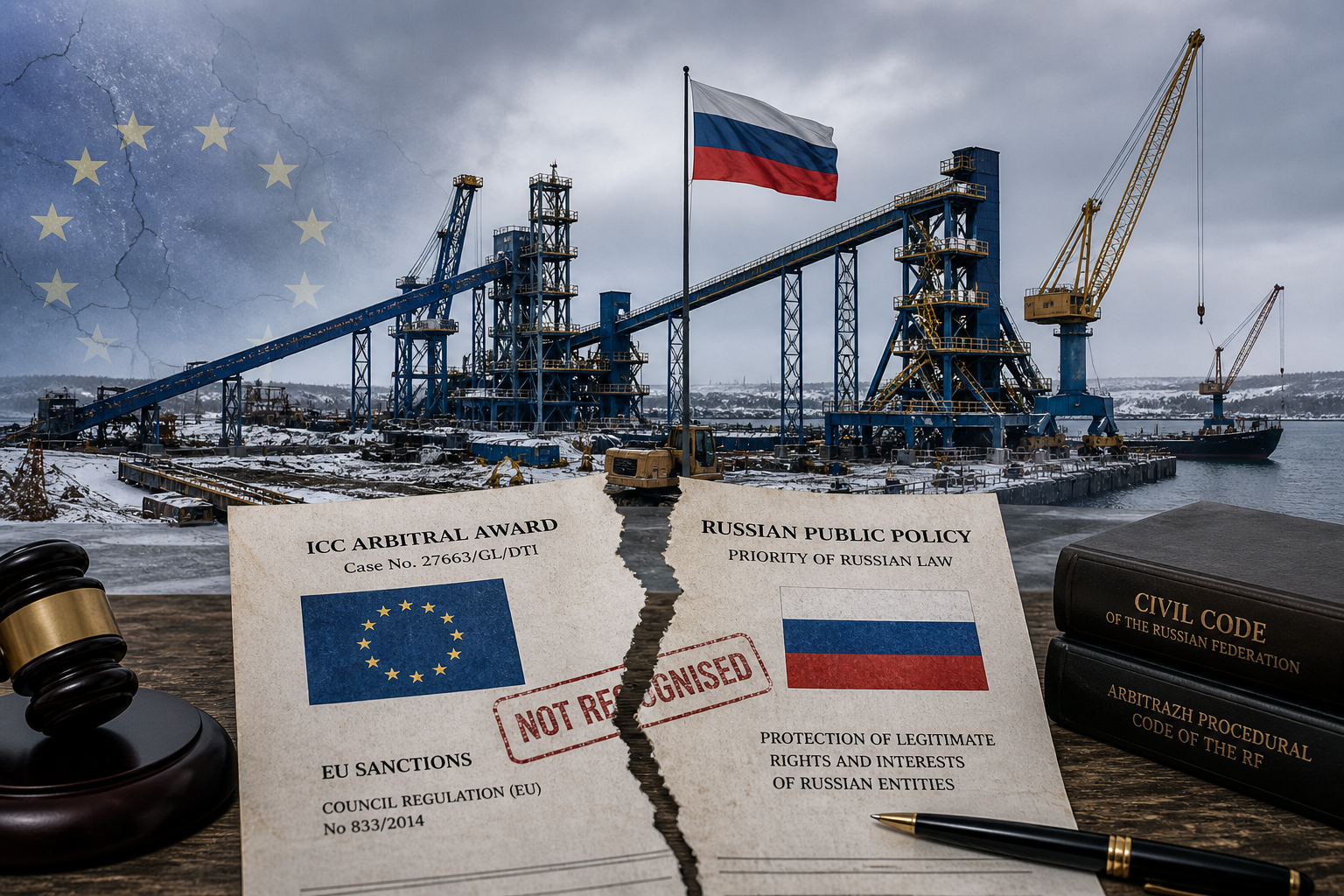
In its judgment of 27 April 2026, the Arbitrazh Court of the Murmansk Region (case no. A42-2551/2025) ordered T. AG (Germany) and AS L. (Latvia) to jointly compensate damages of EUR 8.8 million to ООО “MTP Lavna”. The court held that the defendants’ refusal to return advance payments—based on EU sanctions—constituted a tortious act under Russian law, despite prior arbitral proceedings rejecting the same claim.
Crucially, the decision builds upon earlier proceedings in case No. A42-5661/2025, where Russian courts refused to recognize an ICC arbitral award rendered in Amsterdam which had dealt with the same claim for reimbursement of the advance payment based on the contract (and rejected it due to sanctions). The 27 April 2026 judgment demonstrates how Russian courts are increasingly willing to re-adjudicate contractual disputes as tort claims to ensure judicial protection for sanctioned Russian entities.
Background: The Preceding Proceedings (Case No. A42-5661/2025)
The dispute originates from a 2018 contract for the supply and installation of equipment for the Lavna coal terminal project in Murmansk. Following EU sanctions introduced in April 2022, the foreign contractors refused to perform installation services and did not return advance payments.
The Russian claimant initiated ICC arbitration in Amsterdam, which resulted in an award dismissing the claim for repayment, relying on EU sanctions regulations.
However, Russian courts refused to recognize that award:
- Murmansk Arbitrazh Court (1 August 2025): refused recognition on public policy grounds, citing reliance on EU sanctions and concerns over impartiality.
- North-West District Court (21 November 2025): upheld the refusal, emphasizing that sanctions-based reasoning violates fundamental principles of Russian law.
- Supreme Court (11 February 2026): declined to review the case, making the refusal final.
These decisions established two key legal premises:
- EU sanctions cannot justify non-performance vis-à-vis Russian parties under Russian public policy;
- Foreign arbitral awards relying on such sanctions are denied recognition.
Facts and Arguments in the 2026 Proceedings
Following the refusal to recognize the arbitral award, the claimant (MTP Lavna) initiated new proceedings before Russian courts, this time seeking damages in tort rather than contractual relief.
Claimant’s Position
The claimant argued that:
- The defendants unlawfully retained advance payments (EUR 8.8 million);
- Their refusal to return funds—based solely on EU sanctions—caused financial harm in Russia;
- Given the impossibility of enforcing rights via arbitration, damages under Russian tort law were the only effective remedy.
Defendants’ Position
The defendants contended that:
- The dispute had already been resolved in arbitration (res judicata);
- The arbitration clause mandated dispute resolution in Amsterdam;
- EU sanctions legally prevented performance and repayment;
- The Russian court lacked jurisdiction.
Legal Framework Applied by the Court
The court relied on a combination of procedural, private international law, and substantive civil law provisions:
- Articles 248.1–248.2 APC RF (known as “Lugovoy-Law”): establishing exclusive jurisdiction of Russian courts in disputes involving sanctions;
- Article 247 APC RF: jurisdiction based on a close connection to Russia;
- Article 1219 Civil Code RF: application of Russian law to torts where harm occurs in Russia;
- Articles 15 and 1064 Civil Code RF: general rules on damages and tort liability;
- Public policy doctrine: previously established in case No. A42-5661/2025.
Court’s Reasoning
1. Jurisdiction Despite Arbitration Clause
The court rejected the arbitration clause as a barrier, emphasizing that:
- The dispute arose directly from sanctions;
- Sanctions impaired access to justice abroad;
- Russian courts therefore had exclusive jurisdiction under Article 248.1 APC RF.
2. No Res Judicata Effect of the Arbitral Award
Because the arbitral award had been denied recognition in Russia, it could not preclude litigation before Russian courts.
3. Qualification as Tort (Delict)
The court recharacterized the dispute:
- Not as a contractual claim, but as damage caused by unlawful conduct;
- The defendants’ reliance on sanctions was treated as conduct causing harm in Russia.
This allowed the court to bypass both:
- the arbitration clause; and
- contractual limitations.
4. Rejection of EU Sanctions as a Defense
The court reaffirmed that:
- Foreign sanctions lack extraterritorial effect in Russia;
- Compliance with such sanctions cannot justify harm to Russian entities;
- Reliance on sanctions may constitute bad faith (abuse of rights).
5. Establishment of Liability
The court found:
- Damage: non-returned advance payments;
- Causation: defendants’ refusal to repay;
- Fault: presumed and not rebutted;
- Joint liability due to consortium structure.
Outcome
The court:
- Awarded EUR 8,799,286.20 in damages;
- Imposed joint and several liability on both defendants;
- Ordered reimbursement of legal costs.
Comment
These decisions confirm the Russian caselaw on the provisions of Lugovoy Law. An interesting twist to the matter is that the claimant itself started the ICC arbiration and when it failed, re-filed the same claim in a Russian court on the basis of tort law.
The next twist could be proceedings in Europe based on EU sanctions to compensate for the losses inferred by the Russian judgement.
In the context of sanctions, “res judicata” is not a concept to be relied on anymore. It remains to be seen if the claimant will try to enforce the judgement outside Russia, for example, in countries which recognise and execute Russian judgements under the Kiev, Minsk or Chisinau Conventions.