

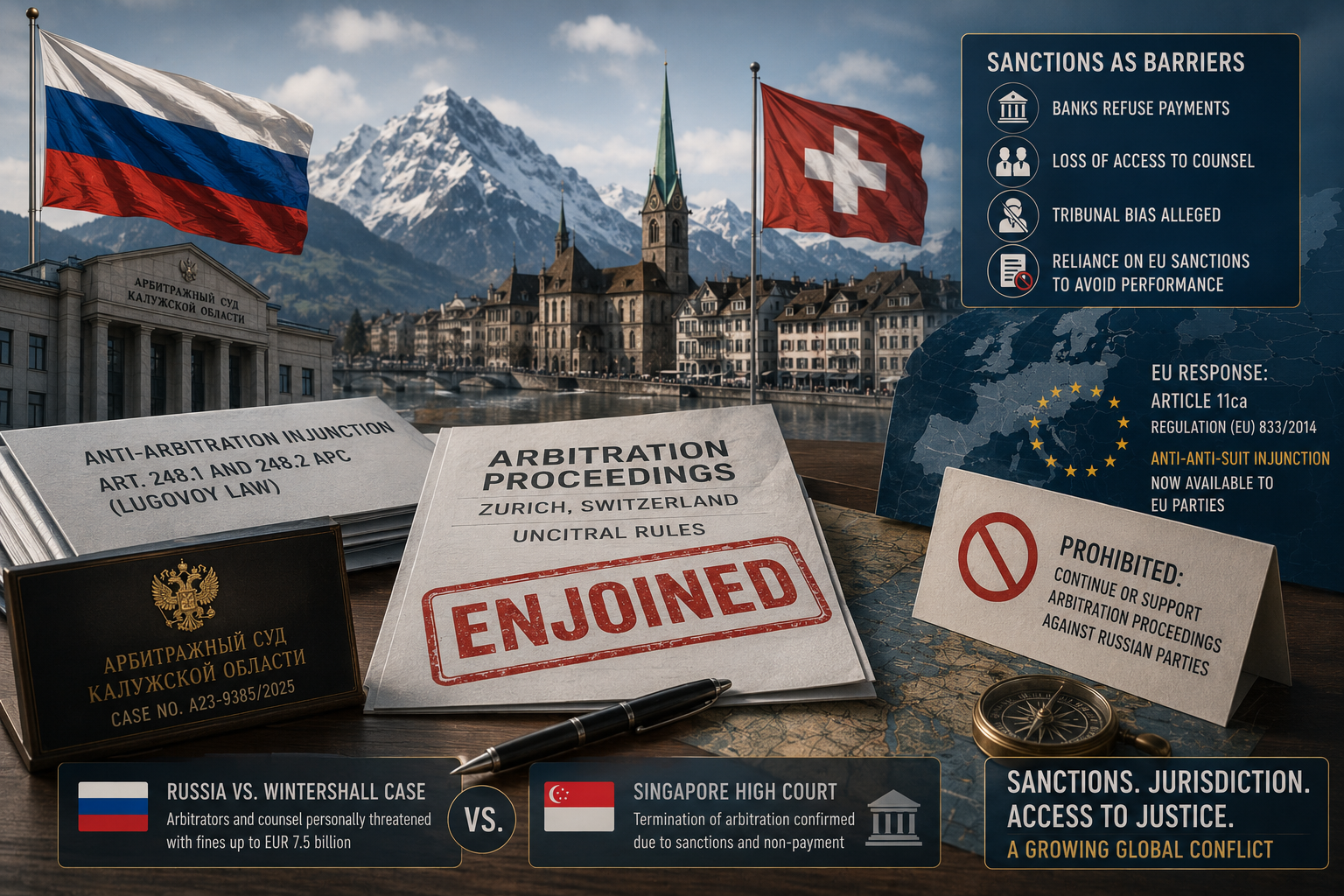
On 3 April 2026, the Arbitrazh Court of the Kaluga Region issued an anti-arbitration injunction in case No. A23-9385/2025 involving JSC “Kaluga Plant Remputmash” (“RPM”) and Austrian manufacturer L. Maschinenfabrik GmbH. In application of the notorious “Lugovoy-Law” (art. 248.1 and 248.2 of the APC), the court prohibited the Austrian company from continuing or supporting arbitration proceedings seated in Zurich under the UNCITRAL Rules and further ordered it to take all necessary steps — including withdrawal of claims — to terminate the foreign proceedings.
Originally, the claim was also directed against the arbitrators, which raises discomforting associations with the injunctions and judgements against counsel and arbitrators in the Russia vs. Winterhall case on which we have commented previously (https://kdb.legal/en/arbitrators-and-counsel-face-e-7-5-bn-fine-by-russian-court-in-case-of-continuation-of-arbitration-proceedings/).
Unlike that earlier matter, the present case ultimately did not proceed against the arbitrators personally. Although RPM initially asserted claims directly against members of the arbitral tribunal, those claims were later voluntarily withdrawn and the arbitrators were removed from the proceedings. This distinction may indicate a more cautious or strategic procedural approach by the claimant compared with earlier Russian anti-arbitration litigation targeting arbitrators and counsel individually.
In support of its application, the Russian claimant also invoked that it was hindered from pursuing its arbitration due to impossibility to pay the fees for arbitration. A similar argument was accepted as grounds for termination of arbitration recently by a tribunal seated in Singapore and confirmed by the High Court of Singapore. See our respective analysis here:
https://kdb.legal/en/high-court-of-singapore-confirms-termination-of-arbitration-due-to-sanctions-imposed-on-the-claimant/
Background of the Dispute
The dispute in this matter arose from a 2012 supply contract under which L. Maschinenfabrik GmbH agreed to deliver five rail milling trains to RPM for approximately EUR 41.18 million. According to the court record, only three trains were partially delivered, allegedly in disassembled and non-operational condition, while two units were never delivered despite advance payments.
The contract contained an arbitration clause providing for ad hoc arbitration in Zurich under the UNCITRAL Arbitration Rules and Swiss substantive law.
RPM terminated the contract in 2014 and initiated arbitration proceedings in Zurich in 2015, seeking repayment of sums already paid, damages, and return of the trains. The Austrian respondent subsequently filed counterclaims exceeding EUR 12 million.
In 2017, the arbitral tribunal issued a partial award confirming termination of the contract under Swiss law and directing that final financial calculations be determined through expert examination.
The proceedings were later suspended while the parties explored settlement options. In 2021, the parties negotiated a framework aimed at restoring and certifying the rail milling trains for operation in Russia. However, in November 2022, L. Maschinenfabrik GmbH withdrew from settlement discussions, citing EU sanctions restrictions under Regulation No. 833/2014 and related implementing regulations.
According to RPM, the Austrian company expressly relied on EU sanctions as the legal reason preventing further performance of repair and restoration obligations. This became central to RPM’s later jurisdictional arguments before the Russian court.
Claims Initially Asserted Against Arbitrators
One of the more unusual procedural aspects of the case was that RPM initially sought relief not only against the Austrian respondent but also directly against the members of the arbitral tribunal seated in Zurich.
The original application requested that the arbitrators be prohibited from:
- requesting or reviewing evidence;
- conducting hearings;
- issuing procedural or substantive orders;
- otherwise continuing or supporting the arbitration proceedings.
However, during the proceedings before the Russian court, RPM voluntarily withdrew those claims. The court formally terminated the proceedings against the arbitrators and removed them from the list of parties.
This is a notable distinction from the earlier Russian anti-arbitration case discussed here involving threatened multi-billion-euro penalties against arbitrators and legal counsel personally for continuing foreign proceedings. In the present matter, while the Russian court granted broad anti-arbitration relief against the foreign counterparty, it stopped short of issuing coercive measures directly against the tribunal members themselves.
RPM’s Arguments Before the Russian Court
RPM argued that sanctions imposed by the European Union and other “unfriendly states” had rendered the Swiss arbitration inaccessible and fundamentally unfair.
The claimant relied heavily on Articles 248.1 and 248.2 APC (known as “Lugovoy Law”), which were introduced in 2020 specifically to protect Russian parties affected by foreign sanctions. RPM asserted that:
- EU sanctions directly affected the underlying contractual relationship;
- Swiss and Austrian authorities belonged to jurisdictions classified by Russia as “unfriendly states”;
- RPM’s corporate structure had become fully sanctioned;
- Russian banks refused to process arbitration-related payments, including tribunal fees and expert costs;
- RPM lost access to its Swiss legal counsel following sanctions-related complications;
- the arbitral tribunal allegedly demonstrated sanctions-related bias, including scrutiny of RPM’s ownership structure under “50% control” sanctions rules;
- experts from “hostile jurisdictions” were considered for appointment despite objections.
RPM submitted correspondence from several Russian banks allegedly refusing to process arbitration-related payments due to sanctions concerns.
The claimant also argued that the tribunal had not obtained formal authorization from the Swiss State Secretariat for Economic Affairs (SECO) to conduct proceedings involving a sanctioned Russian entity.
According to RPM, these circumstances created insurmountable barriers to effective participation in the Zurich arbitration and undermined guarantees of impartial justice.
Respondent’s Position
L. Maschinenfabrik GmbH opposed the application and argued that RPM was abusing Russian procedural mechanisms to avoid arbitration previously agreed by the parties.
The Austrian company maintained that no sanctions had been imposed directly against RPM itself that would justify interference with the arbitral process. It also argued that granting the injunction would improperly undermine party autonomy and the validity of the arbitration agreement.
Court’s Legal Analysis
The Kaluga court relied extensively on recent Russian Supreme Court jurisprudence interpreting Articles 248.1 and 248.2 APC.
The court reiterated the now-established Russian position that the mere existence of foreign sanctions against a Russian party is generally sufficient to presume restrictions on access to justice abroad. The court cited multiple Supreme Court decisions, including:
- Supreme Court Ruling No. 309-ЭС21-6955(1-3) dated 9 December 2021;
- Supreme Court Ruling No. 307-ЭС23-4890 dated 4 July 2023;
- Supreme Court Ruling in case No. A40-214726/2023 dated 28 November 2024.
The court emphasized that sanctions are not merely economic measures but also create reputational inequality and legitimate doubts concerning the impartiality of foreign adjudicatory forums located in sanctioning jurisdictions.
Importantly, the court held that RPM was not required to prove actual impossibility of participating in the arbitration. Instead, the existence of sanctions itself generated a presumption that access to justice was impaired.
The court further accepted RPM’s evidence that sanctions had already materially affected the proceedings through:
- refusal of banking transactions;
- inability to finance experts and counsel;
- sanctions-related scrutiny by the arbitral tribunal;
- reliance by the Austrian respondent itself on EU sanctions regulations to justify contractual non-performance.
The court concluded that there was no realistic prospect of an impartial and fully accessible arbitration in Zurich under current geopolitical conditions.
The Court’s Orders
The court granted RPM’s application in full and ordered that L. Maschinenfabrik GmbH:
- cease and refrain from continuing any foreign court or arbitral proceedings against RPM outside Russia relating to the 2012 contract;
- refrain from enforcing any foreign judgments or arbitral awards obtained abroad concerning those disputes;
- take all necessary measures within ten days — including withdrawal of claims — to terminate the Zurich arbitration;
- reimburse RPM’s court fees in the amount of RUB 100,000.
The court also formally terminated the proceedings against the arbitrators after RPM withdrew those claims.
Significance of the Decision
This ruling continues the increasingly expansive Russian judicial practice surrounding anti-suit and anti-arbitration injunctions under Articles 248.1 and 248.2 APC.
Several notable aspects stand out:
1. Broad Presumption of Denial of Justice
The court reaffirmed that sanctions alone may suffice to establish presumed barriers to justice abroad, without requiring concrete proof of actual procedural discrimination.
2. Increased Scrutiny of EU-Seated Arbitrations
The decision reflects growing Russian skepticism toward arbitral proceedings seated in EU or other “unfriendly” jurisdictions where sanctions may affect payments, representation, or enforcement.
3. Use of Sanctions as Jurisdictional Trigger
The court treated the respondent’s own reliance on EU sanctions regulations as evidence that sanctions had become legally intertwined with the underlying dispute itself.
4. Outlook:
The 20th sanctions package against Russia introduced Art. 11ca in regulation (EU) 833/2014 which now allows a EU party to seek an anti-anti-arbitraiton injunction, that is, the Austrian party could apply to an Austrian court for protection against the Russian order. Whether or not that is worth the effort will depend on the question whether either of the parties has assets in a jurisdiction that would enforce the respective order.