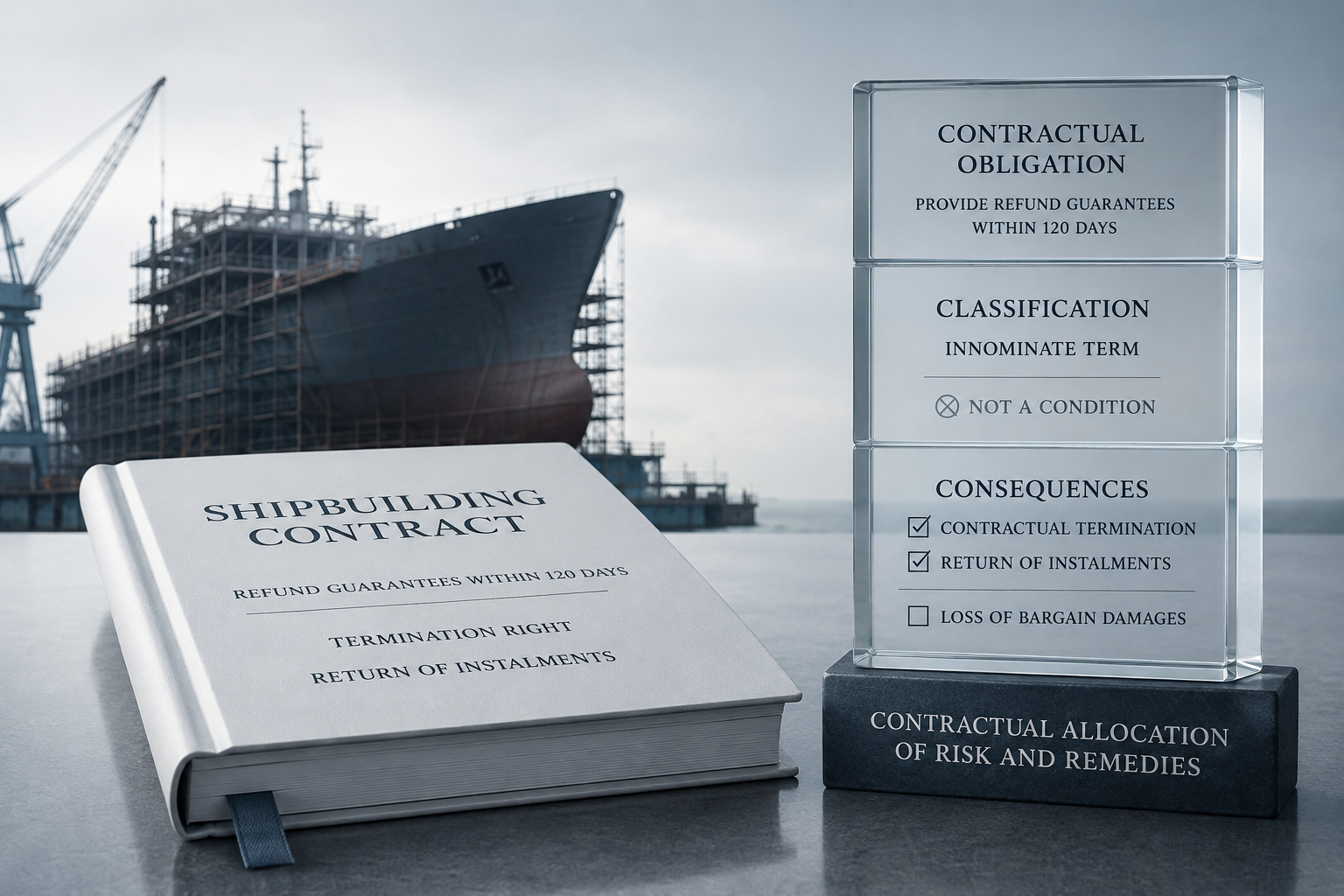
In the judgement for the case SLB & Ors vs. PAK & Ors [2026] EWHC 449 (Comm) dated 2 March 2026, the Commercial Court dismissed appeals brought under section 69 of the Arbitration Act 1996 and confirmed an arbitral tribunal’s finding that a shipyard’s obligation to procure refund guarantees within a specified contractual period constituted an innominate term, rather than a contractual condition.

I. Introduction
Although the buyers were entitled to terminate the shipbuilding contracts under the contractual mechanism agreed by the parties, they were not entitled to recover loss of bargain damages. The judgment provides valuable guidance on the classification of contractual obligations and demonstrates the English courts’ reluctance to expand remedies beyond those expressly negotiated in sophisticated commercial contracts.
II. Background of the Dispute
The proceedings arose out of ten shipbuilding contracts for the construction of container vessels. Following a novation of the agreements, the shipyard became obliged to procure refund guarantees within 120 days. These guarantees were intended to protect the buyers by ensuring that instalments already paid would be repaid if the shipyard failed to perform its contractual obligations.
The guarantees were not delivered within the agreed contractual period. Relying on the termination provisions contained in the contracts, the buyers brought the agreements to an end and recovered the instalments they had already paid. They also sought substantial damages for loss of bargain, arguing that the late provision of the guarantees constituted a breach of a contractual condition. According to the buyers, this entitled them not only to terminate the contracts but also to recover damages reflecting the value of the commercial bargain they had lost.
The dispute was referred to arbitration. The tribunal rejected the buyers’ argument and held that the obligation to provide the refund guarantees was an innominate term rather than a condition. The buyers subsequently appealed to the Commercial Court on a question of law pursuant to section 69 of the Arbitration Act 1996.
III. The Parties’ Positions
The buyers submitted that the obligation to provide refund guarantees within 120 days lay at the heart of the contractual allocation of risk. In their view, the guarantees formed an essential part of the commercial bargain because they secured repayment of substantial instalments should the shipyard default. They argued that strict compliance with the agreed deadline was therefore fundamental to the contracts and that any breach should automatically be treated as a breach of condition. If the obligation were classified as a condition, any failure to comply would entitle the buyers to terminate the contracts at common law and recover expectation damages representing the benefit they would have obtained had the shipbuilding contracts been fully performed.
The shipyard disagreed. It argued that the contracts contained a carefully negotiated mechanism dealing specifically with the consequences of failing to provide refund guarantees on time. The parties had expressly agreed that the buyers could terminate the contracts and recover their instalments if the guarantees were not delivered within the stipulated period. However, they had not agreed that every breach of this obligation would amount to a repudiatory breach giving rise to additional common law remedies. According to the shipyard, classifying the obligation as a condition would undermine the contractual allocation of remedies deliberately negotiated by experienced commercial parties.
IV. The Court’s Analysis
The court upheld the tribunal’s decision and dismissed all ten appeals. The Court emphasised that the classification of contractual terms depends on the construction of the agreement as a whole rather than on the commercial importance of an individual clause viewed in isolation.
Central to the Court’s reasoning was the fact that the parties had expressly negotiated a detailed contractual regime governing the consequences of a failure to provide refund guarantees within the agreed period. The contracts already specified when the buyers could terminate and what financial consequences would follow. That contractual framework suggested that the parties had consciously allocated the risks associated with late delivery of the guarantees.
The Court rejected the argument that the commercial significance of the guarantees automatically elevated the obligation to the status of a contractual condition. Instead, the judgment reiterates the well-established principle that English law will classify a contractual provision as a condition only where the parties’ intention is sufficiently clear. Where sophisticated commercial parties have negotiated a comprehensive remedial scheme, the courts will generally be reluctant to supplement that scheme by implying additional remedies.
The distinction between a contractual condition and an innominate term proved decisive because it determined the remedies available to the buyers. Had the obligation to procure the refund guarantees been classified as a condition, the buyers would have been entitled to treat any breach as terminating the contracts at common law and to claim expectation damages reflecting the value of the bargain they had lost. Those damages would have sought to place the buyers in the financial position they would have occupied had the shipbuilding contracts been properly performed, rather than merely restoring the instalments already paid.
By contrast, the tribunal had concluded that the obligation constituted an innominate term. In English law, a breach of an innominate term gives rise to the right to terminate at common law only where the breach is sufficiently serious to amount to a repudiatory breach, namely where it deprives the innocent party of substantially the whole benefit of the contract. The tribunal found that the late provision of the refund guarantees did not satisfy that threshold, and the High Court saw no error of law in that conclusion.
The buyers therefore remained entitled to terminate the contracts because the parties had expressly provided for that right in the shipbuilding contracts themselves. However, the contractual termination clause did not provide for expectation damages. Since the breach was neither a breach of condition nor a repudiatory breach, the buyers’ remedies were limited to those set out in the contractual termination mechanism. The Court therefore confirmed that they could recover the instalments they had paid but were not entitled to claim damages for the loss of the commercial bargain.
V. Conclusion
The decision in SLB & Ors v PAK & Ors provides a valuable illustration of the English courts’ approach to contractual interpretation and the classification of contractual terms. It confirms that even commercially significant obligations will not necessarily be treated as contractual conditions simply because they play an important role in the parties’ bargain. Instead, the courts will examine the structure and wording of the agreement as a whole and will ordinarily uphold the contractual allocation of risk and remedies negotiated by sophisticated commercial parties.
For commercial parties, the judgment reinforces a broader lesson: the availability of contractual termination does not necessarily carry with it the right to recover expectation damages. Where parties have carefully defined the consequences of a particular breach, English courts will generally respect that allocation of risk rather than supplement it with additional common law remedies.
VI. Practical Implications
The judgment serves as an important reminder that English courts continue to place considerable weight on the contractual framework negotiated by sophisticated commercial parties. Rather than focusing exclusively on the commercial importance of a particular obligation, the courts will examine the agreement as a whole to determine whether the parties intended a breach to carry the automatic consequences associated with a contractual condition.
The decision also illustrates the distinction between contractual termination rights and common law remedies. Parties are free to agree that certain events give rise to a contractual right of termination without thereby conferring a right to recover expectation damages. Unless the contract expressly provides otherwise, or the breach amounts to a breach of condition or a repudiatory breach, the innocent party may find that its remedies are limited to those specifically negotiated in the agreement.
For parties negotiating shipbuilding contracts, construction agreements and other high-value international commercial contracts, the judgment highlights the importance of careful drafting. If the parties intend that breach of a particular obligation should automatically entitle the innocent party to terminate the contract and recover loss of bargain damages, that intention should be expressed in clear and unequivocal terms. Otherwise, English courts are likely to conclude that the contractual remedies expressly agreed by the parties define the consequences of the breach.