
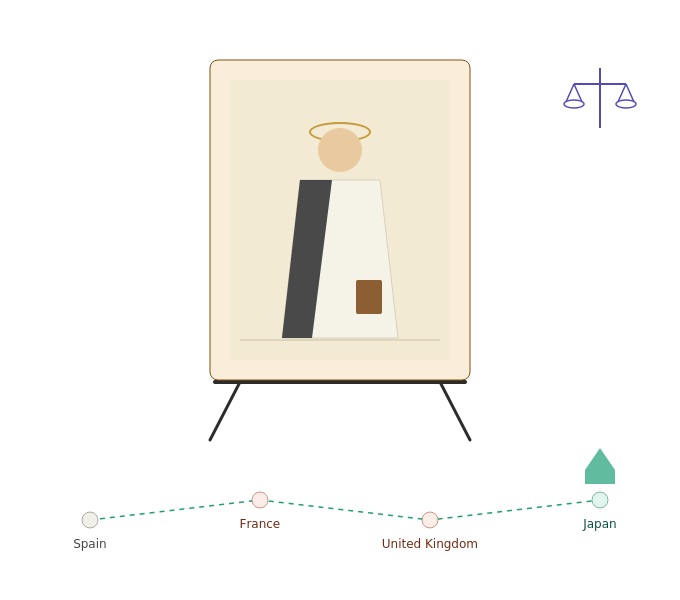
A Spanish court is trying to get back a valuable painting by Zurbarán (“Santo Domingo de Guzmán”) that’s now on display at a museum in Tokyo, because they believe it was illegally taken out of Spain without an export permit.
The case stems from a family dispute. Several relatives allegedly held onto the painting under a 2001 loan arrangement, then it moved through France and the UK before ending up sold to the Tokyo museum in 2019. Spanish investigators have asked Japan for legal assistance to freeze the painting (blocking any sale or transfer, though it can still be displayed), pursue its return, and get documents about how the museum acquired it.
What’s the case about?
At the center of the dispute is the painting “Santo Domingo de Guzmán,” attributed to the Spanish Baroque painter Francisco de Zurbarán. It dates from 1626 and is currently on display at the National Museum of Western Art in Tokyo.
Spanish authorities believe the painting was illegally exported from Spain, meaning it left the country without the required permit. Back in 1985, the then-owner had actually applied for an export license, but it was refused: Spain’s Ministry of Culture explicitly declared the work non-exportable.
How did this happen?
The case began with a criminal complaint filed in June 2024. A man came forward as the sole heir of his late sister, whom he described as the painting’s rightful owner.
According to his account, four brothers had wrongfully held onto the painting. This went back to a 2001 arrangement: the painting was to be deposited with a lawyer in San Sebastián until it was sold, while the sister would receive €600 a month in the meantime. That sale, however, never happened.
Over the years, the painting’s whereabouts can be pieced together from various clues: it was reportedly offered unsuccessfully to Spanish museums between the 1970s and 1985, there was another attempted sale through a Seville auction house around 2000, and from 2001 it was verifiably kept at the lawyer’s office, first at his original location until 2008. After that, the painting is said to have been in northern Spain for a time before later turning up in France.
The international journey in 2018/2019
Starting in 2018, the case takes on an international dimension:
- July 2018: The painting is transported from France to London.
- August 2018: A UK shipping company applies for an export license from the UK to the US — the intended destination was originally the J. Paul Getty Museum in Los Angeles. The declared value: the equivalent of over £4.4 million.
- February 2019: The four brothers finally sell the painting for €522,500 to a Madrid-based art dealer.
Today the painting hangs in the museum in Tokyo. Spanish investigators argue that the provenance published by the museum (i.e., its documented ownership history) actually supports the claim that it’s the very same painting once located in Spain, since the same previous owners are named there.
What is Spain asking Japan to do?
The Spanish investigating judge has submitted a request for judicial assistance to Japan. Specifically, this covers three points:
- Securing the painting, so it can’t disappear or be resold.
- Initial steps toward restitution of the allegedly illegally exported cultural object.
- Disclosure of the museum’s acquisition records, including the purchase contract.
The four brothers appealed against this order. Their argument: the court had relied on incorrect facts, particularly regarding when the painting actually left Spain. They also claimed the measures were disproportionate and insufficiently specific.
A court responded with a clarification: the “precautionary intervention” doesn’t mean the painting has to be removed from the museum, it can continue to be publicly displayed. What’s prohibited is only selling it or transferring it to third parties without prior court approval.
The legal basis
The case rests primarily on several Spanish laws:
- The Spanish Historical Heritage Act provides that cultural goods exported without authorization remain the property of the Spanish State, permanently, regardless of how long the work has been abroad.
- The Smuggling Act classifies the unauthorized export of cultural goods worth at least €50,000 as a criminal offense.
- Misappropriation and money laundering are also being examined as possible related offenses.
- At the international level, Spain relies on the 1970 UNESCO Convention on the protection of cultural property, to which both Spain (since 1986) and Japan (since 2002) are parties. This convention generally obliges member states to cooperate on the return of illegally removed cultural property.
What happens next?
A final decision on whether the request for judicial assistance to Japan will be fully upheld is still pending. The case is a good illustration of how closely national cultural heritage law and international judicial cooperation are intertwined, and how long such a dispute can drag on when an artwork changes hands across multiple national borders.