Can a Master Forger Reclaim His Own Fake?

Can a forger claim back his own forgery? Germany’s Federal Court of Justice must now decide. Wolfgang Beltracchi, one of the most notorious art forgers of the post-war era, is suing for the return of “Red Painting with Horses” (“Rotes Bild mit Pferden”). It is the very canvas whose exposure in 2010 brought his scheme to an end. Judgment is due on 15 January 2027.
A painting with an invented past
For years, Beltracchi painted works in the style of celebrated modernists, which he and his wife Helene then placed on the art market. Each came with a carefully invented provenance: the paintings were said to come from the collection of Helene’s grandfather, Werner Jägers.
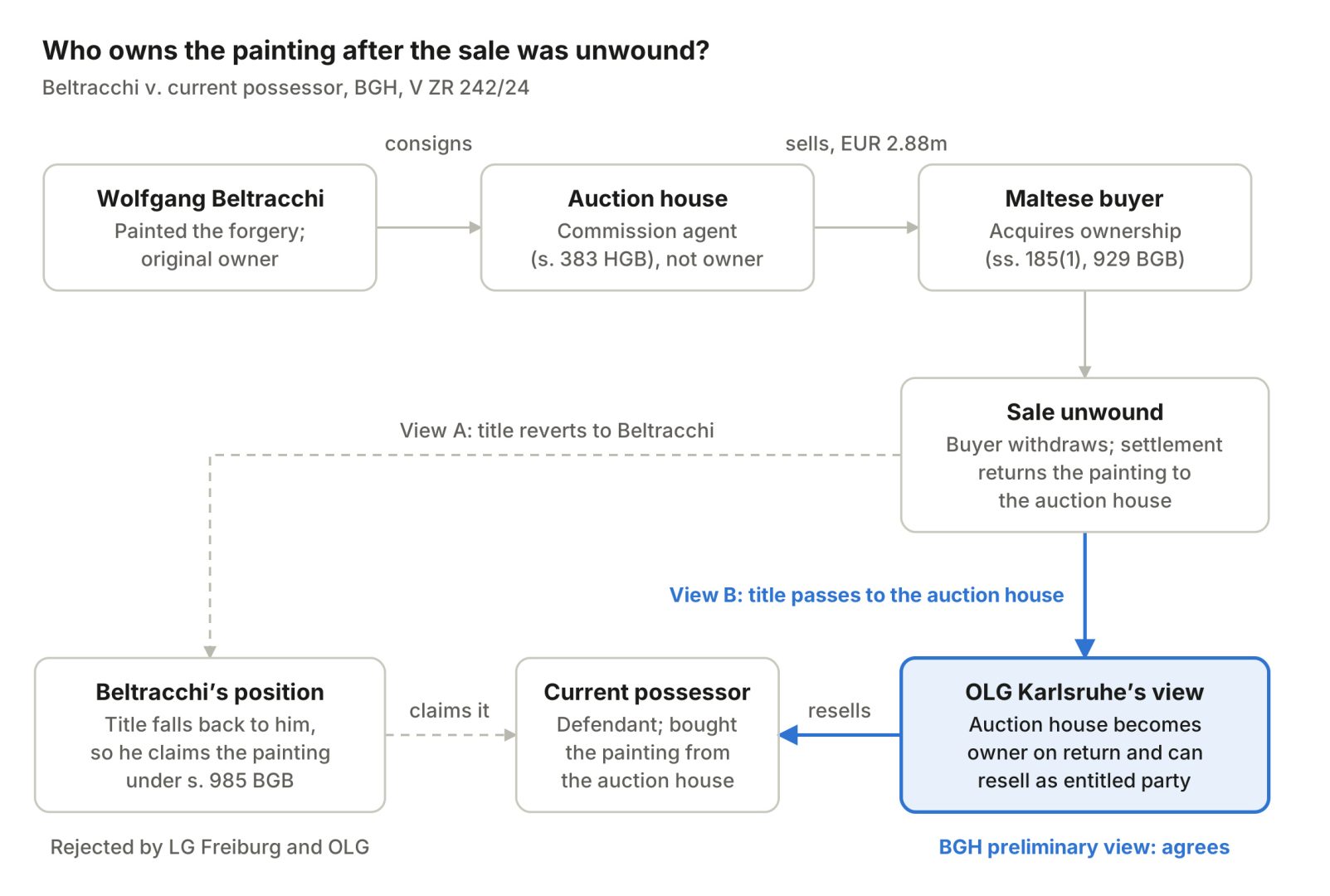
“Red Painting with Horses” was one of them, presented as a lost 1914 work by the Expressionist Heinrich Campendonk. In 2006, it sold at auction for EUR 2.88 million. Beltracchi never transferred ownership to the auction house. Instead, the house acted as a commission agent under section 383 of the German Commercial Code (HGB). It sold the painting in its own name and, with Beltracchi’s consent, passed title directly to the buyer, a Maltese company.
The buyer later grew suspicious. Scientific analysis revealed titanium white, a pigment not available as a commercial artists’ paint in 1914. The Maltese company withdrew from the purchase, sued the auction house, and the dispute ended in a settlement: the painting went back to the auction house. The auction house then sold it again, to the current possessor, who is the defendant in the present case.
The wider forgery scheme came to light in 2010. In 2011, the Regional Court of Cologne sentenced Beltracchi to six years in prison. Today he paints under his own name. His argument now is simple: when the sale to the Maltese company was unwound, ownership of the painting returned to him, so the current possessor must hand it over.
The road to Karlsruhe
Beltracchi lost before both the Regional Court of Freiburg and the Higher Regional Court of Karlsruhe. On 9 October 2026, the Fifth Civil Senate of the Federal Court of Justice heard his final appeal on points of law (case no. V ZR 242/24).
The forgery itself is not what the case is about. The question is one of pure property law: when a sale made through a commission agent is later reversed, does ownership go back to the original owner, or can it pass to the agent, who never owned the object at all?
The legal framework
Beltracchi relies on section 985 of the German Civil Code (BGB), which allows an owner to reclaim his property from whoever holds it, unless that person has a right to possess it (section 986 BGB). So Beltracchi must show that he is still, or once again, the owner.
Both sides agree on the starting point. Ownership passed validly to the Maltese buyer: the auction house was not the owner, but could dispose of the painting with Beltracchi’s consent (section 185(1) BGB), and title to movable property passes by agreement and delivery (section 929, first sentence, BGB). The real question is what became of that title when the sale fell apart.
The Higher Regional Court: title went to the auction house
The Karlsruhe court relied on two cornerstones of German property law, the principles of separation and abstraction. Under these, the contract of sale and the transfer of ownership are separate legal acts. Withdrawing from the contract therefore does not undo the transfer of title; it merely obliges the parties to give back what they received (sections 346 et seq. BGB).
On this view, the auction house became the owner when the painting was returned to it under the settlement, even though it had never owned it before. Title did not spring back to Beltracchi, and the auction house could later pass it on to the defendant as the rightful owner.
Beltracchi: title should have come home
Beltracchi sees it differently. The rule that lets a non-owner dispose of property with the owner’s consent, he argues, exists to protect the buyer, not the auction house. Once the buyer gives the painting up, ownership must revert to him. If that is right, the auction house never became owner and could not validly sell the painting to the defendant. At the hearing, his counsel put it in terms of fairness: unwinding a sale should restore the previous position, and no one should end up with more than they had before.
The hearing: a clear signal
The presiding judge, Bettina Brückner, indicated that the Senate’s preliminary assessment is against Beltracchi. The court apparently sees no basis for an automatic reversion to the original owner, either in the clear rules of the Civil Code or in considerations of fairness.
Counsel for the defendant added a practical point: had the parties wanted a particular form of unwinding, they could have agreed on it by contract. No statutory provision requires ownership to return to the former owner.
The preliminary view is not binding, and the outcome remains open until judgment is pronounced. The written reasons, expected after 15 January 2027, will also show how far the ruling reaches, for example where a sale is unwound without a settlement, or where good-faith acquisition comes into play.
Why it matters
Risk in consignment sales. On the court’s preliminary view, a consignor who authorises a commission agent to transfer ownership does not automatically get title back if the buyer later withdraws. If the work is returned to the agent, the agent may become the owner and may resell it.
Drafting is decisive. As the defendant’s counsel noted, the parties could have regulated the unwinding themselves. Consignment and settlement agreements should therefore state expressly who receives title if a sale is reversed, for instance by providing for re-transfer directly to the consignor.
Certainty for later buyers. Collectors who acquire a work after an earlier sale has been unwound would gain legal certainty: buying from the party to whom the work was returned would no longer carry the risk of a claim by the original consignor.
How we can help
KDB.legal advises collectors, galleries, auction houses and other art market participants on art law and the German property and contract law questions behind it. Our work includes ownership and title disputes, the drafting and review of consignment and settlement agreements, and the unwinding of transactions involving forged or misattributed works.


