
Introduction
“From its earliest days, the café’s clientele frequented Lloyd’s for more than just a warm drink.”:
In Halbower v. Hiscox Syndicate 33 of Lloyd’s of London (6th Cir., 29 May 2026), the U.S. Court of Appeals for the Sixth Circuit considered a dispute arising from the destruction of several high-value artworks in a fire that consumed a private residence in Michigan. The collection, owned by the Halbower Legacy Trust, reportedly included works attributed to Claude Monet. After the insurer denied coverage for two of the lost artworks, the trust brought suit. Yet before addressing the insurance dispute itself, the court was confronted with a more fundamental question:
what exactly is Lloyd’s of London, and whose citizenship matters when a Lloyd’s syndicate is sued in a U.S. federal court?
To answer that question, the court began with an unusual historical excursion.
The Fire and the Insurance Dispute
The case arose from a devastating fire that destroyed a residence near Pentwater, Michigan, in June 2022. Among the items lost were five artworks belonging to the Halbower Legacy Trust. Court records suggest that several of the works were paintings by Claude Monet, while another was attributed to Francis Picabia.
The collection was insured through the Lloyd’s market under a policy underwritten by Hiscox Syndicate 33. Following the fire, the insurer accepted coverage for three paintings and paid approximately USD 31.3 million. However, it denied coverage for two further works, arguing that they were not included in the schedule held by the Lloyd’s broker. The trust subsequently brought proceedings seeking compensation for the disputed artworks.
At first glance, the dispute appeared to be a relatively conventional insurance coverage case. Instead, it became an examination of one of the most unusual institutions in the insurance world.
A Brief Detour to Lloyd’s Coffee House
To explain the legal issues before it, the Sixth Circuit embarked on an unusual historical journey.
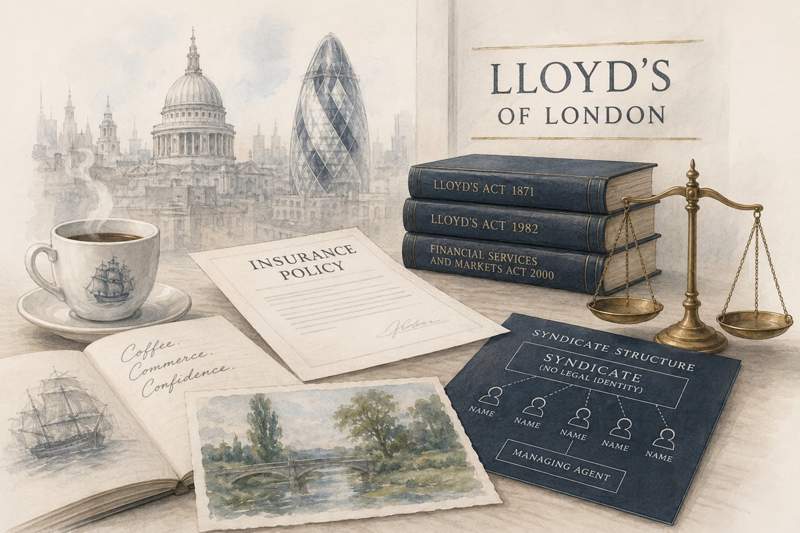
Lloyd’s of London traces its origins to the late seventeenth century, when entrepreneur Edward Lloyd operated a coffee house near the River Thames. Merchants, shipowners, and traders gathered there not only to drink coffee but also to exchange information about ships, cargoes, and developments overseas. Over time, the coffee house evolved into a meeting place where risks were shared and underwritten, eventually giving rise to the “Society of Underwriters at Lloyd’s Coffee House” and, ultimately, today’s Lloyd’s of London.
As the court observed:
“From its earliest days, the café’s clientele frequented Lloyd’s for more than just a warm drink. Lloyd, it turns out, was also known for his vast knowledge of the shipping business: He regularly published intelligence on ships, cargo, and foreign events.“
“The coffee house quickly became a place where patrons, primarily those in the shipping industry, could engage in underwriting, that is, negotiating a fee to be paid in exchange for taking on financial risk held by another.”
“In the ensuing decades, Lloyd’s customers came to be known as the “Society of Underwriters at Lloyd’s Coffee House.” The Society would later evolve into what we now know as Lloyd’s of London, an enterprise that today insures risks totaling “+£46bn in insurance premiums each year.”
Halbower v. Hiscox Syndicate 33 of Lloyd’s of London, No. 25-1152 (6th Cir. May 29, 2026).
The court emphasized that Lloyd’s is not itself an insurance company. Rather, it is a marketplace where insurance risks are placed with underwriters. The entities appearing on policies are often Lloyd’s syndicates, which consist of numerous individual or corporate underwriting members, known as “Names.” Importantly, a syndicate has no separate legal personality under English law; it is simply the administrative structure through which its members underwrite risks.
The Jurisdictional Question
The parties largely focused on whether the disputed artworks were covered under the insurance policy. The Court of Appeals, however, raised a threshold issue on its own initiative: whether the federal courts had jurisdiction to hear the case.
The insurer had removed the case from state court to federal court on the basis of diversity jurisdiction. Under U.S. law, federal courts may hear disputes between citizens of different states or countries, provided complete diversity exists between all parties.
Determining the citizenship of the plaintiff trust was straightforward. Determining the citizenship of Hiscox Syndicate 33 was not.
The question was whether the court should look only to the citizenship of the syndicate’s managing agent or instead to the citizenship of every underwriting member participating in the syndicate. Because Lloyd’s syndicates can consist of hundreds or even thousands of individual Names, the answer has potentially significant consequences for federal jurisdiction.
The Court’s Reasoning
The Sixth Circuit concluded that a Lloyd’s syndicate must be treated as an unincorporated association for purposes of diversity jurisdiction. Following established Supreme Court precedent, the citizenship of such an entity depends on the citizenship of all of its members. Accordingly, the relevant inquiry was not the citizenship of the syndicate’s managing agent, but the citizenship of each underwriting Name participating in Hiscox Syndicate 33.
The court rejected the argument that the citizenship of the managing agent alone should control. Although the managing agent administers the syndicate’s affairs and negotiates contracts, it does not itself bear liability under the insurance policy. Liability ultimately rests with the underwriting members of the syndicate.
In reaching this conclusion, the court distinguished its earlier decision in Certain Interested Underwriters v. Layne, explaining that the earlier case involved a different contractual structure and did not resolve how the citizenship of a Lloyd’s syndicate itself should be assessed when the syndicate is the party before the court.
Because the record contained insufficient information regarding the citizenship of the underwriting Names, the court vacated the district court’s dismissal and remanded the matter for further jurisdictional discovery.
Conclusion
The Sixth Circuit never reached the substantive question of whether the disputed artworks were insured. Instead, the case turned on the unique structure of Lloyd’s of London and the procedural requirements of federal jurisdiction.
The ruling reinforces the principle that Lloyd’s syndicates are to be treated as unincorporated associations for jurisdictional purposes. When a Lloyd’s syndicate is a party to litigation in the United States, courts must look beyond the syndicate’s name and examine the citizenship of its underlying underwriting members.
What began as a multi-million-dollar art insurance dispute ultimately became a lesson in the centuries-old and highly distinctive architecture of the Lloyd’s market.