
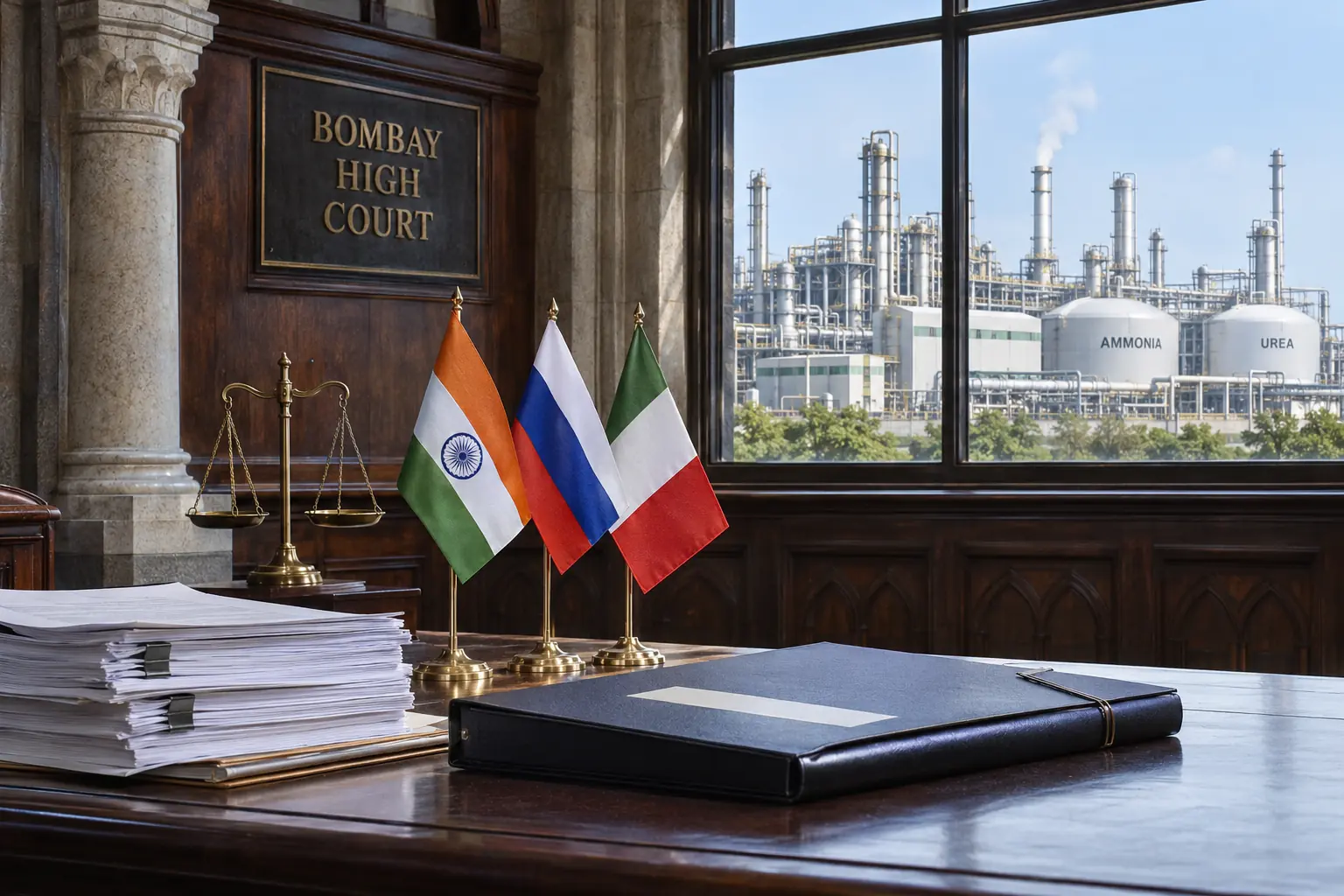
Bombay High Court Upholds Refusal of Interim Asset Restraints
In a decision dated 29 October 2026, the High Court of Judicature at Bombay in Commercial Appeal (L) No. 20333 of 2026 (Limited Liability Company EuroChem North-West-2 v Tecnimont S.p.A., 2026:BHC-OS:23757) rendered a judgment on interim measures sought in India on the basis of a Russian judgment issued under Article 248.1 of the Russian Arbitrazh Procedure Code.
The Division Bench of Justices Bharati Dangre and Manjusha Deshpande dismissed EuroChem’s appeal against the order of 8 June 2026. It upheld the refusal to restrain Tecnimont from disposing of assets in India pending EuroChem’s suit for an Indian decree based on a Russian judgment exceeding RUB 171 billion.
The court examined whether the Moscow Commercial Court was, prima facie, a court of competent jurisdiction for the purposes of Sections 13 and 14 of the Indian Code of Civil Procedure. Its analysis focused on the parties’ London-seated ICC arbitration agreements and the Russian court’s reliance on the legislation commonly known as the Lugovoy Law.
Factual Background
EuroChem North-West-2 is a Russian company involved in the construction of a fertiliser complex in the Leningrad Region with an intended annual production capacity of 1.1 million tonnes of ammonia and 1.4 million tonnes of urea.
On 1 June 2020, EuroChem entered into three agreements with the Italian contractor Tecnimont S.p.A. and Tecnimont’s Russian subsidiary, LLC MT Russia:
- an onshore engineering, local procurement and construction contract with MT Russia;
- an offshore engineering and procurement contract with Tecnimont; and
- a coordination and interface agreement among the parties.
All three contracts provided for arbitration under the ICC Rules, with London as the place and seat of arbitration. The offshore and coordination agreements were governed by the laws of England and Wales, while the onshore agreement was governed by Russian law.
The Bombay High Court reproduced the following provisions from the offshore contract:
“21.3.1. Any Dispute… may be submitted by either Party for binding resolution by arbitration under the Rules of Arbitration of the International Chamber of Commerce…
21.3.2 The place of the arbitration shall be London…. The seat of arbitration shall be London…. Each Party hereby excludes and waives irrevocably any rights or application or appeal to the courts of any country otherwise having jurisdiction….”
The contract also provided:
“This Contract, and any non-contractual obligations arising out of or in connection with it, shall in all respects be governed by and interpreted in accordance with the laws of England and Wales without application of the conflict of laws principles thereof.”
Following the imposition of European Union and United Kingdom sanctions in 2022, Tecnimont and MT Russia suspended performance of parts of the project. EuroChem terminated the relevant contracts on 4 August 2022.
Tecnimont and MT Russia commenced ICC arbitration in August 2022. EuroChem participated in the arbitration, nominated an arbitrator and filed a counterclaim. It did not initially challenge the tribunal’s jurisdiction.
EuroChem also demanded payment under performance bonds issued by Société Générale and ING. When the banks refused payment on sanctions grounds, EuroChem brought proceedings before the English Commercial Court. On 31 July 2025, the English court held that the banks were entitled to withhold payment because of the sanctions applicable to the ultimate beneficiaries identified in the judgment.
Proceedings in Russia
On 1 September 2025, EuroChem commenced proceedings before the Moscow Commercial Court. It sought repayment of advances, interest and damages arising from the K2 contracts.
EuroChem relied on Article 248.1 APC RF, part of the legislation generally referred to as the Lugovoy Law. It argued that the sanctions and the English decision had rendered the arbitration agreements ineffective and had created obstacles to accessing justice outside Russia.
The Moscow Commercial Court accepted jurisdiction notwithstanding the ICC arbitration clauses. It reasoned that the imposition of restrictive measures on a Russian party involved in foreign arbitration was sufficient to establish restricted access to justice. It also expressed doubts about the independence and impartiality of the ICC tribunal because the arbitration was seated in London and the dispute concerned sanctions.
On 27 November 2025, the Moscow court announced the operative part of its judgment. Its full reasons followed on 5 December 2025. Tecnimont and MT Russia were held jointly and severally liable for:
- RUB 8,058,168,619.35 in unjust enrichment;
- RUB 3,834,694,789.96 in interest;
- RUB 159,222,357,146 in damages; and
- continuing interest on the amount awarded as unjust enrichment.
The judgment was upheld by the Ninth Arbitrazh Appeal Court in Moscow on 4 March 2026.
In parallel, the ICC tribunal issued orders directing EuroChem to withdraw or stay the Russian proceedings. It subsequently restrained EuroChem from enforcing the Russian judgment. English courts also issued orders supporting the arbitration, while a court in St Petersburg issued anti-arbitration and anti-suit relief against Tecnimont and MT Russia.
Proceedings Before the Bombay High Court
Because Russia is not a reciprocating territory under Section 44A of the Indian Code of Civil Procedure, the Russian judgment could not be executed directly in India. EuroChem therefore commenced Commercial Suit No. 6 of 2026, seeking a new Indian decree based on the Russian judgment.
Pending that suit, EuroChem applied for an injunction preventing Tecnimont from removing, transferring or disposing of assets in India up to RUB 171,115,220,555. It also sought an affidavit disclosing Tecnimont’s Indian assets.
On 8 June 2026, the Single Judge dismissed the interim application. The court found that the competence of the Moscow court was doubtful in view of the arbitration agreements, the pending ICC arbitration and the objections raised under Section 13 CPC. It also found insufficient evidence that Tecnimont intended to dissipate its Indian assets.
EuroChem appealed, arguing that the certified Russian judgment triggered the presumption of competence under Section 14 CPC. According to EuroChem, this presumption could be rebutted only at trial and not when considering interim relief.
Tecnimont maintained that the presumption was rebuttable at the interim stage. It relied on the London arbitration agreements, EuroChem’s participation in the arbitration, the ICC and English court orders, and alleged procedural deficiencies in the Moscow proceedings.
Article 248.1 APC and the Competence of the Russian Court
The Division Bench examined the wording of Article 248.1 APC. It noted that paragraph 1 begins with an exception for an international treaty or an agreement referring disputes to a foreign court or an international commercial arbitration outside Russia.
Paragraph 4 allows the Russian courts to intervene where such a foreign forum agreement is incapable of being performed because restrictive measures create obstacles to a party’s access to justice.
The High Court held that Russian exclusive jurisdiction was not an automatic consequence of sanctions. Where the parties had chosen a foreign arbitral forum, the Moscow court was required to examine whether sanctions had actually made that agreement incapable of performance and created an obstacle to access to justice.
The court found that the Moscow judgment did not identify the particular obstacles EuroChem had encountered. EuroChem had participated in the ICC arbitration for approximately three years, nominated an arbitrator, pursued a counterclaim and continued to participate after the English judgment. It had also been able to pursue proceedings before the English courts.
The Division Bench further noted that the Moscow court had referred to the arbitrators as British, whereas the tribunal consisted of arbitrators of British, Canadian and Australian nationality.
On that record, the Bombay High Court was not persuaded, for the purposes of the interim application, that the Moscow court had been justified in exercising jurisdiction under Article 248.1. It agreed with the Single Judge that a substantial question existed as to the Russian court’s competence.
The court did not finally determine whether the Russian judgment was enforceable in India. That issue remains to be decided in the underlying suit.
Foreign Decisions Considered by the Court
The Division Bench referred to two foreign decisions when considering Article 248.1 and the effect of sanctions on agreed dispute-resolution clauses.
In Bank A v Bank B [2024] HKCFI 2529, the Hong Kong Court of First Instance considered Russian proceedings brought despite an HKIAC arbitration agreement. The Hong Kong court distinguished the performance of the underlying payment obligation from the continued validity and operation of the arbitration agreement. It held that the possible inability to perform an award because of sanctions did not make the arbitration agreement or the arbitration itself invalid.
The Bombay High Court also discussed Google LLC v NAO Tsargrad Media [2025] EWHC 94 (Comm). In that case, the English Commercial Court rejected the proposition that Article 248.1 created exclusive Russian jurisdiction that automatically displaced the parties’ contractual choice of an English forum. Article 248.1 could apply where sanctions made the chosen foreign forum agreement inoperative, but it did not itself prevent a sanctioned Russian party from commencing proceedings in the agreed forum.
The Division Bench treated both decisions as supporting the distinction between sanctions affecting substantive performance and sanctions rendering an agreed foreign forum genuinely inaccessible.
Sections 13 and 14 CPC at the Interim Stage
Section 13 CPC provides that a foreign judgment is conclusive as to matters directly adjudicated between the parties unless one of six statutory exceptions applies. These include want of jurisdiction and proceedings opposed to natural justice.
The Division Bench held that Section 13 itself creates no presumption. Section 14 creates a limited and rebuttable presumption that a certified foreign judgment was pronounced by a court of competent jurisdiction. The presumption may be displaced where the contrary appears from the record or want of jurisdiction is proved.
The expression “on the record” was not confined to the foreign judgment itself. At the interim stage, the Indian court could consider the pleadings, the parties’ agreements, the ICC orders, the English decisions and other materials relied upon by Tecnimont.
The court rejected EuroChem’s argument that the Section 14 presumption could be examined only at trial. A party seeking an interim injunction must still establish a prima facie case, balance of convenience and irreparable harm under Order XXXIX Rule 1 CPC. These requirements apply equally to a suit based on a foreign judgment.
Accordingly, an Indian court may form a prima facie view at the interim stage on whether the foreign court was competent and whether the judgment is conclusive under Section 13.
Natural Justice Objections
Tecnimont also raised objections to the conduct of the Moscow proceedings. It alleged that EuroChem submitted an amendment and approximately 20,000 pages of supporting materials shortly before the final hearing. Requests for additional time and for an independent expert were refused, while the Moscow court relied on EuroChem’s expert material.
The Division Bench described the Russian court’s treatment of the requests as prima facie indicative of a “lopsided approach.” It held that Tecnimont had presented sufficient material at the interim stage to raise an issue under Section 13(d) CPC, which excludes foreign judgments obtained in proceedings opposed to natural justice.
The court expressly confined these observations to the interim assessment and did not finally decide the natural justice objection.
Dismissal of the Appeal
The Division Bench found no basis for interfering with the Single Judge’s exercise of discretion. EuroChem had not established a prima facie case based on a presently conclusive foreign judgment, and the material before the court did not justify an automatic restraint on Tecnimont’s Indian assets.
The appeal was dismissed without an order as to costs. EuroChem’s request to stay the appellate judgment was refused. The associated interim applications were also disposed of.
Earlier kdb.legal Coverage
The proceedings were previously discussed in “Waiting for the Bombay Court – Will there be a freezing order to enforce a Lugovoy-Law decision?”, which reported on the Russian and English proceedings and clarified that the initial preservation of Tecnimont’s assets resulted from a voluntary undertaking rather than a judicial freezing order.
The Single Judge’s decision of 8 June 2026 was analysed in “Bombay High Court Refuses Interim Measures Based On Lugovoy Judgement”. The appeal judgment confirms the refusal of interim relief and provides a more extensive analysis of Article 248.1 APC and the rebuttable presumption under Section 14 CPC.
KDB.legal Koch Boës advises and represents clients in all kind of sanctions’ related questions both in litigation and arbitration.


