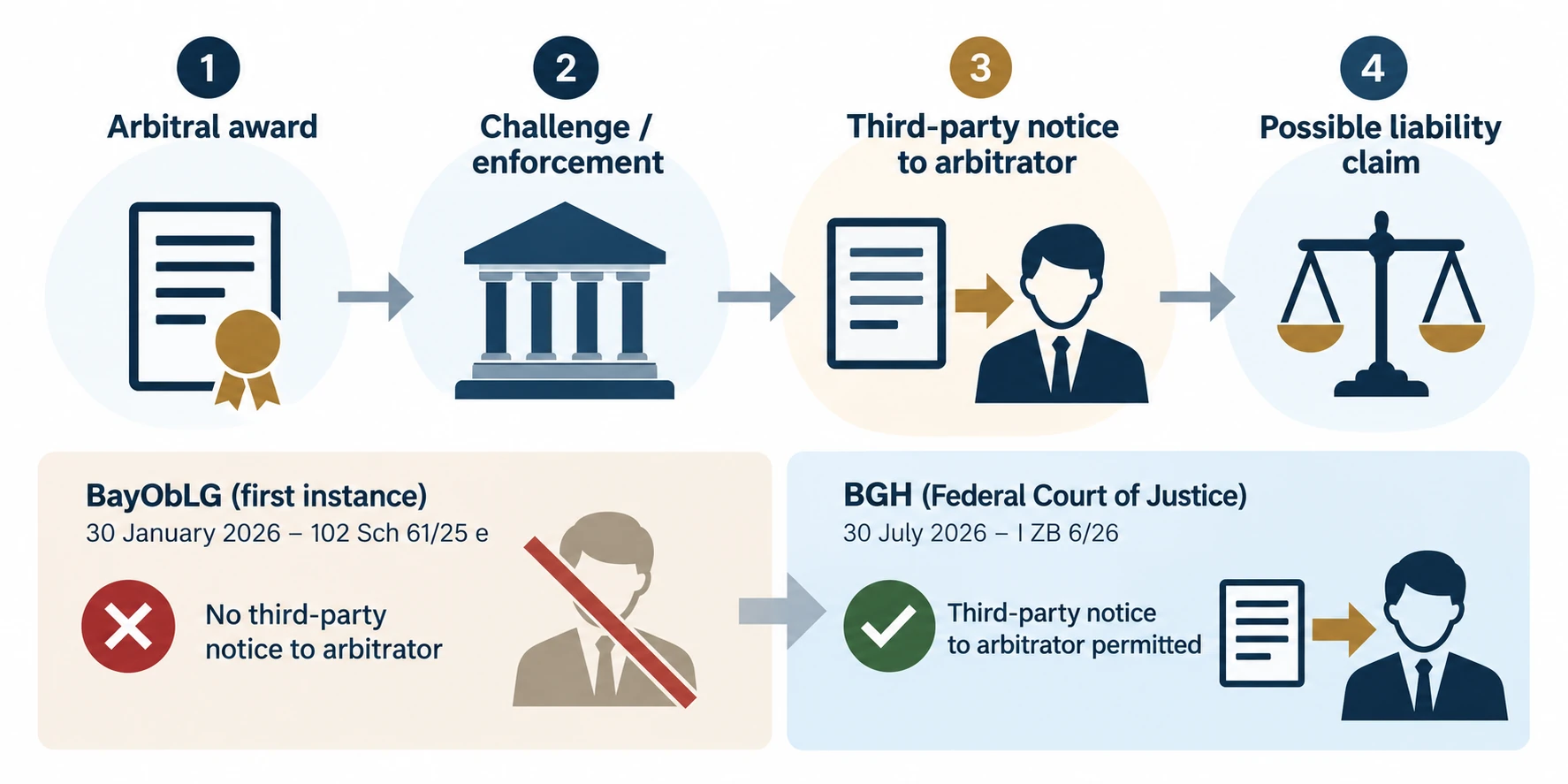
In a recent decision, the German Federal Court of Justice (BGH) has held that a party may serve a third-party notice to an arbitrator (Streitverkündung) in proceedings concerning the setting aside or enforcement of an arbitral award. The decision reverses an earlier ruling of the Bavarian Supreme Court (BayObLG).
BGH, Order of 30 July 2026 – I ZB 6/26
BayObLG, Order of 30 January 2026 – 102 Sch 61/25 e
Background
The case arose from proceedings concerning a domestic German arbitral award rendered by a three-member tribunal.
One party sought to set aside the award, relying inter alia on an alleged breach of an arbitrator’s disclosure obligations. It alleged that the arbitrator had failed to disclose a long-standing relationship with a law firm that had advised the opposing party, including in connection with a transaction relevant to the arbitration.
The party seeking to uphold the award took the position that, if the award were set aside because of the arbitrator’s conduct, it might have a contractual damages claim against the arbitrator under section 280(1) BGB.
It therefore sought to serve a third-party notice (Streitverkündung) on the arbitrator pursuant to section 72 ZPO.
Such a notice may be relevant in subsequent proceedings against the third party. In particular, sections 68 and 74(3) ZPO can give findings made in the first proceedings binding effect in subsequent proceedings against the recipient of the notice.
BayObLG refuses the third-party notice
The BayObLG refused to serve the notice.
Section 72(2) ZPO expressly prevents a party from serving a third-party notice on the court hearing the case or on a court-appointed expert.
Although arbitrators are not covered by the wording of that provision, the BayObLG considered that section 72(2) ZPO should apply to arbitrators by analogy.
The court was particularly concerned about the arbitrator’s duty of impartiality. If the arbitrator joined the court proceedings following the third-party notice, this could create doubts about his impartiality.
This could also affect the possibility of remitting the dispute to the same arbitral tribunal under section 1059(4) ZPO if the award were set aside.
The BGH reverses
The BGH disagreed and reversed the BayObLG’s decision.
It held that a party to proceedings concerning the setting aside or enforcement of an arbitral award may serve a third-party notice on an arbitrator where it considers that it may have a damages claim against that arbitrator if the award is set aside.
Most importantly, the BGH rejected an analogous application of section 72(2) ZPO.
The position of an arbitrator differs from that of the state-court judge hearing the case or a court-appointed expert. Once the arbitration has ended, the arbitrator is generally not involved in the subsequent setting-aside or enforcement proceedings.
A third-party notice therefore performs a genuine notification function.
The BGH also considered the potential intervention effect under sections 68 and 74(3) ZPO relevant. Findings made by the state court in the proceedings concerning the award – for example, findings concerning a breach of an arbitrator’s disclosure obligations – may subsequently become important in damages proceedings against the arbitrator.
Does the notice affect the arbitrator’s impartiality?
The BGH also addressed an important practical consequence.
The mere service of a third-party notice does not generally create doubts about the arbitrator’s impartiality.
The situation may be different if the arbitrator actually joins the court proceedings.
Such participation may give rise to concerns regarding impartiality and may therefore affect whether the case can subsequently be remitted to the same arbitral tribunal under section 1059(4) ZPO.
(See here a recent decision of BGH on the question when a remittal to the tribunal is possible: https://kdb.legal/en/federal-court-of-justice-bgh-on-the-setting-aside-and-remittal-of-arbitral-awards-to-the-original-tribunal-for-re-consideration/)
For the BGH, however, this possibility was not sufficient to exclude third-party notices against arbitrators altogether.
Why the decision matters
The decision creates an important procedural link between award challenge proceedings and potential arbitrator liability.
Where an award is challenged because of alleged misconduct by an arbitrator, the party defending the award may face a difficult situation: if the challenge succeeds, it may suffer losses because of circumstances attributable to the arbitrator.
The BGH now confirms that the party may use a Streitverkündung to preserve its procedural position for a possible subsequent damages action.
The decision is particularly relevant where the challenge concerns an alleged failure to disclose circumstances affecting an arbitrator’s independence or impartiality.
However, the BGH did not decide whether the arbitrator in the present case was actually liable. Nor does the decision establish that every violation of an arbitrator’s disclosure obligations gives rise to damages.
Substantive arbitrator liability remains a separate question.
Practical takeaway
Parties pursuing an arbitral award in German setting-aside proceedings should consider whether a third-party notice may be appropriate where the challenge is based on alleged misconduct by an arbitrator.
For arbitrators, the decision also raises an important strategic question. An arbitrator who receives such a notice must carefully consider whether to intervene in the proceedings. While receipt of the notice alone will generally not affect impartiality, active participation may have consequences for any subsequent remittal to the tribunal.
The BGH’s decision thus strengthens the procedural position of parties seeking to preserve potential claims against arbitrators – without deciding the separate and potentially more difficult question of substantive arbitrator liability.
KDB.legal Koch Boës regularly assists parties in arbitration proceedings, proceedings to enforce arbitral awards and set-aside proceedings. If you have any questions relating to arbitration, please do get in touch.