Introduction
In a decision dated 18 September 2026, the Delhi High Court in FAO(OS) 40/2026, CNR No. DLHC010124872026 (Sarr Freights Corporation & Anr v Argo Coral Maritime Ltd) rendered a judgment on whether a London-seated maritime arbitration could continue where the parties’ signed booking note incorporated rider clauses 20-41, while the arbitration provision appeared in Clause 43 (and the earlier fixture recap provided for English Law and LMAA arbitration).
The Division Bench held that the signed booking note was the parties’ final agreement, that it did not contain an arbitration agreement, and that prior correspondence referring to London arbitration could not be used to add Clause 43 to the unambiguous written contract. It allowed the appeal, set aside the order refusing interim relief, and restrained Argo Coral Maritime Ltd. from continuing the LMAA arbitration.
Facts
Sarr Freights was required to transport military cargo for the United Nations Peace Keeping Force from New Delhi to Sudan. The sea leg was to run from Nhava Sheva Port in Mumbai to Port Sudan. The terms were negotiated through Pirama, acting as broker or agent for Sarr Freights, and Ocean7, the booking agent for Argo Coral Maritime.
The parties’ agents exchanged emails and a fixture recap dated 4 April 2023. Clause 23 of that recap stated:
“English law and London arbitration”
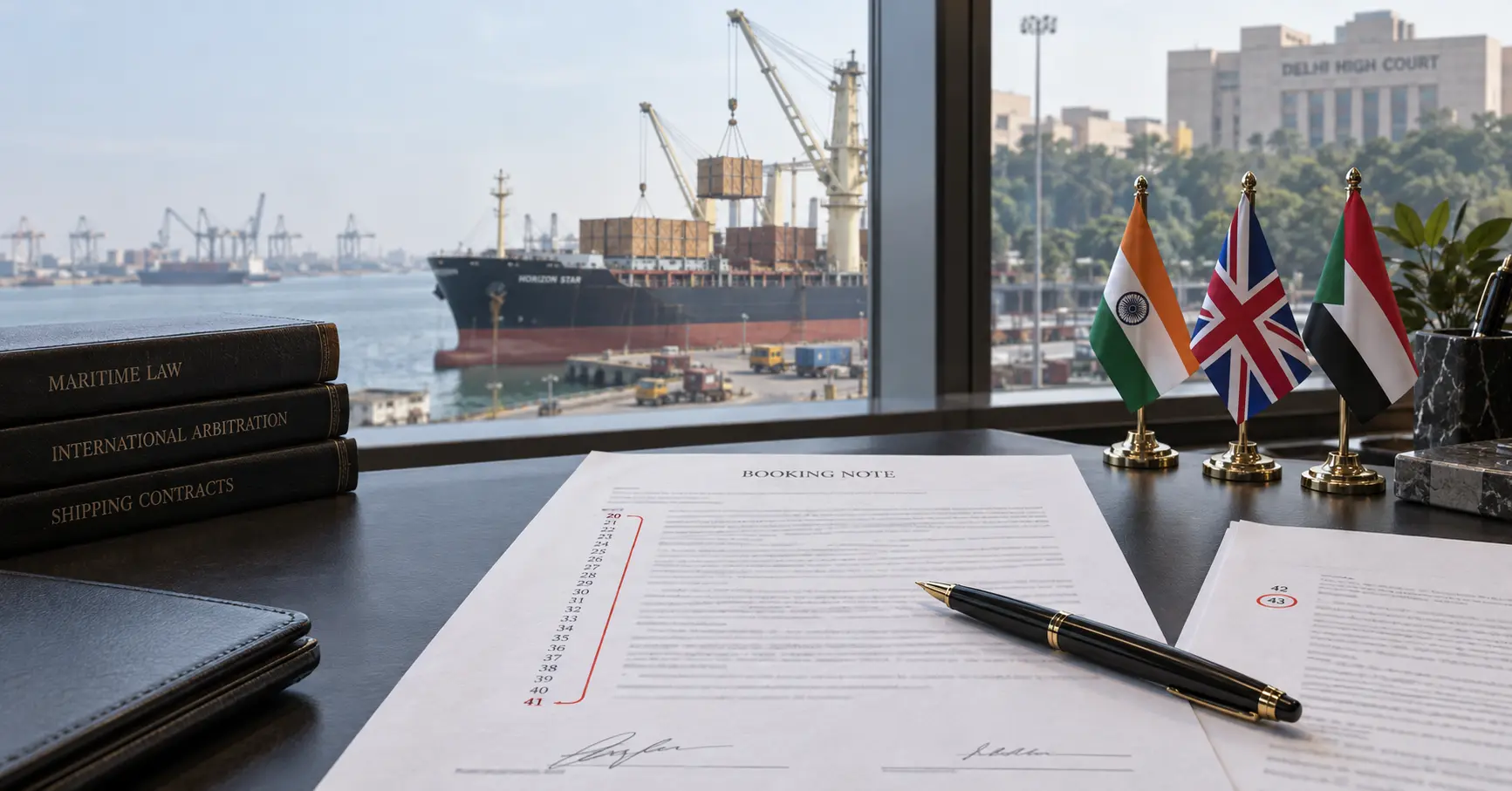
A final booking note dated 4 April 2023 was signed on 5 April 2023 by Sarr Freights Corporation and Ocean7. Five pages of additional rider clauses, numbered 1 to 43, were attached and signed at the bottom of each page. Clauses 41 to 43 appeared on the final page. Clause 43 stated:
“Bimco Dispute Resolution Clause latest edition to apply, subject to English Law and LMAA Terms and Procedures”
The booking note’s Special Terms box, however, incorporated only the following range:
“As per additional rider clause 20 – 41 in attached”
The booking note also provided:
“It is hereby agreed that this Contract shall be performed subject to the terms contained on Page 1 and 2 hereto which shall prevail over any previous arrangements and which shall in turn be superseded (except as to deadfreight) by the terms of the Bill of Lading”
No bill of lading was issued.
On 18 April 2023, the United Nations issued an advisory declaring cargo movements through Sudanese ports unsafe. Sarr Freights cancelled the booking note on the basis of force majeure. A dispute followed, and Argo Coral Maritime invoked arbitration under Clause 43. Sarr Freights participated while reserving its objection to the tribunal’s jurisdiction.
The dispute led to two arbitration references. The first was commenced by a notice dated 27 July 2023. During that proceeding, the tribunal noted that the booking note had been signed by Sarr Freights Corporation, whereas an arbitrator appeared to have been appointed only on behalf of Sarr Freights Limited. Argo Coral Maritime therefore issued a second notice on 6 December 2024 against Sarr Freights Corporation, without prejudice to the earlier notice. The references were consolidated and heard together on common preliminary issues.
Those issues included whether the fixture recap or booking note contained an arbitration agreement and whether the booking note should be rectified by replacing “clause 20-41” with “clause 20-43”.
In a partial award dated 18 October 2025, a majority of the tribunal applied English common law and found that the parties had agreed to English law and London arbitration in the fixture recap. The majority interpreted the booking note as referring disputes to London arbitration under Clause 43 and treated the reference to Clause 41 as a typographical error that should be rectified to Clause 43. One member of the tribunal dissented.
Sarr Freights then brought proceedings before the Delhi High Court seeking an anti-arbitration injunction. On 13 March 2026, the single judge refused interim relief. The judge considered that a valid arbitration agreement could be derived from the fixture recap and Clause 43 and treated the reference to clauses 20-41 as an inadvertent error. Sarr Freights appealed.
Legal considerations
Delhi High Court’s territorial jurisdiction
Argo Coral Maritime argued that the booking note concerned carriage from Mumbai to Sudan and that the courts in Mumbai were the appropriate Indian forum. Sarr Freights relied on its presence in Delhi, the signing of the booking note in Delhi, and the cargo’s initial movement from Delhi.
The Division Bench upheld the single judge’s finding that the Delhi High Court had territorial jurisdiction. A substantial part of the cause of action arose in Delhi: the appellants were based there, the booking note was signed there, and any enforcement against them would take place there. The fact that courts in Mumbai might also have jurisdiction did not remove the jurisdiction of the courts in Delhi.
Judicial examination of the existence of an arbitration agreement
The Court distinguished the tribunal’s competence to rule on its own jurisdiction from the court’s power to determine whether the parties had ever entered into an arbitration agreement. Relying on Mcdonald’s India Private Limited v Vikram Bakshi, it held that Indian courts may decide whether an arbitration agreement is void or a nullity.
The signed booking note as the final agreement
The central issue was whether the earlier fixture recap could be used to read Clause 43 into the later signed booking note. The appellants argued that the booking note was the final contract, expressly superseded prior arrangements, and deliberately incorporated only Clauses 20 to 41. Argo Coral Maritime contended that the reference to Clause 41 was a typographical mistake because the fixture recap already provided for English law and London arbitration and the parties had signed the page on which Clause 43 appeared.
The Division Bench applied Sections 91, 92 and 94 of the Indian Evidence Act, 1872. It held that once contractual terms have been reduced to a clear, unambiguous and signed document, earlier negotiations, correspondence and communications cannot be used to contradict, vary, add to or subtract from those terms. External material may be considered where the language is ambiguous, defective or does not apply meaningfully to the existing facts, but the Court found no such problem in the booking note.
The Court distinguished Govind Rubber Limited v Louis Dreyfus Commodities Asia Private Limited and Trimex International FZE Limited, Dubai v Vedanta Aluminium Limited, India. Those cases concerned situations in which no signed written agreement existed and correspondence therefore had to be examined to determine whether the parties had reached agreement. Here, the parties had executed a signed contract that expressly prevailed over earlier arrangements.
The Court also rejected the application of English common-law rectification principles. It observed that English common law may permit a court to examine prior negotiations and correct a written instrument that does not reflect the parties’ prior common intention. Indian law, as applied by the Court, did not permit that approach where a signed agreement was clear and unambiguous.
Several features of the booking note supported the Court’s finding:
- The standard-form Special Terms box referred to rider clauses 20-41, and the parties retained that reference while adding four further special terms.
- The booking note expressly stated that its terms prevailed over previous arrangements.
- Other terms in the booking note differed from the fixture recap, including provisions on the vessel and detention, showing that the booking note was not merely a reproduction of the recap.
- The two dispute-resolution wordings were not identical. The fixture recap referred generally to English law and London arbitration, while Clause 43 referred to the BIMCO Dispute Resolution Clause and LMAA terms and procedures.
- The fact that Clauses 41, 42 and 43 appeared on the same signed page did not incorporate provisions beyond the expressly selected range of Clauses 20-41.
The Division Bench therefore held that the booking note contained no mistake, ambiguity or defective language and that no arbitration agreement existed between the parties.
Order granting the anti-arbitration injunction
Because there was no arbitration agreement, the Court found that the foundation for the LMAA proceedings was absent. It treated the case as one of the exceptional circumstances in which an anti-arbitration injunction could be granted.
The Court allowed the appeal and set aside the single judge’s order dated 13 March 2026. It restrained Argo Coral Maritime Ltd. from continuing, pursuing or taking any steps in the LMAA arbitration titled Argo Coral Maritime Ltd. v SARR Freights Ltd/SARR Freights Corporation.