
Introduction
In decisions dated 31 July 2023 and 1 April 2026, the High Court of Ireland in case number 2023 No. 88 COS (In the Matter of GTLK Europe DAC and GTLK Europe Capital DAC [2023] IEHC 486) and the Frankfurt Higher Regional Court in case number 17 U 20/25 (ECLI:DE:OLGHE:2026:0401.17U20.25.00) rendered judgments on whether insolvency displaces control by a person or entity listed under Council Regulation (EU) No 269/2014.
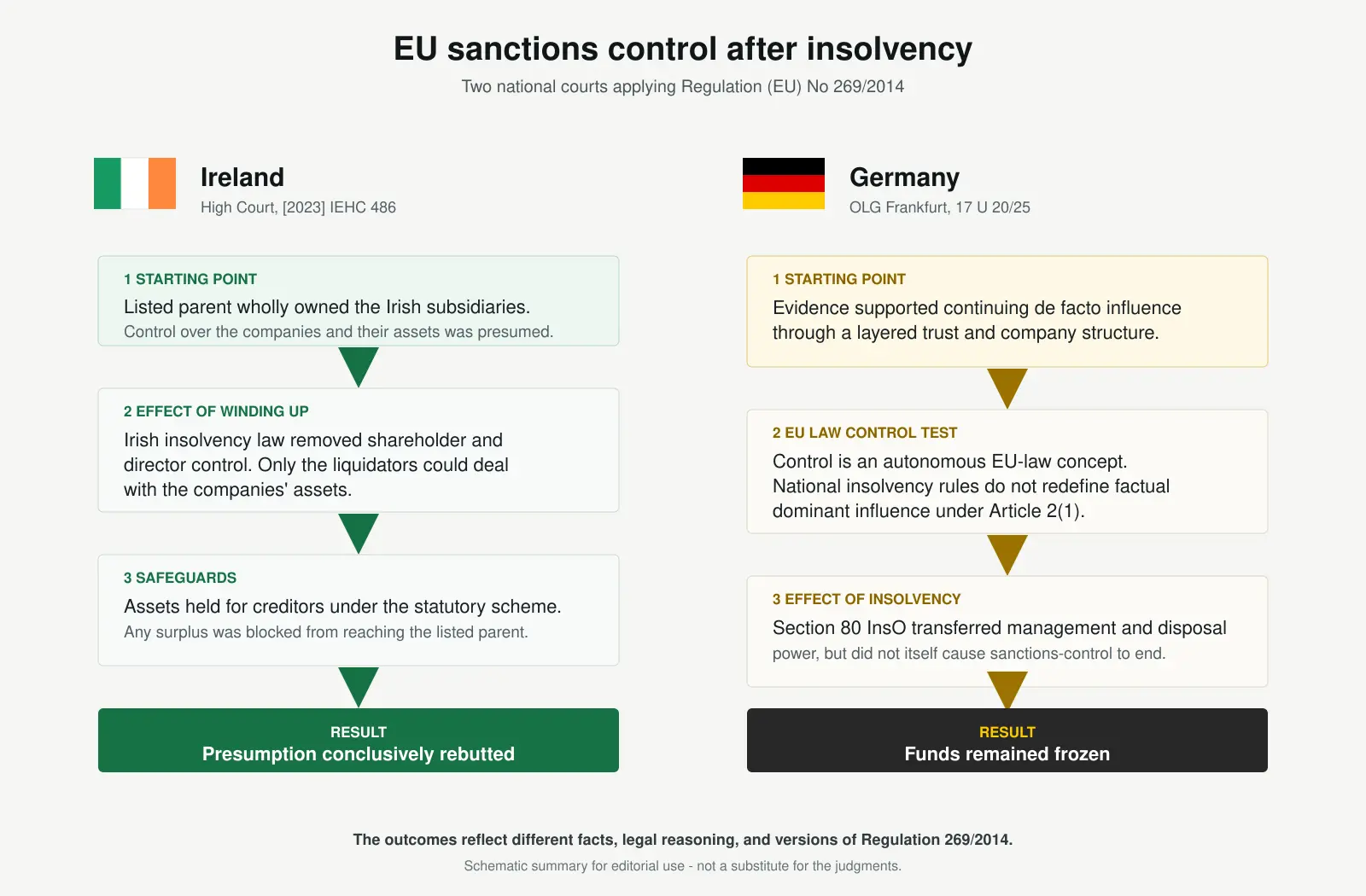
The Irish court held that the presumption of control arising from a listed parent’s ownership was conclusively rebutted when court-appointed liquidators became the only persons entitled to deal with the subsidiaries’ assets. The German court reached the opposite result on materially different facts: it found continuing de facto control through a trust structure and held that the transfer of management and disposal powers to an insolvency administrator under section 80(1) of the German Insolvency Code did not end control for sanctions purposes.
Factual Background
The Irish GTLK Liquidations
GTLK Europe DAC and GTLK Europe Capital DAC were Irish companies in an international transport leasing group. The group held aircraft and sea vessels through a complex subsidiary structure. JSC GTLK, the ultimate parent, was wholly owned by the Russian Federation through its Ministry of Transport and was added to Annex I to Regulation 269/2014 on 8 April 2022. The Irish companies themselves were not listed. Before the winding-up, the court accepted that they were properly presumed to be under the ultimate parent’s control.
The companies had issued or guaranteed several billion US dollars of loan notes. In April 2023, noteholders petitioned for their winding-up. On 31 May 2023, the High Court refused an examinership application, found the companies insolvent on cash-flow and balance-sheet evidence, ordered their winding-up in Irish main insolvency proceedings, and appointed joint liquidators.
The liquidators needed to collect, preserve and realise assets, replace directors of subsidiaries, exercise voting rights and make urgent operational payments. The Central Bank of Ireland had indicated that, if the companies remained within the asset freeze, individual authorisations could be required for transactions undertaken in the liquidation. The liquidators therefore sought directions under section 631 of the Companies Act 2014, including declarations that the presumption of control had been rebutted and that only they could deal with the companies’ assets.
The German Bank Accounts and Trust Structure
The German proceedings concerned an insolvency administrator’s claim against a bank for payment of balances held in four accounts of P Limited, an Isle of Man company. The accounts held an aggregate equivalent of EUR 950,044.88 on 30 June 2022. The bank refused payment on the ground that the balances were frozen under Regulation 269/2014. The Frankfurt Regional Court dismissed the claim as currently unfounded, and the administrator appealed.
The debtor sat within a layered offshore structure. Its sole shareholder was a Bermuda company. Shares further up the chain were held by a Swiss company as trustee for the S Trust, also established in Bermuda. The trust’s settlors and original beneficiaries included D, a person listed in Annex I, and his sister E. The former protector of the trust had also represented himself to the bank as D’s family officer and authorised representative.
The administrator argued that D and E had been excluded as beneficiaries in February and April 2022, that the trustee managed the trust independently, and that only the administrator now exercised control over the debtor. The bank relied on the structure, the personal links and the timing of the changes. By the time of the appeal, E had been removed from Annex I and the reference to the Swiss trustee in her listing had disappeared, so the Higher Regional Court did not uphold the Regional Court’s earlier reasoning based on an ‘association’ with E. It instead examined whether listed D factually controlled the trust and the bank balances.
Legal Considerations
The Common EU Framework
Article 2(1) of Regulation 269/2014 requires the freezing of all funds and economic resources belonging to, owned, held or controlled by persons, entities or bodies listed in Annex I. Both cases concerned assets nominally held by an unlisted company and asked whether a listed person or entity nevertheless controlled those assets.
In the Irish proceedings, the court relied on the European Commission’s 2020 and 2021 opinions and its sanctions FAQs. That guidance stated that, once a listed person is found to control an unlisted entity, control may be presumed to extend to the entity’s assets and subsidiaries. The presumption may be rebutted case by case if the entity shows that its assets are outside the listed person’s control or that funds made available to it would not reach or benefit that person. The High Court summarised the position as a rebuttable presumption applying to a wholly owned subsidiary (Irish judgment, paras 44-51).
The German court applied Regulation 269/2014 in the version effective from 23 October 2025. Article 1(j), introduced through Regulation (EU) 2025/2037, defines control and includes the ability to exercise de facto a right of dominant influence even without formally holding that right. The court also used the Council’s non-binding EU Best Practices as an interpretive aid, including indicators such as unnecessarily complex structures, trustees or shell companies, and transfers shortly before listing (German judgment, pp. 12-14).
The Irish Approach Presumption Rebutted by the Winding Up
The Irish court approached the issue through the legal consequences of the winding-up. Article 7 of the Recast Insolvency Regulation directed the court to Irish law for the conduct of the proceedings, the assets in the insolvency estate, the respective powers of the debtor and the insolvency practitioner, and distribution. The court therefore examined Part 11 of the Companies Act 2014 and Irish authority on the statutory trust arising in liquidation.
Sections 596, 602, 624, 627 and 677 of the Companies Act placed the company’s property under the liquidators’ control, invalidated unauthorised post-commencement dispositions and ended the directors’ powers except to the limited extent sanctioned with the liquidators’ approval. The court held that the loss of shareholder control was ‘absolute’: any attempt by JSC GTLK to replace directors or direct dealings with the companies’ assets would be ineffective. The joint liquidators were the only persons entitled to deal with those assets (paras 90-103).
That conclusion was reinforced by the treatment of beneficial ownership. On an insolvent winding-up, the company retained legal title but ceased to be the beneficial owner of its assets. The assets were held under the statutory distribution scheme for creditors, and the liquidators had to collect, realise and distribute them according to the Companies Act. The court declared that no distribution could be made to the ultimate parent without a further court order. Any surplus had to be placed in a designated Irish account and could not be released to JSC GTLK unless EU law permitted it (paras 78 and 104-115).
On that basis, Mr Justice Quinn held that the presumption of control under Article 2 was ‘conclusively rebutted’ by the winding-up order and the appointment of the joint liquidators. The ruling concerned control and ownership during the companies’ insolvency and rested on the court’s findings that the companies were insolvent, the shareholder could no longer influence their affairs, and safeguards prevented any residual value from reaching the listed parent.
The German Approach Insolvency Does Not Alter EU Sanctions Control
The Frankfurt Higher Regional Court began with factual control. It accepted that D did not formally possess contractual or constitutional rights to direct the trust under Article 1(j)(iv). It nevertheless found sufficient indications that he could exercise de facto dominant influence under Article 1(j)(v). These included the former protector’s dual role as protector and as D’s family officer and representative, the complex trust and company structure, the timing of D’s purported exclusion as a beneficiary three weeks before his EU listing, and a sanctions-related exclusion clause. The court treated the relevant changes as attempts to circumvent the Regulation and found that D continued to control the trust and, indirectly, the debtor and its balances (pp. 12-15).
The insolvency opening did not change that assessment. Section 80(1) of the German Insolvency Code transferred the right to manage and dispose of estate assets from the debtor to the insolvency administrator. The court nevertheless held that this transfer did not affect control within Article 2(1). Ownership, possession, holding and control were autonomous concepts of EU law that had to be interpreted uniformly. National law was relevant only where EU law expressly or implicitly referred to it; Article 1(j) contained no such reference for the question before the court (pp. 15-16).
The court also rejected the argument that EU provisions permitting a firewall showed that national insolvency rules could define control. In its view, Article 6b(5d) allowed a competent authority to release specified frozen assets where a firewall was implemented; it did not permit national law to redefine the EU concept of control. The existence of that release mechanism instead supported the view that insolvency alone did not end sanctions control. The bank balances therefore remained frozen, the bank was not required to pay them to the administrator, and the appeal was dismissed.
Comparison of the Two Approaches
| Issue | Irish High Court | Frankfurt Higher Regional Court |
| Initial basis | Wholly owned subsidiaries of a listed parent; control expressly treated as presumed. | A listed settlor’s de facto influence through a layered trust structure; control established from a body of factual indicators. |
| Role of insolvency law | Irish law determined who could control and benefit from assets during the winding-up. | German insolvency law transferred management and disposal powers but could not define the autonomous EU concept of control. |
| Effect on control | Shareholder and director control ended absolutely; only the joint liquidators could deal with assets. | The insolvency opening was a factual circumstance but did not extinguish the listed person’s sanctions control. |
| Protective mechanism | Creditor-focused statutory trust, court control over any shareholder distribution, and blocked surplus account. | A release requires the competent authority’s decision, including a possible firewall under Article 6b(5d). |
| Outcome | Presumption conclusively rebutted; the companies were not treated as controlled by JSC GTLK during the insolvency. | Balances remained frozen; payment to the insolvency administrator was refused. |
The difference is therefore not simply whether an insolvency practitioner has formal power over the estate. The Irish court used the legal incidents of the insolvent winding-up to answer the sanctions question and treated the appointment, together with the statutory distribution regime and surplus safeguards, as decisive rebuttal evidence. The German court separated the administrator’s national-law powers from the EU-law concept of control and asked whether the listed person retained a factual ability to exercise dominant influence through the wider structure.
The factual and legislative settings also differ. The Irish case concerned direct corporate ownership by a listed state-owned parent and was decided in 2023 using Commission guidance. The German case concerned indirect factual control through a trust and was decided after the 2025 amendment that inserted express definitions of ownership and control. The German court also found circumvention indicators that had no counterpart in the Irish judgment. The two judgments accordingly describe different routes through the presumption of control, rather than deciding the same evidential record under the same version of the Regulation.
Related Reading on kdb legal
The kdb.legal article CJEU – A Connection to sanctioned individuals is not sufficient Control needs to be established discusses Case C-147/25, Inter Rao Lietuva, and the requirement for an objectively substantiated and sufficiently solid factual basis for control. It also explains the indicative role of the EU Best Practices and the rebuttable presumption where a control criterion is established.
A later GTLK-related application of the Irish liquidation is summarised in English Commercial Court Enforces Bareboat Charter Guarantees in Sanctions Dispute, which records that the Irish declaration formed part of the subsequent sanctions history of GTLK Europe and its subsidiaries.
KDB.legal Koch Boës advises on all kind of disputes (litigation and arbitration) especially when sanctions are involved.


