
Introduction
In a decision dated 7 October 2026, the Landgericht Nürnberg-Fürth (Regional Court of Nuremberg-Fürth) in case number 12 Qs 62/12 (Landgericht Nürnberg-Fürth, 12 Qs 62/12) rendered a ruling on the continued seizure of cash in an investigation concerning alleged violations of EU Russia sanctions.
The court dismissed the suspect’s appeal as unfounded and held that, on the facts available at this early stage of the investigation, there was sufficient initial suspicion to justify pre-trial seizure of €95,800 in euro banknotes as potential confiscation property.
Facts
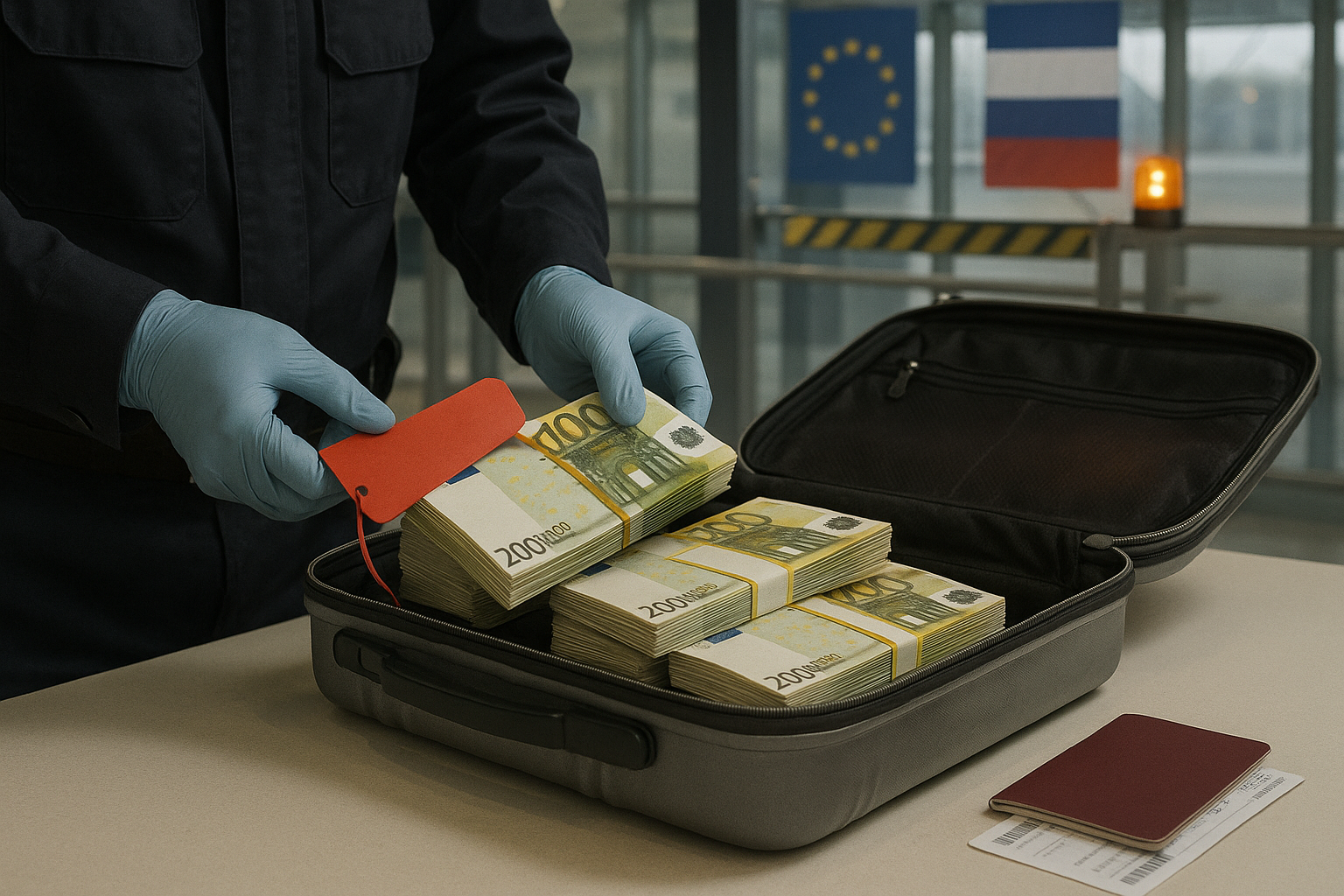
The suspect is a dual German and Russian national. On 14 May 2026, shortly before boarding a flight from Nuremberg airport to Istanbul, he declared at the customs desk that he was exporting €95,800 in euro banknotes.
According to the decision, the suspect told customs officers that he was travelling to Istanbul and, after initially evasive answers, produced a boarding pass. He stated that his final destination airport was Alanya (Turkey) and that he intended to purchase real estate there. He did not initially provide documentation about the intended real estate transactions. He identified a broker “Svetlana”, said he had the locations “in his head”, but did not provide details of specific properties.
After a customs officer pointed out the possibility of a seizure of the cash, the suspect changed his account and stated that the money was for paying remaining debts from an already completed real estate purchase and that he had bought an apartment in the project “…” (project name redacted in the decision). The decision notes that he did not explain the discrepancy between his first and later account.
Customs searched the suspect for additional cash; beyond the declared amount he carried €15 and 5,700 Russian rubles. As documentation for the asserted real estate purchase he produced a Russian-language document which he described as the purchase contract.
Due to contradictory statements and the lack of coherent documentation regarding the purpose of the funds, customs initiated a “clearing procedure” under § 12a(7) ZollVG (German Customs Administration Act) and secured the cash.
Further customs inquiries identified additional circumstances cited by the court:
- On 20 August 2024, the suspect had previously declared the export of €65,000 for a real estate purchase.
- In November 2022 and January 2023, a bank (name redacted) filed suspicious activity reports relating to cash deposits into the suspect’s account, stating that the origin of the funds had not been explained and that the bank had no other information about their provenance.
- Turkey’s Financial Intelligence Unit (FIU) reportedly informed the German authorities that no real estate ownership or other registered rights in Turkish real estate were recorded for the suspect or his wife (name redacted).
- Booking data showed that the suspect had not booked a connecting flight from Istanbul to Alanya. Instead, he had booked a flight from Istanbul to Moscow on 15 May 2026 at 01:15, as well as two further flights on 19 May 2026 from Moscow to Istanbul and from Istanbul onwards to Nuremberg.
On application by the public prosecutor’s office (Staatsanwaltschaft Nürnberg-Fürth), the Amtsgericht Nürnberg (Local Court of Nuremberg) issued an order on 10 June 2026 under §§ 111b, 111j StPO (German Code of Criminal Procedure) attaching (beschlagnahmen) the secured cash to prepare for potential confiscation (Einziehung) as proceeds/instrumentality of an offence. The stated basis was possible confiscation under § 20(1) no. 1 AWG (German Foreign Trade and Payments Act) in conjunction with § 73 StGB (German Criminal Code).
Defence counsel filed an appeal. In later submissions, the defence argued (in summary) that the Moscow itinerary related to a planned visit to the suspect’s brother, but that the suspect decided against travelling to Moscow due to drone-related risks and the overall situation in Russia. The defence further asserted that the suspect travelled with only a German passport and did not carry his Russian passport; without a visa, he could not enter Russia with the German passport. The defence maintained that the money was intended for Turkish real estate transactions, including instalments said to be due for an apartment purchase, and possibly for an additional purchase.
Legal considerations
Procedural posture and standard of review
The Regional Court treated the request for a “judicial decision” ordering release of the cash as, in substance, an appeal against the Local Court’s attachment order. If the attachment was valid, the court reasoned, release could not be ordered at this stage.
For a pre-trial attachment securing potential confiscation under § 111b StPO, the court emphasised that the threshold is an “initial suspicion” (Anfangsverdacht) within the meaning of § 152(2) StPO, not proof or a higher level of suspicion. The court considered whether there was initial suspicion of a criminal offence that could lead to confiscation of the cash as the object of the offence under § 20(1) no. 1 AWG.
Substantive legal framework: EU ban on exporting euro banknotes to Russia
The suspected offence was framed as a potential breach of § 18(1) no. 1(h) AWG (criminalising violations of directly applicable EU legal acts implementing sanctions adopted under the EU Common Foreign and Security Policy), with attempt being punishable under § 18(6) AWG.
The court identified the relevant directly applicable EU measure as Article 5i(1) of Regulation (EU) No 833/2014 (as inserted by Regulation (EU) 2022/345, in force since 2 March 2022). As quoted in substance by the court, Article 5i(1) prohibits selling, supplying, transferring or exporting euro-denominated banknotes to Russia or to persons, organisations or entities in Russia, including the Russian government and central bank, or for use in Russia.
The court also addressed the personal-use exception in Article 5i(2)(a) of Regulation 833/2014, which allows euro banknotes as “means of payment for the personal use” of natural persons travelling to Russia. Relying on the Court of Justice of the EU (CJEU) (judgment of 30 April 2025, C-246/24), the Regional Court stated that this exception must be interpreted narrowly. In the CJEU’s formulation quoted by the German court, the exception covers only cash carried by a person travelling to Russia that is required to purchase goods or services necessary to cover needs caused by the trip and stay in Russia (and, if applicable, accompanying immediate family members).
The decision further noted, with reference to German Federal Court of Justice and CJEU case law, that the concept of “making funds available/provision” (Bereitstellung) is to be interpreted broadly, encompassing acts enabling a listed person/entity or the embargoed destination to obtain effective control over the asset.
Initial suspicion: indicators pointing to intended onward travel to Russia
The court held that the available indicators supported initial suspicion that the suspect at least attempted to export €95,800 in euro banknotes to Russia, contrary to Article 5i(1) of Regulation 833/2014, and thus attempted an offence under § 18(1) no. 1(h) and § 18(6) AWG.
Key reasons given were:
- Lack of credibility of the Turkey real estate narrative: The court found the suspect’s explanations inconsistent—alternating between an intended purchase and payment of remaining debts for an already purchased property, with the additional suggestion that instalments could be postponed in favour of a new purchase. The court also pointed to the Turkish FIU response stating no registered Turkish real estate ownership or rights for the suspect or his wife, while noting that the evidential value of the document produced at the airport would be for further investigation.
- Suspicious nature of the produced “contract”: The court remarked on the appearance of the purported two-page purchase contract for an allegedly Turkish property, describing it as drafted in Russian with insertions in Latin letters, partly English and partly German. The decision gives one illustrative detail: next to the suspect’s personal data, alongside the Russian (Cyrillic) word “strana” (= country), the document contained the word “DEUTSCH”.
- Travel booking pattern indicating Moscow rather than Alanya: The suspect had booked a connecting flight from Istanbul to Moscow (and return flights) rather than to Alanya. The court considered the defence claim—that he changed his mind due to drone risks—unpersuasive because the Moscow bookings remained in place and there was no rebooking toward Alanya. The court provisionally treated this as a protective assertion.
- Russian passport not carried not decisive: The court held that travelling without a Russian passport did not exclude an intention to enter Russia, including because Russian border authorities could recognise his Russian citizenship from personal data. The presence of a small amount of rubles was also mentioned as consistent with a planned Russia trip.
Attempt (rather than completed export) and “direct commencement”
The court explained that “export” in this context means delivery of goods from the EU to a third country. The offence would be completed when the cash crosses the EU’s external border. If customs stops the export before the border is crossed, liability may arise only for attempt.
On the facts, the court considered the cash had not yet been exported but that the suspect had “directly commenced” the offence (unmittelbar angesetzt), because he declared the export in Nuremberg and represented Alanya as his destination in order to obtain customs consent for taking the banknotes out. The contemplated chain of acts involved the first step of exporting from the EU, ultimately resulting (in the court’s assessment of the suspicion) in making the euro banknotes available in Russia to an as yet unknown natural or legal person.
No disproportionality at this stage
Finally, the court found no proportionality barrier to continued attachment. The investigation was at an early stage and verifying the asserted Turkish property transactions would require investigative steps outside the EU. Against that background, the court held that it was not necessary to demand a level of suspicion beyond initial suspicion at this point.
The appeal was therefore dismissed, and the suspect was ordered to bear the costs of his unsuccessful remedy (§ 473(1) StPO).


