

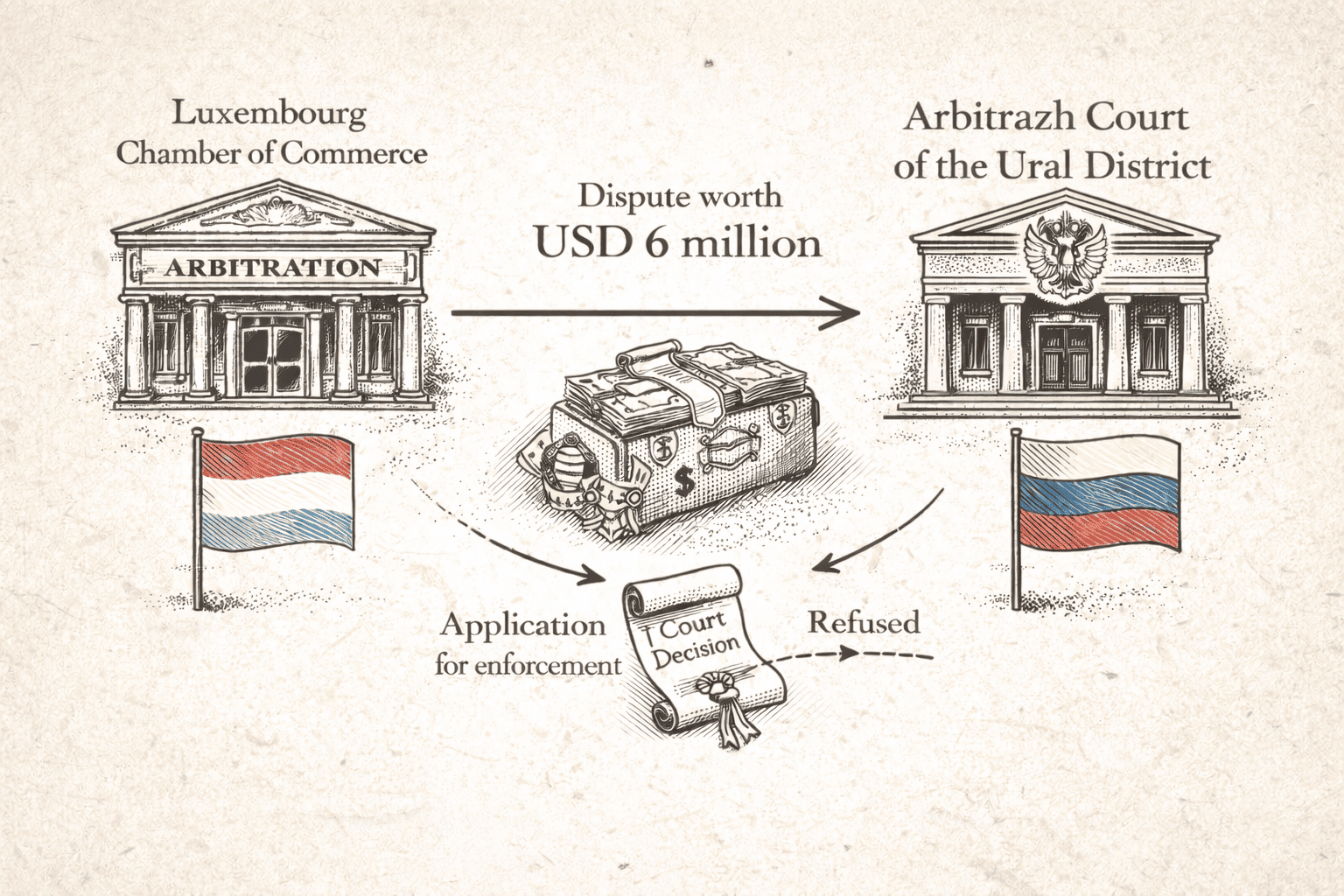
The Arbitrazh Court of the Ural District refused recognition and enforcement of Luxembourg arbitration awards, reasoning, inter alia, that enforcement could “cause damage to Russian industry.”
Background of the dispute
The dispute arose between Giuseppe Bruzzone and Luigi Stoppani (both Italian citizens) and Koaland Investment Ltd (BVI), on the one side (collectively, the claimants), and JSC Khrompik (Russia), Mr. Gilvarg (a Russian citizen), and Midural Industrial Group Limited (Cyprus), on the other side (collectively, the interested parties). The dispute concerned a share purchase agreement and a guarantee agreement dated 7 November 2012. Both agreements contained arbitration clauses referring disputes to the Arbitration Center at the Luxembourg Chamber of Commerce.
The arbitration proceedings in Luxembourg
The claimants initiated arbitration under the rules of the Arbitration Center at the Luxembourg Chamber of Commerce against the interested parties, seeking joint and several recovery of the outstanding debt as well as costs. The arbitral tribunal issued two awards. Under the first award, the interested parties were ordered to pay the principal debt of USD 6 million plus interest. Under the second award, the interested parties were ordered to reimburse arbitration costs of EUR 286,000 and USD 6,100.
Application for recognition and enforcement in Russia
The claimants subsequently filed an application with the Arbitrazh Court of the Sverdlovsk Region seeking recognition and enforcement of the two awards in Russia against the interested parties.
- Sergey Gilvarg had not been properly notified, as notifications were sent to addresses not used in the agreements;
- The sanctions regime created an unequal position of the parties in the arbitration;
- Enforcement of the awards would contradict Russian public policy.
Cassation appeal before the Arbitrazh Court of the Ural District
The interested parties filed a cassation appeal with the Arbitrazh Court of the Ural District challenging the decision of the first-instance court. Among other arguments, they submitted that Sergey Gilvarg had in fact been properly notified, as he participated in the proceedings personally and through representatives without any impediment.
The cassation court agreed with the lower court and relied on the following considerations:
🔘 Enforcement of the awards in Russia would contradict Russian public policy, since the recovery “may cause damage to a major enterprise of Russian industry, which is unacceptable and does not correspond to the interests of the Russian side from the perspective of both private and public interests”;
🔘 Restrictive measures introduced by a number of foreign states against Russia indicate that enforcement of such awards under these conditions may affect the interests of the Russian side;
🔘 The case materials demonstrate an unequal position of the parties in the arbitration, including due to the refusal of several law firms to represent the interested parties.
At the same time, the cassation court did not comment on the applicants’ argument regarding Sergey Gilvarg’s participation in the proceedings.
As a result, the decision of the court of first instance was upheld, and the cassation appeal of the claimants was dismissed.
📎 The court decision is available at the link.