

Cour de cassation (2e civ.), 5 February 2026, No. 23-15.936
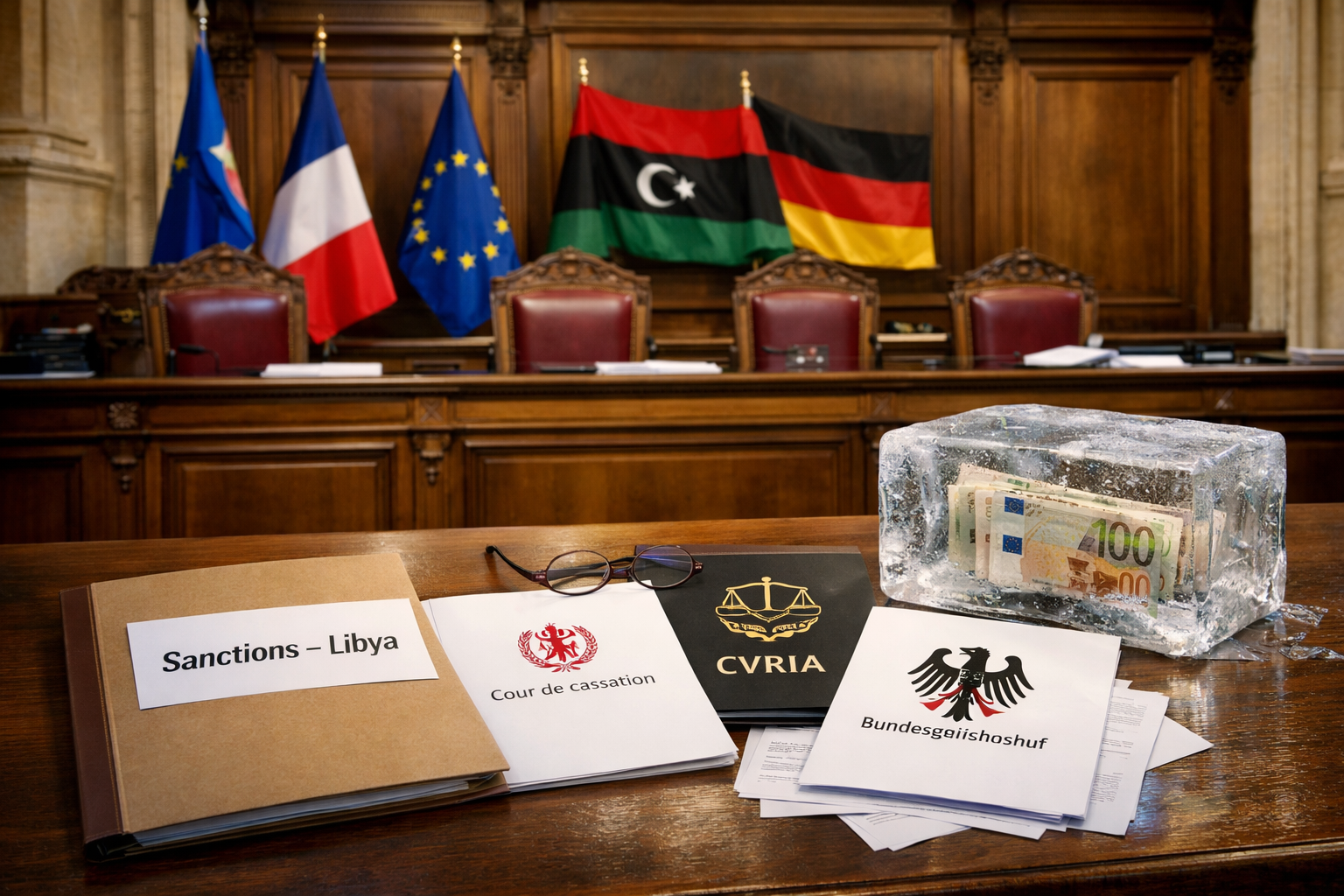
1. Introduction and procedural background
In its judgment of 5 February 2026 (No. 23-15.936), the Second Civil Chamber of the Cour de cassation dismissed an appeal against a decision of the Paris Court of Appeal (2 February 2023), confirming that no enforcement measure may be authorised or validated against frozen Libyan assets without prior authorisation from the French Treasury (Direction générale du Trésor) .
The case concerned an arbitral award rendered against the Libyan State. The creditor, after obtaining exequatur in France, sought to attach funds held in France in the name of the Libyan Investment Authority (LIA), an entity listed in Annex VI to Regulation (EU) No 2016/44 concerning restrictive measures in view of the situation in Libya.
The central issue was whether a saisie-attribution (third-party attachment) could be authorised by the enforcement judge without prior administrative authorisation under Article 11(2) of Regulation 2016/44.
2. Summary of the ruling
The Cour de cassation held that:
- Regulation (EU) 2016/44 prohibits any enforcement measure on frozen funds that would either:
- remove them from the debtor’s patrimony; or
- confer a preferential right on the attaching creditor,
- unless prior authorisation has been granted by the competent national authority (in France: the Director General of the Treasury).
The Court confirmed that:
- The freeze affects not only the effectiveness but also the validity of the attachment.
- The administrative authorisation must precede judicial authorisation under Article L. 111-1-1 of the Code des procédures civiles d’exécution.
- The EU regulation’s objective — preventing the use of misappropriated Libyan public funds in a manner threatening peace and stability — justifies a broad interpretation of the freeze.
Accordingly, in the absence of prior Treasury authorisation, the enforcement judge could neither authorise nor validate the saisie-attribution .
3. Facts and arguments of the parties
The creditor relied on an arbitral award rendered abroad and enforced in France. It obtained, on request, judicial authorisation to attach funds held by Société Générale in the name of the LIA.
The LIA sought annulment of the attachment, arguing that:
- its funds were frozen under Article 5(4) of Regulation 2016/44;
- under Article 11(2), only the competent national authority could authorise any release or measure affecting such funds.
The creditor argued that:
- Regulation 2016/44 requires authorisation only at the payment stage, not at the stage of judicial validation of attachment;
- requiring prior administrative approval would add a condition not foreseen in the Regulation;
- French law (notably Article L. 111-1-1 CPCE, introduced by the “Sapin II” law) governs judicial authorisation of enforcement measures against foreign States, without reference to administrative approval.
The Court of Appeal rejected these arguments, and the Cour de cassation confirmed.
4. Applicable legal framework and the Court’s reasoning
(a) EU law: Regulation (EU) 2016/44
The Court relied on:
- Article 1 (definition of “funds” and “freezing of funds”),
- Article 5(4) (continued freezing of assets of listed entities, including the LIA),
- Article 11(2) (possibility of authorising the release of frozen funds for pre-designation contractual obligations, subject to prior notification and control).
The freeze is defined broadly as any action preventing movement, transfer, use, or alteration that could enable use of the funds.
The Court emphasised the preventive objective of the Regulation, as expressed in recital 2: preventing the misuse of Libyan public funds that could endanger peace and political transition.
(b) Effect of enforcement measures
The Court reasoned that:
- A saisie-attribution entails immediate transfer of the claim to the attaching creditor up to the seized amount.
- Even if funds do not physically leave the debtor’s patrimony at the stage of judicial authorisation, the attachment confers a preferential right, altering the legal destiny of the funds.
- Such alteration falls within the broad concept of “freezing of funds” and thus requires prior authorisation.
This reasoning mirrors the logic adopted by the Court of Justice of the European Union (CJEU) in sanctions cases concerning Iran.
5. Reference to European case law – C-340/20 (Bank Sepah)
The French decision is clearly aligned with the CJEU’s judgment of 11 November 2021 in Bank Sepah (C-340/20), delivered upon a request for a preliminary ruling from the French Cour de cassation .
In that case, the CJEU held that:
- Measures conferring a preferential right on a creditor (even without transferring the asset out of the debtor’s patrimony) fall within the prohibition of “freezing of funds”;
- Prior authorisation by the competent national authority is required;
- It is irrelevant whether the underlying claim predates the sanctions or is unrelated to the sanctioned activity .
Although the 5 February 2026 judgment does not expressly cite C-340/20 in the operative part, its reasoning reproduces the CJEU’s approach almost verbatim. The French Court interprets the Libyan sanctions regime in the same expansive manner previously endorsed by the CJEU for the Iranian regime.
6. Comparison with the German Federal Court of Justice (BGH)
The German Federal Court of Justice (BGH), in its judgment of 25 January 2024 (IX ZR 19/22), reached the same conclusion regarding Libyan sanctions. See our commentary on that decison here.
The BGH expressly relied on C-340/20 and held that:
- No attachment — even a purely securing one — may be carried out on frozen funds without prior authorisation;
- A creditor who attaches without authorisation does not acquire a valid pledge;
- Even a claim for deposit (Hinterlegung) requires authorisation, as it constitutes a “movement” or “transfer” of funds .
The German court further emphasised that the defect is substantive: the pledge is invalid ab initio, and the objection may be raised in third-party proceedings.
8. Practical implications
For practitioners in international arbitration and sovereign debt enforcement:
- Judicial authorisation under French law is insufficient where EU sanctions apply.
- Prior authorisation from the Direction générale du Trésor is a substantive precondition.
- Enforcement strategies must integrate sanctions compliance at the earliest stage.
- Claims predating sanctions do not automatically escape the freeze regime.
9. Conclusion
The judgment of 5 February 2026 confirms the convergence of French, German and EU jurisprudence on enforcement against frozen assets. By adopting the CJEU’s broad reading of the concept of “freezing of funds,” the Cour de cassation consolidates a strict, preventive approach that prioritises the effectiveness of sanctions over private enforcement interests.
The decision is a further step toward a coherent European doctrine on the interaction between restrictive measures and civil enforcement — a topic of growing relevance in the context of geopolitical sanctions regimes.