
A. Background of the Case
The Higher Regional Court (OLG) Munich (judgement of 15 January 2026, case no. 14 U 3118/25 e) recently dealt with a dispute over freight remuneration for four international road transports carried out in late September and early October 2023. The carrier (plaintiff) had invoiced a total of EUR 8,040 to the ordering party (defendant).
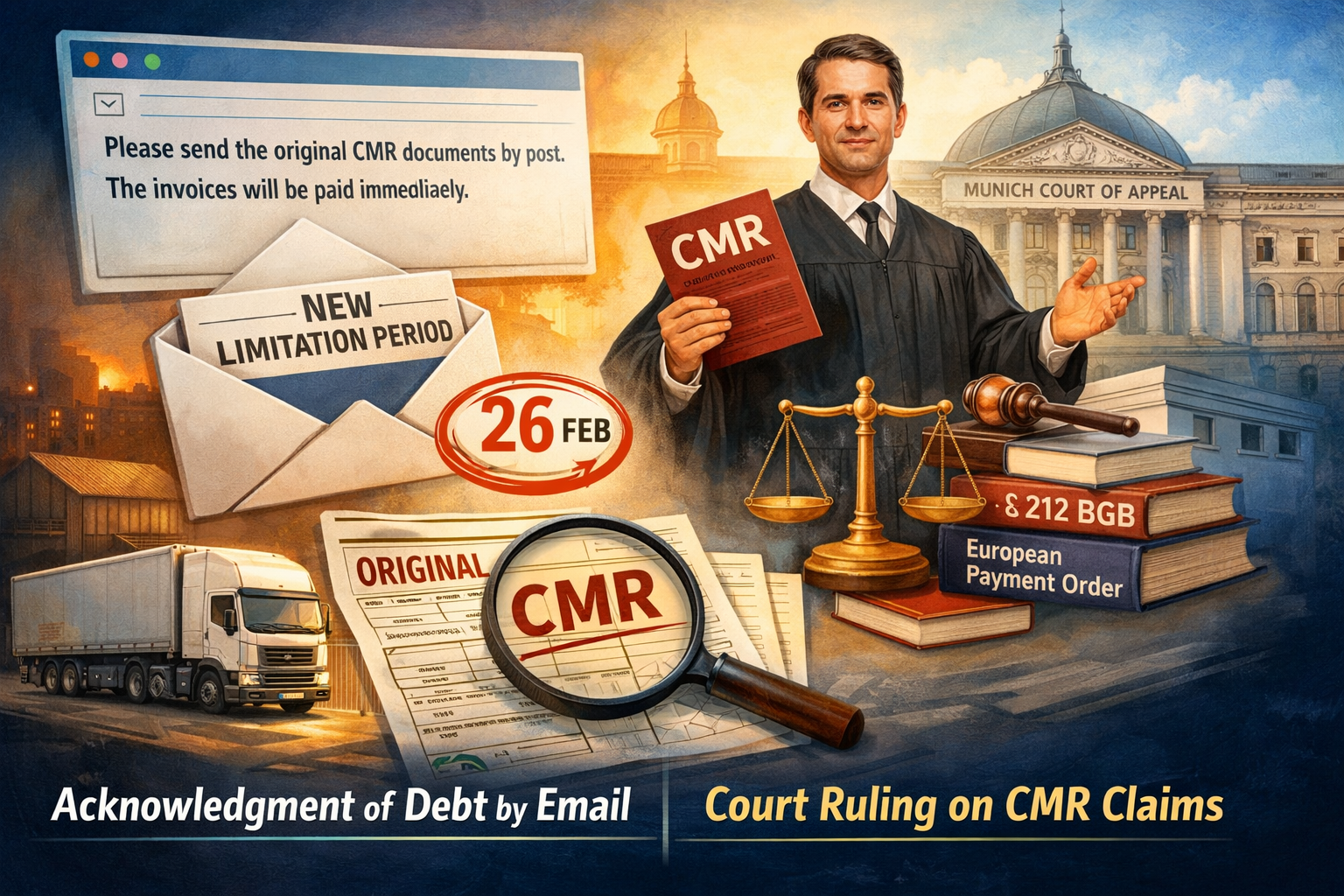
When payment did not follow, the carrier sent a reminder by email on 23 February 2024. On 26 February 2024, the parties exchanged several emails that later became crucial for the question of limitation and acknowledgment of the claim.
After another reminder in January 2025, the debtor raised the time-bar defense on 15 January 2025. The carrier then applied on 24 February 2025 for a European order for payment, which was issued on 25 March 2025 and served on 31 March 2025.
The Regional Court Kempten had dismissed the action in full, essentially on the ground that the claims were time-barred under § 439 HGB (one-year limitation) and that there was no effective acknowledgment or suspension of limitation. The OLG Munich partially overturned that decision and awarded the freight charges, though only step-by-step against delivery of original CMR consignment notes.
B. Core Issues Before the OLG Munich
The OLG addressed three practical questions relevant for commercial road transport and logistics:
- Does an email promising “immediate payment” after receipt of original documents amount to an acknowledgment under § 212 BGB, triggering a new limitation period?
- Does the service of a European order for payment (“Europäischer Zahlungsbefehl”) suspend the limitation period “in time” under § 204 Abs. 1 Nr. 3 BGB and § 167 ZPO?
- Can the debtor rely on a contractual clause to provide original CMR waybill and withhold payment until originals are presented?
C. Acknowledgment of Debt by Email
I. The Email Wording
In response to the carrier’s reminder, the debtor wrote on 26 February 2024:
- First email:
German original:
„[…] zum o.g. Transport benötigen wir für unseren Kunden die originalen Ablieferbelege. Deshalb bitten wir Sie[,] uns diese per Post zuzusenden.
Die Rechnungen werden danach sofort bezahlt.“ - English translation:
“[…] For the above-mentioned transport we need the original delivery receipts for our customer. Therefore we kindly ask you to send them to us by post.
The invoices will be paid immediately afterwards.” - After the carrier asked which transport was meant, the debtor clarified:
German original:
„[…] bitte für alle 4 Transporte die Originale per Post senden.“ - English translation:
“[…] please send the originals by post for all 4 transports.”
The carrier then replied that billing had previously been done electronically, that proof of delivery had already been provided, and again asked when the outstanding freight from the previous year would finally be paid.
II. Legal Assessment as Acknowledgment
The OLG Munich classified the debtor’s email of 26 February 2024 as an acknowledgment under § 212 Abs. 1 Nr. 1 BGB, triggering a new limitation period.
- An acknowledgment requires conduct by the debtor that unambiguously expresses awareness of the claim’s existence – at least in principle – and that justifies the creditor’s expectation that the debtor will not promptly invoke limitation.
- Such conduct can be purely factual, not necessarily a formal legal statement.
According to the court, the statement that the invoices would be paid “sofort” (“immediately”) after receipt of the delivery documents could only be understood by the carrier as meaning that no further merits review of the underlying claim was intended; payment was merely made conditional on the provision of documents. The internal allocation of responsibilities within the debtor’s organisation (i.e. whether the employee who wrote the email had issued the transport orders) was irrelevant from the creditor’s perspective.
As a result, the one-year limitation period—which originally ran from delivery of the goods under § 439 HGB—began anew on 26 February 2024. Without further interrupting or suspending events, limitation would have occurred at the end of 26 February 2025.
D. Suspension of Limitation through European Order for Payment
To prevent limitation, the carrier applied for a European order for payment on 24 February 2025; the application reached the competent court (AG Wedding) on the same day. The order was issued on 25 March 2025 and served on 31 March 2025.
Under § 204 Abs. 1 Nr. 3 BGB, the service of the order suspends limitation. By virtue of § 167 ZPO, this suspension retroacts to the date on which the application was lodged, provided service takes place “demnächst” (i.e. without undue delay).
The OLG Munich applied the case law developed by the Federal Court of Justice (BGH) for national payment order proceedings analogously to the European order for payment (EuMVVO). It held:
- Delays caused solely by the court’s internal processing do not necessarily break the “demnächst” requirement; the key question is whether the claimant did everything reasonably required for timely service.
- In this case, service took place about one month and one week after the application was filed. Given postal transit times and the lack of any fault on the claimant’s side, the court considered service to have occurred “demnächst”.
Consequently, the suspension of limitation was deemed to have commenced on 24 February 2025, i.e. before the new limitation period expired on 26 February 2025.
E. Withholding Payment Until Original CMR Documents
I. Contractual Clause and Validity
The parties had agreed that the debtor would pay only upon submission of original CMR consignment notes (“Originalfrachtbriefe”). The carrier argued that such a clause was invalid under § 307 BGB because the 2008 CMR Additional Protocol allows for electronic consignment notes, making a requirement for paper originals unreasonable.
The OLG rejected this argument:
- The Additional Protocol allows electronic consignment notes but does not prohibit parties from requiring traditional, paper-based CMR documents.
- The contractual clause merely required proof of delivery in the form of a “quittierter CMR” (CMR with documented receipt), without mandating a particular medium; in principle, this could also have been satisfied by electronic CMRs duly confirmed, but the carrier had not done so.
The court therefore considered the clause to be valid.
II. No Substitution by Copies in Litigation
The carrier had filed copies of the CMR consignment notes with the court (exhibits K 8-1 to K 8-4), but had not produced the originals to the debtor.
The OLG made clear that:
- Submission of copies to the court record does not replace the contractually agreed obligation to present original documents to the debtor.
- The carrier had not sufficiently demonstrated that it had actually presented the original documents as required by the contract.
III. Legal Consequence: Withholding Right, Not Loss of Claim
The absence of original documents did not extinguish the freight claim itself. Instead, the debtor could rely on a right of retention under § 273 BGB:
- The court interpreted the debtor’s refusal to pay, based on the missing originals, as the exercise of a right to withhold performance.
- Accordingly, the carrier’s payment claim was upheld only step-by-step against presentation of the original CMR consignment notes.
However, because the debtor was legitimately exercising a right of retention, the OLG denied the claim for default interest; no delay in payment (Verzug) was assumed under these circumstances.
F. Practical Takeaways for Freight, Logistics and Commercial Credit Management
I. Wording of Emails Can Restart Limitation
- Email communications in which a debtor announces payment (“Die Rechnungen werden danach sofort bezahlt”) after a minor condition (such as sending documents) can be interpreted as an acknowledgment under § 212 BGB, potentially restarting the limitation period.
- Legal departments and credit managers should be aware that informal email exchanges may have substantive effects on limitation, even if they are not labelled as “acknowledgment”.
II. European Order for Payment as an Effective Tool
- The European order for payment procedure is a suitable instrument to suspend limitation, provided the application is filed in good time and the claimant fulfils all procedural requirements promptly.
- Delays within the court’s sphere (processing times, postal delays) will not usually prejudice the claimant, as long as service occurs within a reasonable timeframe (here: approximately five weeks).
III. Contractual Requirements for Original Documents
- Clauses requiring original consignment notes or other original documents as a precondition for payment are, in principle, enforceable, even in an era of digital freight documentation, as long as they are not otherwise unreasonable in the individual case.
- Carriers should ensure internal processes allow for timely transmission of agreed originals (or, where possible, appropriately certified or agreed electronic equivalents) to avoid giving the debtor a sustainable right to withhold payment.
G. Conclusion
The decision of the OLG Munich illustrates, in a pragmatic way, how:
- An email promise to pay – “Die Rechnungen werden danach sofort bezahlt” – can amount to an acknowledgment of debt and reset the limitation period.
- The European order for payment procedure can effectively suspend limitation when used in a timely manner.
- Contractual documentation requirements (original CMRs) will be taken seriously by the courts and, if not complied with, may justify a right of retention rather than a total defeat of the claim.
For companies in the transport and logistics sector, and for their advisors, this underlines the importance of carefully managing both email correspondence on outstanding receivables and compliance with contractual documentation clauses in order to secure payment while controlling limitation risks.