
Arbitrazh Court of the Nizhny Novgorod Region
Decision dated: 28 June 2026 (operative part announced on 7 May 2026)
Case No.: A43-34213/2023
Overview
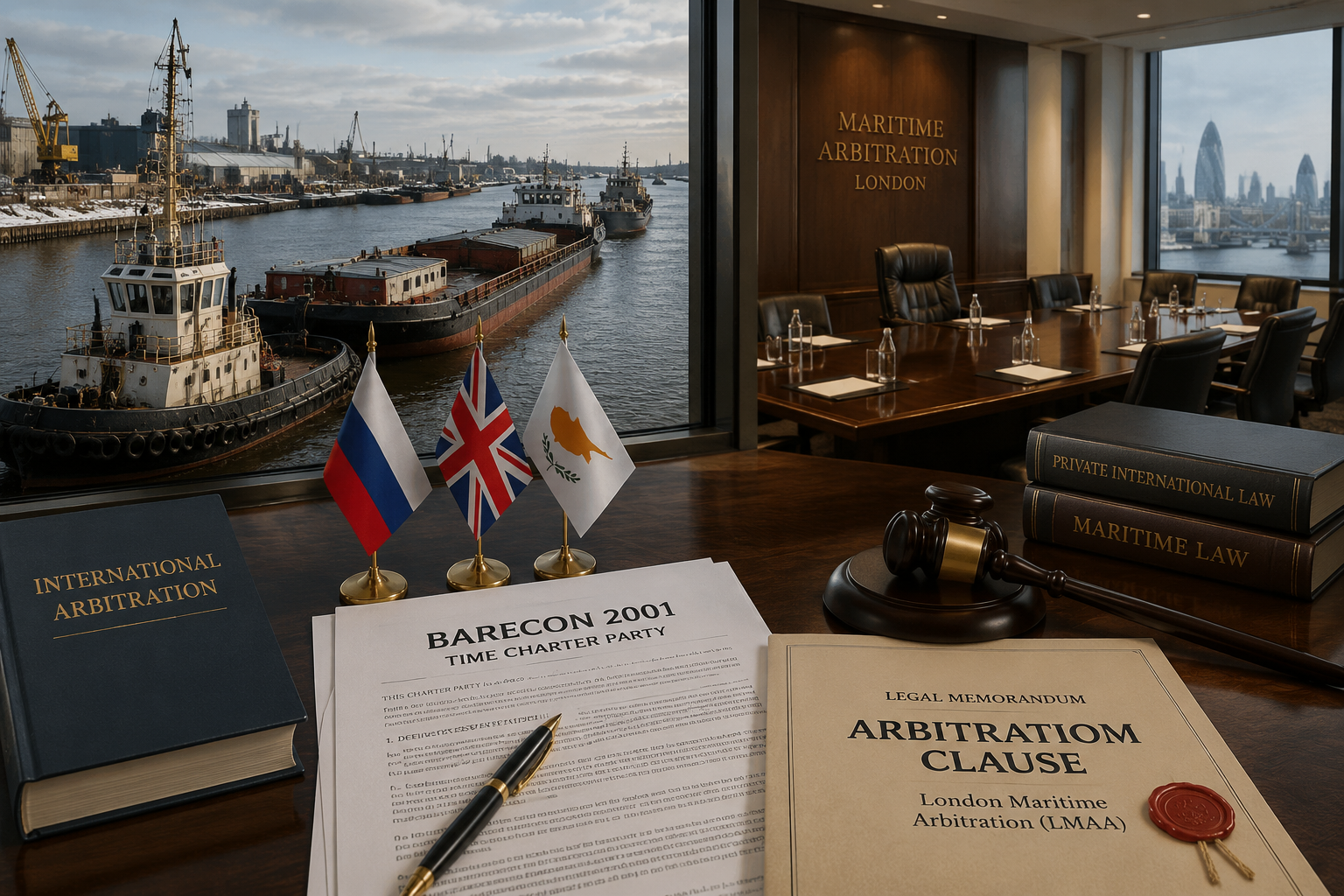
In a very recent decision, the Arbitrazh Court of the Nizhny Novgorod Region left without consideration a claim for RUB 409,582,668 brought by AAS Amur Assets Shipping Company Limited (Cyprus) against LLC “Nizhny Novgorod Logistics Company”. The court held that the dispute fell within a valid and enforceable London arbitration clause contained in 15 bareboat charter agreements dated 20 March 2018.
The ruling is particularly interesting because the claimant sought to resist the arbitration clause by invoking alleged sanctions-related impediments to foreign dispute resolution. The court rejected those objections and did not treat the case as one falling under the exceptional logic of the Russian “Lugovoy Law” (Articles 248.1–248.2 APC RF).
Facts and Procedural Background
The claim originally had been filed by LLC “D.N.K.”, which was later replaced in the proceedings by AAS Amur Assets Shipping Company Limited by way of procedural succession. The claim concerned alleged debt arising under 15 bareboat charter agreements relating to vessels including tugboats and barges. The defendant raised a timely procedural objection and requested that the Russian court leave the claim without consideration because the contracts referred disputes to London arbitration.
The court accepted that objection. It found that the contracts incorporated the dispute resolution wording of BARECON 2001, and specifically the variant that refers disputes to London arbitration under the rules of the London Maritime Arbitrators Association (LMAA).
Parties’ Arguments
Defendant’s position
The defendant argued that the dispute was covered by a valid arbitration agreement and that, pursuant to Article 148(1)(5) APC RF, the Russian commercial court had to leave the claim without consideration once the defendant objected in time.
Claimant’s position
The claimant and one of the third parties argued that the arbitration clause was either not properly concluded or not capable of being performed. They also relied on the broader sanctions context, arguing in substance that foreign proceedings had become burdensome or practically inaccessible.
Legal Framework Applied by the Court
The court relied primarily on:
- Article 148(1)(5) APC RF;
- Article 7(8) of Federal Law No. 382-FZ “On Arbitration (Arbitral Proceedings) in the Russian Federation”;
- Article 7(9) of the Law of the Russian Federation No. 5338-1 “On International Commercial Arbitration”;
- Plenum Resolution No. 53 of the Supreme Court of the Russian Federation (10 December 2019) on court functions of support and control in relation to arbitration.
The central principle applied by the court was the familiar pro-arbitration presumption: where there is doubt, the arbitration agreement should be interpreted in favour of validity and enforceability. The party challenging the clause bears the burden of showing that any possible interpretation would render the clause invalid or incapable of performance.
Why the Court Upheld the London Arbitration Clause
The court found that the wording of the dispute resolution clause was sufficiently clear. It also held that the references in the contracts to the BIMCO standard wording did not create any uncertainty that would defeat the agreement to arbitrate in London. In the court’s view, the parties had already selected the relevant option in the charter forms and had not designated any alternative arbitral institution or state court.
Just as importantly, the claimant failed to prove that the clause was invalid, expired, or incapable of performance. The court therefore left the claim without consideration and ordered the refund of RUB 200,000 in state duty.
Why the Lugovoy Law Was Not Relevant Here
This case should be read in contrast to the expanding body of Russian sanctions-related jurisdiction cases commonly associated with the “Lugovoy Law”, i.e. Articles 248.1 and 248.2 APC RF, on which we have commented already several times.
1. No sanctioned Russian party was shown to need statutory protection
The Lugovoy Law was introduced to protect Russian parties affected by foreign sanctions where those sanctions interfere with effective access to justice abroad. In this case, however, the claimant was a Cypriot entity, and the court expressly noted that the parties before it had not been shown to be subject to the relevant restrictive measures in a way that would block access to the agreed forum.
2. The claimant did not prove impossibility of access to justice
The court rejected the claimant’s sanctions-based objections as unsupported. Mere reference to a difficult geopolitical environment or general burdens connected with foreign proceedings was not enough. The court specifically stated that there was no proof that the existing restrictions prevented the claimant from bringing the dispute in the agreed forum.
3. This was a classic Article 148 APC RF case, not a 248.1 / 248.2 APC RF case
The court analysed the dispute through the orthodox lens of Article 148(1)(5) APC RF: if a valid arbitration agreement exists and the defendant objects in time, the claim is left without consideration unless the agreement is invalid, inoperative, or incapable of being performed. That is a different analytical route from the sanctions-based exceptions developed under Articles 248.1–248.2 APC RF.
4. Put in perspective: Lugovoy Law is exceptional, not automatic
This is the key point for practitioners. The decision confirms that the Lugovoy Law is not a general “sanctions override” of arbitration agreements. Its application remains exceptional and fact-specific. By contrast, KDB’s prior coverage shows situations where Russian courts have actually relied on Articles 248.1–248.2 APC RF to override foreign arbitration clauses or issue anti-arbitration injunctions — for example in Russian Court Disregards ICC Arbitration Clause under Art. 248.1 APC RF and Orders Refund of USD 81,200 Advance and Effects of ICC Award Nullified by Contradicting Russian Lugovoy Law Judgement.
So, the present case is useful precisely because it shows the limits of Lugovoy Law reasoning: where the party invoking sanctions cannot prove a concrete denial of access to justice, Russian courts may still follow a conventional pro-arbitration approach and enforce the clause as written.
Comment
For shipping, offshore and chartering disputes, this decision is reassuring. It demonstrates that Russian commercial courts do not automatically set aside LMAA or other foreign arbitration clauses merely because sanctions are mentioned in argument. Instead, the court required actual evidence of legal or practical impossibility and, absent such evidence, upheld party autonomy.
For readers following the broader sanctions/arbitration landscape, this decision should also be read together with KDB’s reporting on Sanctions-Related Arbitration Restrictions Challenged Before EU Courts, which addresses the parallel European dimension of sanctions and arbitral enforcement.


