
Will Kazakhstan side with the New York Convention or recognise a Lugovoy judgement?
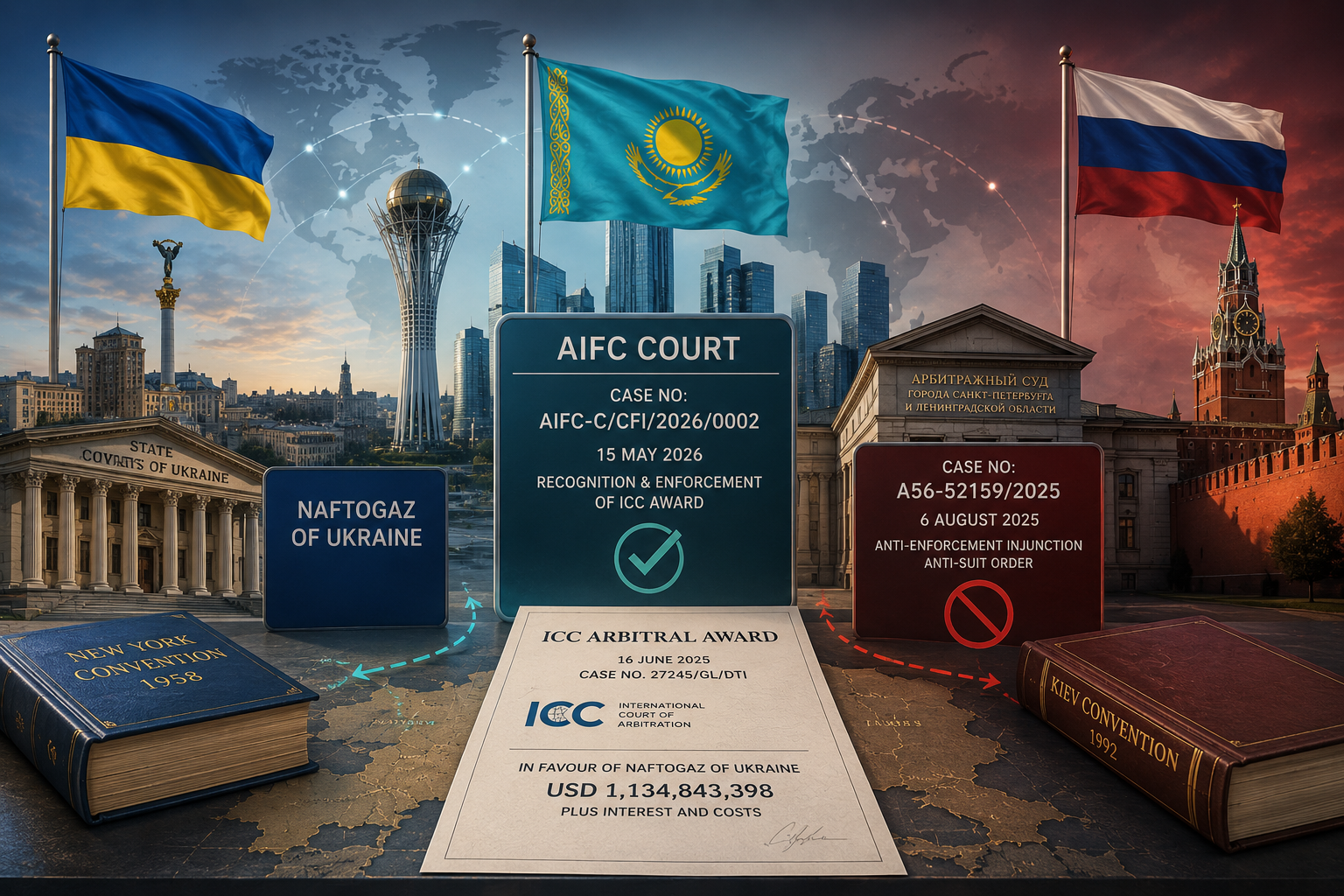
On 15 May 2026, the Court of First Instance of the Astana International Financial Centre (“AIFC Court”) issued a judgment recognising and enforcing a USD 1.37 billion ICC arbitral award obtained by Naftogaz against Gazprom.
The award itself had been rendered in Switzerland on 16 June 2025 in ICC Case No. 27245/GL/DTI.
The AIFC decision is remarkable not only because of the size and geopolitical context of the dispute, but also because it was rendered without notice to Gazprom and expressly leaves open the possibility of a set-aside application by the respondent.
At the same time, the proceedings intersect directly with a Russian state court decision rendered several months earlier, on 6 August 2025, by the Arbitrazh Court of Saint Petersburg and the Leningrad Region (case no. A56-52159/2025).
The Russian court prohibited Naftogaz from seeking recognition and enforcement of the ICC award outside Russia and from continuing foreign proceedings connected with the arbitration.
These two decisions raise important questions concerning:
- the recognition and enforcement of arbitral awards under the New York Convention;
- the recognition of state court judgments under the Kiev Convention;
- the interaction between arbitral enforcement and Russian anti-suit/anti-enforcement injunctions;
- and the extent to which the AIFC Court may exercise jurisdiction over foreign-seated awards.
The AIFC Court Decision
The AIFC Court recognised and enforced the ICC award in favour of Naftogaz and ordered Gazprom to pay more than USD 1.1 billion plus substantial accrued interest and costs.
Importantly, however, the decision was rendered ex parte. The court expressly noted that:
“The application for the recognition and enforcement order … was made by the Claimant without notice.”
The court further granted Gazprom liberty to apply within 14 days to have the order set aside, and suspended enforcement pending any such application.
This procedural posture matters significantly. The decision is not yet the product of adversarial proceedings and does not constitute a final determination on jurisdiction or enforcement defences.
The Jurisdictional Discussion
The most legally significant aspect of the AIFC judgment is the court’s extensive analysis of whether the AIFC Court possesses jurisdiction to recognise arbitral awards rendered outside Kazakhstan.
The award had been rendered in Switzerland, not in Kazakhstan or within the AIFC International Arbitration Centre (“IAC”).
Justice Andrew Spink KC acknowledged that Article 14(4) of the AIFC Constitutional Statute may, depending on translation, be interpreted narrowly as referring only to arbitral awards issued within Kazakhstan.
The judgment therefore undertakes an unusually detailed examination of competing translations of the constitutional text and openly recognises ambiguity in the jurisdictional framework.
Ultimately, the court relied instead on provisions of the AIFC Court Regulations and the AIFC Arbitration Regulations, especially Article 45(1), which provides that:
“An arbitral award, irrespective of the state or jurisdiction in which it was made, shall be recognised as binding in the AIFC …”
On that basis, the court concluded — provisionally — that it had jurisdiction to recognise and enforce the Swiss-seated ICC award.
The Russian Decision
Several months earlier, on 6 August 2025, the Arbitrazh Court of Saint Petersburg and the Leningrad Region issued a broad anti-enforcement injunction in favour of Gazprom.
The Russian court prohibited Naftogaz from:
- seeking recognition or enforcement of arbitral awards or foreign court decisions outside Russia;
- initiating or continuing foreign arbitration or court proceedings connected to the dispute;
- and pursuing anti-anti-suit relief abroad.
The Russian court relied on Articles 248.1 and 248.2 of the Russian Arbitrazh Procedural Code, which establish exclusive Russian jurisdiction where sanctions allegedly impair a Russian party’s access to justice abroad.
The court held that Western sanctions against Gazprom created sufficient obstacles to access to justice such that the arbitration agreement became effectively inoperative from the Russian perspective.
This line of reasoning has become a recurring feature of recent Russian anti-suit injunction jurisprudence.
Recognition Under the New York Convention
The central instrument governing recognition of the ICC award remains the 1958 New York Convention.
Kazakhstan is a Contracting State, as is Switzerland. Russia is likewise a party.
The AIFC Decision and the Convention
The AIFC Court’s analysis is broadly aligned with the pro-enforcement bias of the New York Convention. In particular, Article III obliges Contracting States to recognise foreign arbitral awards subject only to limited defences.
The AIFC Court relied on domestic AIFC legislation that effectively mirrors this principle by recognising awards “irrespective of the state or jurisdiction in which [they were] made.”
Notably, the court did not identify any apparent Convention defence under Article V.
However, because the order was rendered ex parte, Gazprom has not yet advanced any Article V objections. Potential future arguments could include:
- invalidity or inoperability of the arbitration agreement;
- procedural unfairness;
- public policy;
- or reliance on the Russian anti-suit injunctions and related Russian judgments.
Whether such arguments would succeed remains uncertain.
Effect of the Russian Anti-Enforcement Injunction
From a Convention perspective, the Russian judgment does not automatically bar enforcement abroad.
The New York Convention concerns recognition of arbitral awards, not recognition of foreign anti-suit injunctions. A foreign enforcing court is generally not obliged under the Convention to defer to a state court judgment restraining enforcement elsewhere.
Indeed, many jurisdictions have treated Russian anti-suit injunctions under Articles 248.1 and 248.2 with considerable scepticism, particularly where they interfere with international arbitration agreements.
That said, the Russian decision may still become relevant indirectly through:
- public policy arguments;
- parallel proceedings;
- allegations of abuse of process;
- or competing judgments affecting assets located in Convention states.
The Kiev Convention Dimension
The Russian judgment raises a separate issue: whether the Russian state court decision itself could be recognised in other CIS jurisdictions under the 1992 Kiev Convention on the Settlement of Disputes Related to Economic Activities.
The Kiev Convention provides a framework for mutual recognition and enforcement of commercial judgments among participating CIS states.
Potential Relevance in Kazakhstan
Kazakhstan and Russia are both parties to the Kiev Convention. In principle, this creates a pathway for recognition of Russian commercial court judgments in Kazakhstan.
However, several complexities arise.
First, the AIFC Court is not an ordinary Kazakh domestic court. It operates under a distinct legal framework based substantially on common law principles and possesses autonomous procedural rules.
Second, the Russian judgment is not a conventional monetary judgment. It is an anti-suit and anti-enforcement injunction directed at procedural conduct abroad.
Third, there is an inherent tension between:
- recognising the Russian injunction under the Kiev Convention; and
- enforcing the arbitral award pursuant to the New York Convention.
In many legal systems, the New York Convention enjoys a particularly strong international status and is interpreted narrowly in favour of enforcement. A court may therefore be reluctant to permit a foreign anti-suit injunction effectively to neutralise Convention obligations.
Temporal Sequence Matters
The chronology is important.
- The ICC award was rendered on 16 June 2025.
- The Russian anti-enforcement decision followed on 6 August 2025.
- The AIFC recognition order was issued later, on 15 May 2026.
This means the AIFC Court acted with the Russian injunction already in existence.
Nevertheless, the AIFC judgment contains no substantive analysis of the Russian decision or its possible recognition effects under CIS instruments. This omission may become central in any future challenge proceedings.
Outlook
The AIFC Court’s judgment represents another significant development in the growing conflict between international arbitral enforcement mechanisms and Russian anti-suit injunction practice.
At present, however, the AIFC decision remains provisional in an important sense. The order was rendered without participation by Gazprom, enforcement has been temporarily stayed, and the respondent retains the right to apply for the order to be set aside.
Given the unresolved jurisdictional questions identified by the AIFC Court itself, the interaction with the earlier Russian judgment, and the potential implications of both the New York Convention and the Kiev Convention, the forthcoming appellate or set-aside proceedings may prove considerably more consequential than the initial ex parte order.
For now, any definitive assessment of the enforceability landscape must remain tentative. The appeal against the AIFC decision — and any subsequent adversarial consideration of the jurisdictional and recognition issues — has to be awaited.


