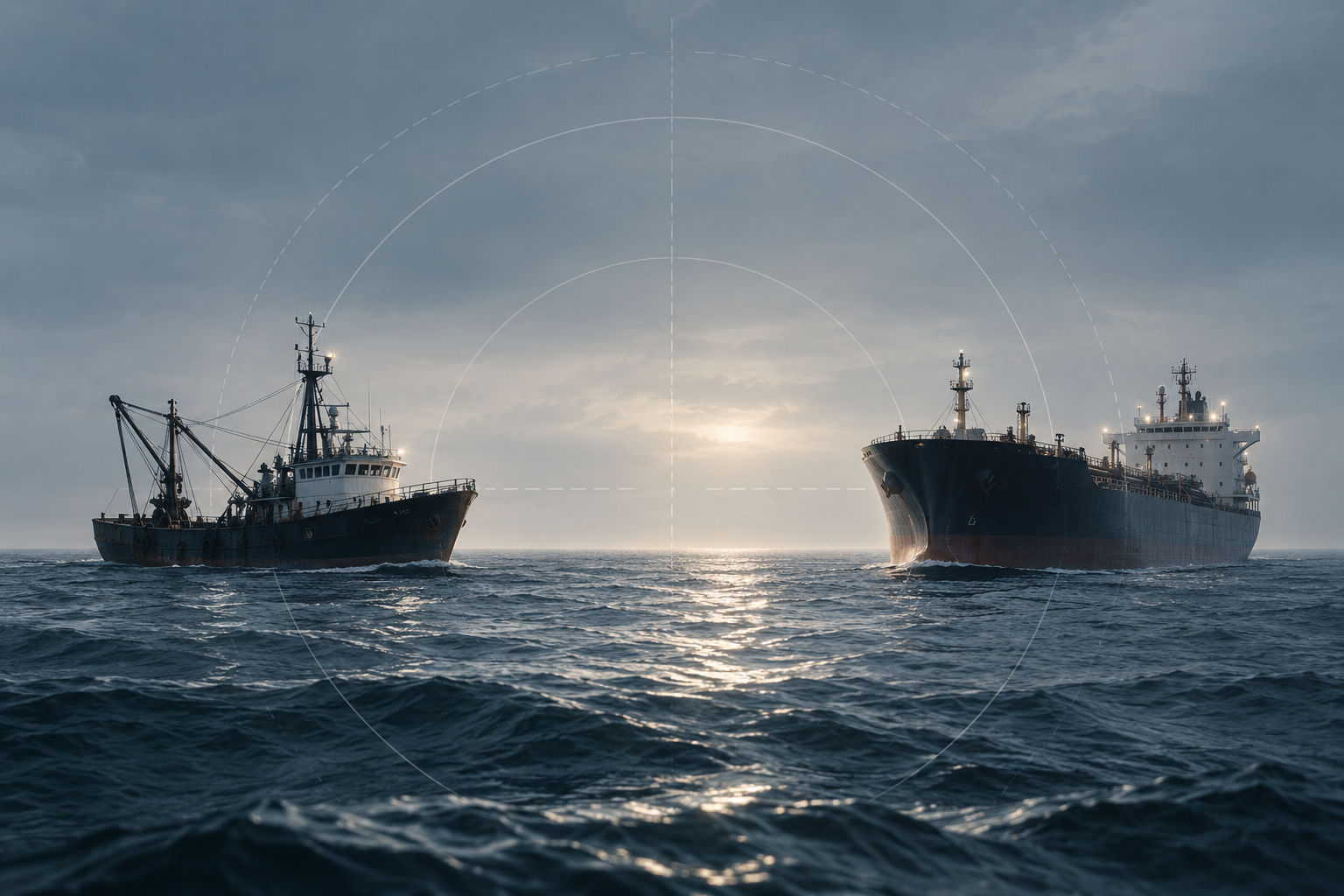
In its judgment of 17 June 2026, the Rotterdam District Court considered liability for a collision on the high seas between the fishing vessel MISS CARLA JEAN and the tanker STOLT MERCURY. The Court concluded that both vessels were at fault but that the MISS CARLA JEAN bore the predominant responsibility. Liability was apportioned 75% to the MISS CARLA JEAN and 25% to the STOLT MERCURY.

I. Introduction
The judgment provides useful guidance on the application of the 1972 International Regulations for Preventing Collisions at Sea (COLREGs), particularly the duties to maintain a proper lookout, use available means to determine the risk of collision, and take appropriate action in a head-on situation. It also addresses when a vessel qualifies as a vessel “engaged in fishing” for the purposes of the COLREGs and illustrates the potential significance of radar and AIS use when apportioning responsibility for a maritime collision.
The Court has not yet finally determined the parties’ respective damages. Both parties were ordered to produce further evidence regarding certain heads of loss.
II. Background of the Dispute
The collision occurred on 30 December 2022 at approximately 17:00 local time, around 400 nautical miles off the coast of Suriname. The MISS CARLA JEAN was owned by Caribbean Seafarms Limited, established in Trinidad and Tobago. The STOLT MERCURY was owned by Sea 181 Leasing Co. Limited, established in Hong Kong.
Both vessels sustained damage and two crew members aboard the MISS CARLA JEAN were injured. Importantly, neither vessel detected the other before the collision. There was no VHF contact between them. The MISS CARLA JEAN was not using AIS and was not visible on radar.
Following the collision, the MISS CARLA JEAN was assisted by her sister vessel, the MISS VIOLA, and returned to Chaguaramas on 5 January 2023.
Caribbean Seafarms subsequently obtained a provisional attachment order against the STOLT MERCURY in the Netherlands. The attachment was lifted after the tanker’s liability insurer, Gard, provided a guarantee.
Caribbean Seafarms commenced proceedings seeking a declaration that Stolt was fully liable for the collision and claiming approximately EUR 1.12 million in damages, together with legal and other costs. Stolt disputed full liability, contending that the MISS CARLA JEAN bore the predominant responsibility, and invoked set-off in respect of its own collision damage.
III. The Parties’ Positions
Caribbean Seafarms argued that the STOLT MERCURY was entirely responsible for the collision. According to Caribbean Seafarms, the MISS CARLA JEAN was engaged in fishing at the relevant time and displayed the lights prescribed by the COLREGs. It argued that the tanker approached the MISS CARLA JEAN from astern and was therefore required to keep out of the way under Rule 13 COLREGs.
Caribbean Seafarms further relied on Rule 18 COLREGs. It maintained that the MISS CARLA JEAN was a vessel engaged in fishing and that the STOLT MERCURY was consequently required to give way. It also argued that the tanker had failed to maintain a proper lookout and had taken no action to prevent the collision. In its view, the MISS CARLA JEAN could not have avoided the collision because the approaching tanker had not been detected and the fishing vessel’s manoeuvrability was restricted by its fishing activities.
Alternatively, Caribbean Seafarms argued that any contributory fault attributable to the MISS CARLA JEAN should be less than 25%.
Stolt accepted that the STOLT MERCURY bore some responsibility, but argued that the MISS CARLA JEAN was substantially more at fault. According to Stolt, the vessels were approaching one another on opposite courses rather than in an overtaking situation. Rule 14 COLREGs therefore required both vessels to alter course to starboard.
Stolt also disputed that the MISS CARLA JEAN qualified as a vessel “engaged in fishing”. Although fishing lines had been deployed, Stolt argued that those lines were no longer attached to the vessel and therefore did not restrict its manoeuvrability.
In addition, Stolt relied on the MISS CARLA JEAN’s failure to maintain a proper lookout and use its available navigational equipment. The STOLT MERCURY was continuously visible on radar, while the MISS CARLA JEAN was not using AIS. Stolt argued that the MISS CARLA JEAN therefore failed to use the means available to determine whether there was a risk of collision.
IV. The Court’s Analysis
The Court first considered jurisdiction and applicable law. Because the parties were established in Trinidad and Tobago and Hong Kong, the proceedings had an international character. The Rotterdam District Court found that it had jurisdiction pursuant to Article 767 of the Dutch Code of Civil Procedure, following the provisional attachment authorised by its preliminary relief judge.
As the collision occurred on the high seas, the Court applied the Brussels Collision Convention of 1910 and the COLREGs. Dutch law applied on a supplementary basis pursuant to Article 10:164 of the Dutch Civil Code.
Under Articles 3 and 4 of the Collision Convention, where a collision results from the fault of both vessels, liability is apportioned according to the relative weight of the respective faults. The same principle is reflected in Articles 8:544 and 8:545 of the Dutch Civil Code.
A central issue was whether the MISS CARLA JEAN was a vessel “engaged in fishing” within the meaning of the COLREGs. Rule 3 defines such a vessel by reference to the use of fishing equipment that restricts its manoeuvrability. The definition does not extend to fishing gear that does not impose such a restriction.
Although the MISS CARLA JEAN had deployed fishing lines, Stolt maintained that the lines were no longer attached to the vessel. The Court found that Caribbean Seafarms had not sufficiently established that the fishing activity actually restricted the vessel’s manoeuvrability at the time of the collision. The MISS CARLA JEAN therefore had not been shown to qualify as a vessel “engaged in fishing”, and the STOLT MERCURY was not required to give way under Rule 18 on that basis.
The Court also rejected Caribbean Seafarms’ characterisation of the incident as an overtaking collision. The physical damage to the MISS CARLA JEAN was concentrated around its starboard bow, rather than its stern. The documentary and photographic evidence did not sufficiently support Caribbean Seafarms’ contention that the tanker had approached from astern.
The Court instead accepted that the vessels were approaching each other on opposite courses. Rule 14 COLREGs therefore required both vessels to alter course to starboard so that they would pass port-to-port. Neither vessel did so. This constituted fault on both sides.
The STOLT MERCURY was also at fault under Rule 5 COLREGs for failing to maintain a proper visual lookout. Stolt argued that the MISS CARLA JEAN had been difficult to see because of defective or obstructed lighting. However, CCTV images from the STOLT MERCURY shortly before the collision showed that the MISS CARLA JEAN was visually discernible. The tanker master was also able to see a light resembling that of a fishing vessel when the STOLT MERCURY subsequently returned towards the collision site. The Court therefore found that the MISS CARLA JEAN could have been detected by a proper visual lookout.
The Court nevertheless identified more extensive navigational failures aboard the MISS CARLA JEAN. Although its master was in the wheelhouse, he did not see the large tanker approaching and was unexpectedly thrown from his chair by the impact. The Court considered this inconsistent with the contention that a proper visual lookout had been maintained. The MISS CARLA JEAN therefore also breached Rule 5.
In addition, the MISS CARLA JEAN breached Rule 7 COLREGs by failing to use all available means to determine whether there was a risk of collision. The STOLT MERCURY had been continuously visible on radar, but there was no evidence that the master of the MISS CARLA JEAN had used his radar to detect the tanker. Had he done so, the Court considered that the STOLT MERCURY could have been detected from a considerable distance, potentially allowing VHF contact and timely collision-avoidance action.
The Court attached particular weight to the MISS CARLA JEAN’s failure to use AIS. It rejected Caribbean Seafarms’ argument that the STOLT MERCURY should have anticipated fishing vessels operating without AIS in the area. The Court referred to Regulation 19.2.2.4 of the SOLAS Convention and held that the MISS CARLA JEAN was required to be equipped with AIS. According to the Court, shifting the consequences of failing to use AIS onto the other vessel would undermine the maritime safety regime established by SOLAS and the COLREGs.
Having weighed the respective faults and their causal significance, the Court apportioned responsibility 75% to the MISS CARLA JEAN and 25% to the STOLT MERCURY.
The Court also considered the parties’ damages claims. Caribbean Seafarms claimed approximately EUR 1.12 million. Certain heads of damage were already assessed, including EUR 250,000 in hull damage, EUR 5,123.63 for replacement ship parts, EUR 66,280.34 for lost fishing gear, EUR 6,310.50 for spoiled catch, EUR 20,130.32 relating to crew wages and repatriation costs, and EUR 84,996.32 for loss suffered by the MISS VIOLA in providing assistance.
Other claims require further evidence, particularly Caribbean Seafarms’ substantial claim for loss of income between December 2022 and February 2024 and various shore-based expenses. Stolt was likewise ordered to substantiate its own collision losses and establish its entitlement to rely on those amounts by way of set-off.
V. Conclusion and Practical Implications
The decision provides a clear example of how liability may be apportioned where both vessels have breached the COLREGs, but the nature and causal importance of their respective failures differ.
The fact that the MISS CARLA JEAN was a fishing vessel did not automatically give it preferential status under Rule 18. The relevant question was whether it was actually engaged in fishing operations that restricted its manoeuvrability at the material time. Caribbean Seafarms failed to establish that requirement.
At the same time, the Court did not accept Stolt’s attempt to place all responsibility on the fishing vessel. The MISS CARLA JEAN was sufficiently visible that a proper lookout aboard the STOLT MERCURY could have detected it, and the tanker was independently at fault for failing to maintain that lookout and failing to alter course to starboard.
The decisive difference was the combination of failures aboard the MISS CARLA JEAN. Its inadequate visual lookout, failure to use radar, failure to operate AIS and failure to manoeuvre to starboard led the Court to conclude that it bore the predominant responsibility for the collision.
The judgment therefore demonstrates that collision liability under the COLREGs requires an assessment not only of which navigation rule technically applied, but also of the relative seriousness and causal significance of each vessel’s navigational failures.
The judgment highlights the importance of maintaining an effective lookout using all means appropriate to the prevailing circumstances. The physical presence of a master or officer in the wheelhouse does not necessarily satisfy Rule 5 COLREGs. Where an approaching vessel that should have been visible goes completely unnoticed, a court may infer that the lookout was inadequate.
The decision also underlines the importance of actually using available navigational equipment. Radar and AIS are not merely supplementary considerations when assessing collision liability. Failure to use equipment capable of providing early warning may significantly affect the eventual allocation of responsibility, particularly where timely detection could have enabled evasive action or VHF communication.
For fishing vessels, the judgment illustrates the distinction between being a fishing vessel in the ordinary sense and being a vessel “engaged in fishing” within the specific COLREGs definition. The latter depends on whether the fishing gear being used restricts manoeuvrability. Operators seeking to rely on the preferential rules applicable to vessels engaged in fishing should therefore be able to demonstrate the actual operational restrictions existing at the relevant time.