
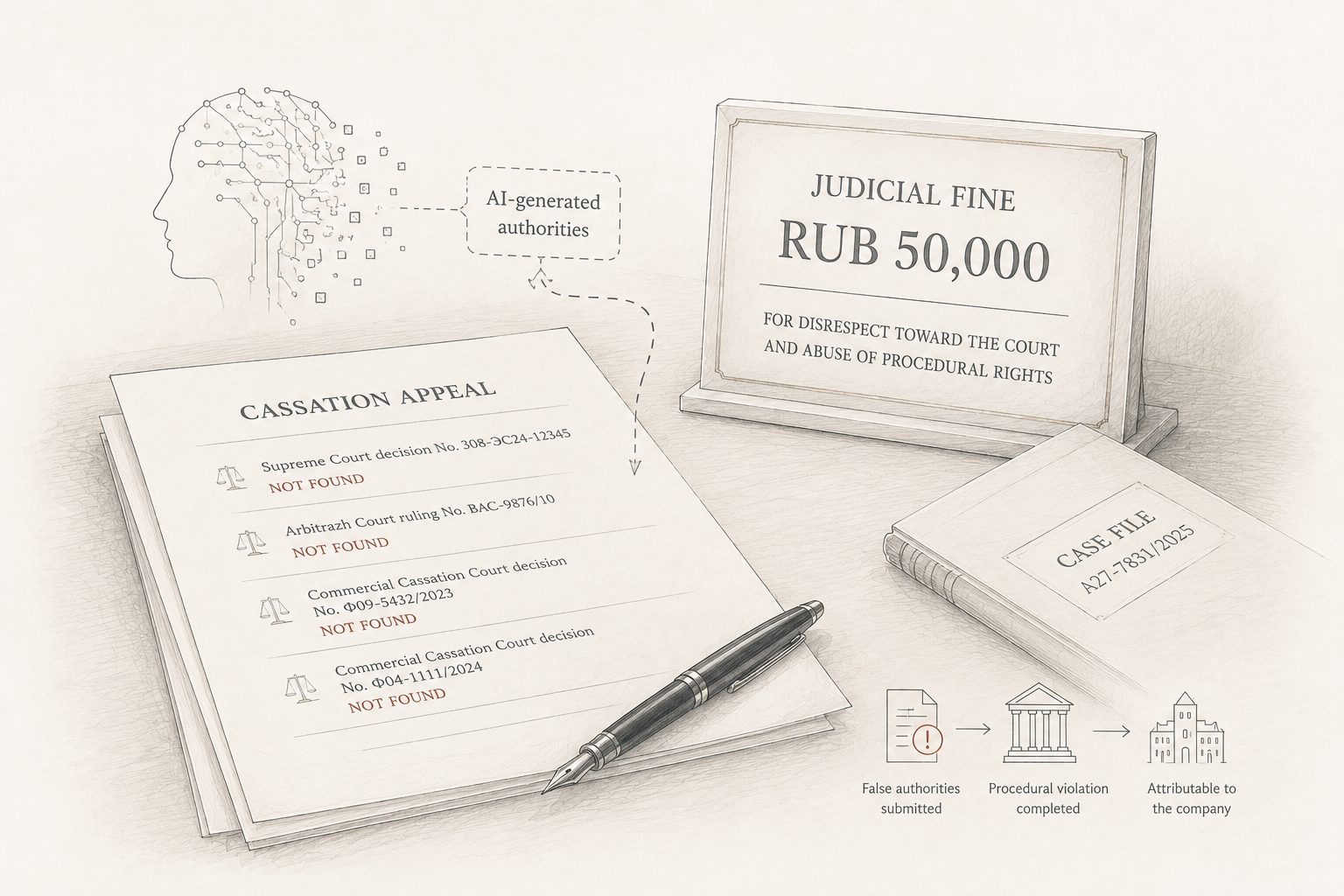
The Arbitrazh Court of the West Siberian District imposed a judicial fine of RUB 50,000 on a litigant after discovering that several court decisions cited in a cassation appeal did not in fact exist, treating the conduct as a serious “act of disrespect toward the court”, with the fine amount being nearly equal to the value of the underlying dispute itself.
What makes the decision particularly noteworthy is not merely the sanction itself, but the court’s extensive reasoning on procedural good faith, abuse of procedural rights, respect for the judiciary, and the use of artificial intelligence in legal drafting.
Factual Background
The dispute itself was relatively straightforward. The claimant, Tochka Opory LLC, sought recovery of unpaid accounting fees and contractual penalties from CSS LLC.
The court of first instance partially granted the claim, awarding approximately RUB 11,500, while the appellate court later reversed that judgment and awarded the claimant the full amount of approximately RUB 57,600.
CSS LLC subsequently filed a cassation appeal before the Arbitrazh Court of the West Siberian District.
During its review of the cassation complaint, however, the court identified serious irregularities in the legal authorities cited by the appellant, as several of the judicial decisions referenced in the appeal could not be located in any publicly available judicial database.
The court concluded that:
- some of the cited cases never existed at all;
- others existed but involved entirely unrelated subject matter;
- and several quoted passages cited in the cassation complaint did not appear anywhere in the underlying judicial acts.
The situation became even more problematic when the appellant’s new representative later admitted during the hearing that the cited case law did not in fact exist.
This prompted the court to initiate separate proceedings on the issue of imposing a judicial fine for contempt of court and abuse of procedural rights.
The Court’s Decision
The court ultimately imposed a judicial fine of RUB 50,000 on CSS LLC for showing severe disrespect toward the court. The fine was imposed pursuant to Article 119 APC RF. Under Article 119(1) APC RF, the maximum judicial fine that may be imposed on a legal entity is RUB 100,000. Although the court characterized the violation as particularly serious, it imposed a sanction amounting to half of the statutory maximum, expressly considering such amount proportionate to the nature and gravity of the misconduct.
Notably, the amount of the fine was still almost identical to the principal amount claimed in the underlying dispute, further underscoring the seriousness with which the court viewed the misconduct and the importance it attached to preserving the integrity of judicial proceedings.
The court found that the appellant had knowingly provided false information and fabricated legal authorities in an attempt to persuade the cassation court through references to non-existent Supreme Court and cassation precedents. The court emphasized that this conduct constituted not merely weak legal argumentation, but a direct deception of the court.
The court further characterized the conduct as:
- a gross manifestation of disrespect toward justice;
- a violation of procedural good faith obligations;
- and an attempt to manipulate judicial review through fabricated legal sources.
The court also rejected the argument that the party should escape liability simply because a new representative later withdrew the fabricated case law. In the court’s view, the procedural violation had already been committed once the false information was submitted.
Importantly, the fine was imposed on the company itself rather than on the individual representative who prepared the cassation complaint. The court emphasized that procedural actions taken by a representative are legally attributable to the party they represent.
The decision contains unusually strong language for a commercial procedural ruling. The court stated that a bona fide participant in judicial proceedings
“should not even allow the thought of distorting reality before the court.“
The AI Discussion
The court explicitly addressed the possible use of AI in drafting the cassation appeal but rejected it as any form of excuse. In particular, the court stated:
“Such conduct cannot have any justification whatsoever, including the preparation of the cassation appeal with the use of artificial intelligence technologies, since responsibility for the accuracy of the generated text rests with the party to the proceedings that used such technology.”
The decision therefore aligns Russian procedural practice with a growing international judicial trend addressing so-called “AI hallucinations” in legal drafting.