
I. Introduction
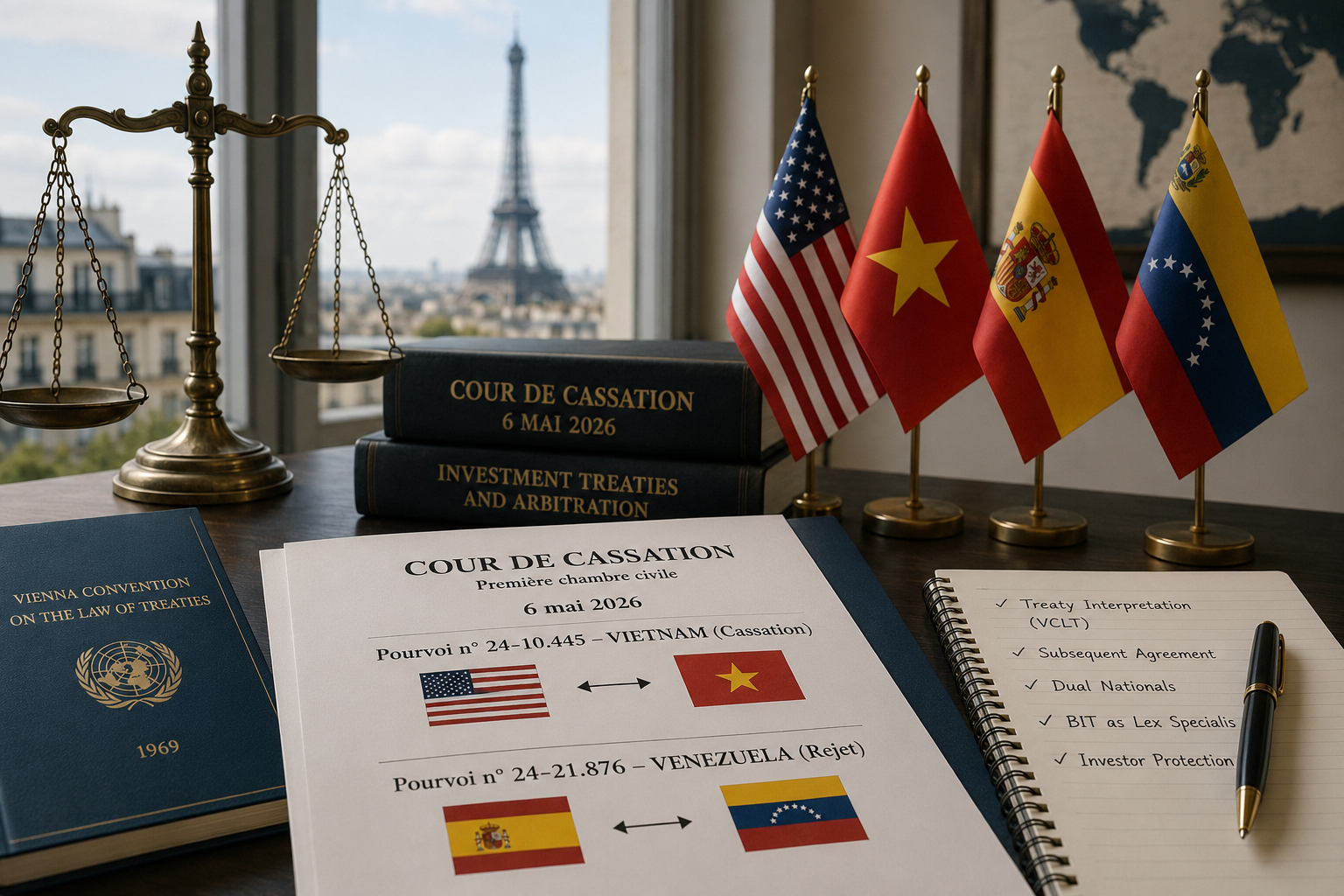
On 6 May 2026, the First Civil Chamber of the Cour de cassation delivered two judgments dealing with bilateral investment treaties (BITs) and investors with dual nationality:
- Vietnam case – Pourvoi n° 24‑10.445 (cassation)
- Venezuela case – Pourvoi n° 24‑21.876 (rejection)
Both arose from annulment actions against jurisdictional awards in investment arbitrations seated in Paris. Both involved dual nationals or potentially dual nationals invoking BIT protection against a State of which they were also nationals. And in both, the Court relied on customary international law as reflected in the Vienna Convention on the Law of Treaties to interpret the relevant treaties.
Yet, the outcomes diverged: the Court annulled the Paris Court of Appeal’s decision in the Vietnam case, but upheld it in the Venezuela case. This blog post analyses the two decisions together, emphasising their common doctrinal foundation and, in particular, their differences in approach and result.
II. Background and Procedural Posture
A. Vietnam / K. et al. – Pourvoi n° 24‑10.445 (Cassation)
1. Facts and arbitration
Ms K. was originally a Vietnamese national and acquired US nationality by naturalisation on 23 July 2014.
She founded two US companies (US Global Institute Inc. and Angels Company Inc.) in Texas, and together they claimed to have invested in Vietnam in a power plant project by taking participations in a Vietnamese company, Tan Tao Energy Corporation (TEC), created for that project and allegedly under her control.
The investors alleged expropriatory measures by Vietnam following the removal of the project from Vietnam’s national electricity development plan in March 2016.
On 4 September 2019, Ms K. and the US companies initiated arbitration under the 1976 UNCITRAL Rules, alleging breaches of an investment chapter in the 13 July 2000 US–Vietnam bilateral treaty on trade relations (the “Treaty”).
2. Annulment proceedings
On 8 December 2021, the arbitral tribunal issued a decision on jurisdiction. Vietnam sought annulment of that decision before the Paris Court of Appeal.
The Court of Appeal rejected Vietnam’s annulment application by an arrêt of 12 September 2023.
Vietnam filed a pourvoi en cassation. The Cour de cassation dismissed some grounds without detailed reasoning under Article 1014(2) of the French Code of Civil Procedure, as not capable of leading to cassation.
However, on one key branch of the first ground, the Court allowed the appeal, quashed the 2023 appellate decision in all its provisions, and remanded the case to a differently composed formation of the Paris Court of Appeal.
B. Venezuela / P. et al. – Pourvoi n° 24‑21.876 (Rejection)
1. Facts and arbitration
The claimants, a father and daughter (the “consorts P.”), acquired, in 2001 and 2006, shares in two Venezuelan companies, Transporte Dole and Alimentos Frisa, from family members.
They only recovered or acquired Spanish nationality in 2004 (father) and 2003 (daughter). They also held Venezuelan nationality.
In 2012, they initiated investment arbitration against Venezuela under the Spain–Venezuela BIT of 2 November 1995, relying on the dispute resolution provisions of that treaty.
2. Annulment proceedings
A jurisdictional award was rendered in Paris on 15 December 2014. Venezuela sought its annulment before the Paris Court of Appeal.
After a first cassation in 2021 and remand, the Paris Court of Appeal again rejected Venezuela’s annulment application in an arrêt of 27 June 2023.
Venezuela filed a new pourvoi en cassation. On 6 Ma 2026, the Cour de cassation rejected the appeal, confirming the appellate court’s decision and upholding the jurisdictional award.
III. Common Doctrinal Ground: Treaty Interpretation and Dual Nationals
Despite their different outcomes, the two decisions share important common themes.
A. BIT‑based consent to arbitration and the “offer to investors”
In both rulings, the Court reiterates that in investment arbitration:
State consent to arbitration stems from a standing offer in a treaty, addressed to a category of investors defined by that treaty, for disputes concerning investments defined in the same instrument.
This underscores that the question of jurisdiction turns on whether the claimants fall within the personal and material scope of the treaty as interpreted according to international law.
B. Customary international law and the Vienna Convention on the Law of Treaties
Both judgments expressly rely on customary rules of treaty interpretation and treat the Vienna Convention on the Law of Treaties (VCLT) as reflecting those rules:
In the Vietnam case, the Court emphasises that, in accordance with customary international law as reflected in Article 31 VCLT, interpretation must consider context and any subsequent agreements between the parties regarding interpretation or application of the treaty.
In the Venezuela case, the Court refers to Articles 31 and 32 VCLT, stressing that a treaty must be interpreted in good faith, according to the ordinary meaning of its terms in their context and in light of its object and purpose; supplementary means under Article 32 serve either to confirm that meaning or to resolve ambiguity or obscurity.
Thus, in both decisions, the Court positions itself squarely within the orthodox VCLT framework and treats it as mandatory law for French courts reviewing arbitral awards involving treaties.
C. Dual nationality as a “gap” or silence in the treaty
Both cases involve treaties that did not expressly deal with dual nationality:
In the Vietnam case, the Court notes that the Treaty contains no specific rule regarding investors who hold both US and Vietnamese nationality and that Article 1(9) merely requires “a natural person who is a national of a Party under its applicable law”.
In the Venezuela case, the BIT “contains no provision concerning dual nationals” according to the arguments raised by Venezuela.
This absence triggers the central question in both decisions: how far can courts go beyond the text—through general international law, diplomatic protection concepts, or subsequent practice—to determine whether dual nationals are covered or excluded?
IV. The Vietnam Decision: Weight of Subsequent Agreement (Cassation)
A. The central issue: effect of a diplomatic note as subsequent agreement
In the Vietnam case, the key point on which the Court intervenes concerns a diplomatic note of 4 April 2023, sent by the US Embassy in Hanoi to Vietnam. The note addressed the interpretation of the Treaty with regard to the protection of natural‑person investors who hold both US and Vietnamese nationality.
Vietnam argued that this note reflected a subsequent agreement between the treaty parties on the interpretation of their Treaty, specifically on dual‑national investors, and therefore had to be taken into account under customary international law as codified in Article 31 VCLT.
The Paris Court of Appeal, however, dismissed the note as:
Merely an opinion of the US Embassy’s economic section;
Not contemporaneous with the Treaty;
Of unclear authority, as the Treaty designated a joint “Committee” under Chapter VII as the competent body for interpretation issues.
B. The Cour de cassation’s approach
The Cour de cassation disagreed with the Court of Appeal’s handling of this diplomatic note. After restating that Article 1520(1) CCP allows annulment where the tribunal has wrongly upheld or declined jurisdiction, and recalling the customary rule that subsequent agreements must be taken into account for interpretation, the Court held:
The diplomatic note, submitted in the proceedings, emanated from the US Embassy in Hanoi and was addressed to Vietnam; its authenticity was not contested.
It established an agreement between the States parties on how the Treaty should be interpreted in cases where the investor is a dual US–Vietnamese national, a scenario on which the Treaty text was silent.
On that basis, the Court concluded that by declining to give effect to this note as a subsequent agreement reflecting the parties’ shared understanding—and thus disregarding a relevant interpretative element required by customary international law—the Court of Appeal violated Article 1520(1) CCP and the principles of customary international law on treaty interpretation.
The appellate decision was therefore quashed in its entirety, and the case was remitted to the Paris Court of Appeal differently composed.
C. Consequence: emphasis on subsequent practice / agreement
The Vietnam decision does not, at this stage, adopt a definitive substantive position on whether dual nationals are ultimately covered or excluded. Instead, it stresses methodology:
Where a diplomatic note reflects a later agreed interpretation between the treaty parties on a point the treaty does not address, French courts must take that agreement into account as part of the interpretative process under Article 31(3)(a) VCLT.
A court may not dismiss such a note simply because it post‑dates the treaty or comes from an embassy, when it clearly expresses the position of the State and is accepted by the other party.
In other words, the Vietnam decision is about the weight of subsequent agreement in treaty interpretation and the need for French courts to respect States’ later common understandings of their BITs.
V. The Venezuela Decision: BIT as Lex specialis and Limits of Diplomatic Protection (Rejection)
A. The central issue: can general rules on diplomatic protection restrict BIT coverage?
In the Venezuela case, the focus is not on a subsequent agreement, but on whether general public international law on diplomatic protection can limit BIT protection for dual nationals when the BIT is silent.
Venezuela advanced three main arguments in its second ground:
- The Court of Appeal allegedly misapplied Article 31 VCLT by treating context and other international rules as “supplementary” rather than integral elements of interpretation.
- Since the BIT did not address dual nationality, general public international law should apply and prevent dual nationals from invoking the BIT against their own State.
- Alternatively, the court should at least have examined the dominant and effective nationality of the investors.
B. The Cour de cassation’s approach
The Cour de cassation first restates the Vienna Convention method, as noted above. It then clearly characterises BITs as lex specialis:
Where BIT provisions are drafted in clear terms that delineate their scope, the BIT operates as a special law between the States parties.
In such circumstances, other rules of public international law—especially those concerning diplomatic protection—cannot be used to fill a treaty’s silence on the impact of dual nationality, unless it is shown that the States intended to incorporate those rules.
The Court then endorses the reasoning of the Paris Court of Appeal, which had found that:
- Article I(1) of the Spain–Venezuela BIT requires only that an investor have the nationality of one of the contracting parties under their national law; the ordinary meaning of this language does not exclude an investor who also holds the nationality of the host State.
- The general rules of interpretation from the VCLT, binding as customary law, do not allow courts to read distinctions into the text that the States themselves did not make.
- The BIT’s object and purpose—to foster favourable conditions for investments by each party’s investors in the territory of the other and to reinforce economic cooperation for mutual benefit—does not suggest an intention to exclude dual nationals.
- Consideration of travaux préparatoires and the nature of the arbitration mechanism confirmed that the treaty’s wording and overall scheme are unambiguous: the contracting States did not intend to treat dual nationals differently or exclude them from protection.
On that basis, the Cour de cassation held that:
Excluding dual nationals from the BIT’s scope would amount to adding a condition that the States did not stipulate.
There was no ambiguity or obscurity warranting recourse to diplomatic protection doctrines or an inquiry into the investors’ dominant and effective nationality.
The Court therefore found the second ground unfounded in all its branches and rejected the pourvoi.
C. Consequence: priority of clear treaty text over diplomatic protection concepts
The Venezuela decision thus clarifies:
If the BIT text is clear and inclusive, general rules of diplomatic protection (such as dominant nationality) do not apply to restrict jurisdiction.
Dual nationals are protected under such a BIT, provided they meet the nationality requirement of one contracting State, even if they are simultaneously nationals of the host State.
VI. Commonalities between the Two Decisions
Despite the different outcomes (cassation vs rejection), the two judgments display several coherent common elements:
- Reliance on VCLT‑style interpretation as customary law
Both decisions anchor treaty interpretation in Article 31 VCLT (and, in the Venezuela case, also Article 32), treating it as reflecting customary international law that binds French courts.
- Recognition that BITs define consent and investor categories
The Court in both cases reaffirms that State consent to arbitration comes from the treaty itself, addressed to a defined category of investors and investments.
- Rejection of “free‑floating” importation of general international law
Both decisions emphasise that general international law (especially diplomatic protection rules) cannot be used to override or supplement clear treaty terms absent evidence of State intent:
In Venezuela, by refusing to let diplomatic protection restrict dual nationals when the BIT is clear and silent.
In Vietnam, by insisting that when States later agree on a specific interpretation (through a diplomatic note), that agreement must be integrated into the treaty’s interpretative framework.
- Cautious, text‑centred approach
In both cases, the starting point is the ordinary meaning of the treaty text, considered in context and in light of object and purpose. Only then does the Court look to supplementary means or general international law, and only when justified by ambiguity or demonstrated State intent.
VII. Key Differences and Their Practical Significance
The more interesting aspect for practitioners lies in the differences.
A. Nature of the external interpretative element
- Vietnam case:
External element: a diplomatic note from the US Embassy to Vietnam, post‑dating the Treaty.
Role: the Cour de cassation sees it as a concrete manifestation of a subsequent agreement between the treaty parties on how to interpret the Treaty regarding dual nationals, which must be taken into account.
Error of the Court of Appeal: failed to give this note its proper interpretative status and weight, thereby misapplying customary treaty interpretation.
- Venezuela case:
External element: general rules of diplomatic protection and the idea of dominant and effective nationality.
Role: the Cour de cassation characterises the BIT as lex specialis, holding that when its text is clear, these general rules cannot be used to fill silence on dual nationality unless the States intended that result.
No error of the Court of Appeal: it correctly prioritised the text, object and purpose, and travaux, and declined to import diplomatic protection concepts where the BIT was unambiguous.
Practical takeaway:
French courts distinguish sharply between:
Specific State practice / subsequent agreement on a particular treaty, which must be integrated into interpretation; and
Abstract general international law rules, which cannot be used to narrow clear BIT protections in the absence of explicit treaty language or demonstrated intent.
B. Outcome for the investors and States
Vietnam case:
Result: annulment of the Court of Appeal’s decision and remand.
Implication: the effect of the subsequent diplomatic note must now be reconsidered. The final outcome for jurisdiction remains open, depending on how the remand court applies the note as a subsequent agreement.
- Venezuela case:
- Result: rejection of the pourvoi, confirmation of jurisdiction and dismissal of the annulment application.
- Implication: the investors, as dual Spanish–Venezuelan nationals, remain within the BIT’s scope, and the jurisdictional award stands.
Practical takeaway:
In the Vietnam-decision, the door is open to a stricter reading of BIT coverage for dual nationals if a subsequent State agreement so indicates. In the Venezuela-decision, the Court gives a strong signal that, absent such an agreement or explicit exclusion, dual nationals will not be excluded by default.
C. Direction of the Court’s review
In the Vietnam-decision, the Court’s intervention is corrective: it does not declare the tribunal incompetent, but finds that the Court of Appeal misapplied interpretative principles by disregarding a relevant subsequent agreement. The Court imposes a stricter standard of review on how national courts must handle State‑to‑State interpretative instruments.
In the Venezuela-decision, the review is deferential to the Court of Appeal’s substantive interpretation of the BIT. The Cour de cassation emphasises that the appellate court’s assessment of the treaty’s wording, object, purpose, and context falls within its sovereign discretion, which was exercised consistently with VCLT methodology.
Practical takeaway:
French review of arbitral awards will be:
Demanding where courts fail to respect clear interpretative elements such as subsequent agreements; but
Restrained where courts follow VCLT‑compliant methods and treat BIT text as lex specialis, even if States later argue for more restrictive readings based on general international law.
VIII. Practical Implications for International Arbitration and Investor Protection
A. For investors (including dual nationals)
- Treaty text remains central
Where a BIT defines “investor” by nationality of a contracting party and is silent on dual nationality, French courts are likely to treat dual nationals as covered, absent contrary indications in the text, context, or object and purpose.
2. Monitor subsequent practice and agreements
The Vietnam decision shows that later diplomatic exchanges between States can significantly affect treaty interpretation, potentially narrowing or confirming protections. Investors should monitor such practice and consider it in risk assessments.
3. Structuring and nationality planning
Dual nationals may continue to rely on BIT protection under France‑seated arbitration, but should pay attention to:
Any explicit exclusions of dual nationals in newer treaties; and
Evidence of subsequent State agreements that might re‑interpret older treaties.
B. For States
- Treaty drafting: clarity on dual nationals
If States intend to exclude dual nationals of the host State from protection, they should say so explicitly in the BIT. The Venezuela decision indicates courts will not infer such exclusions from general diplomatic protection rules.
2. Use of interpretative instruments
The Vietnam decision implicitly encourages States to use interpretative declarations or diplomatic notes when they wish to clarify the application of existing BITs. French courts will treat such instruments as relevant subsequent agreements if they manifest a common position and are presented as such in proceedings.
3. Consistency between policy and practice
States should be aware that their own diplomatic communications may later be used to interpret BITs. Consistency in official statements and practice becomes strategically important.
C. For arbitral tribunals and counsel
- VCLT methodology is not optional
Tribunals seated in Paris should expect that their treaty interpretations will be reviewed against the VCLT framework and that French courts will pay attention to text, context, object, purpose, and subsequent agreements.
2. Cautious use of diplomatic protection concepts
Tribunals should be careful about importing diplomatic protection doctrines (e.g. dominant nationality tests) unless the BIT is ambiguous and there is a clear indication that the States intended those concepts to apply.
3. Evidence of subsequent agreements and practice
Counsel should actively gather and present any relevant diplomatic notes, joint statements, or committee decisions that qualify as subsequent agreements or practice. As the Vietnam case shows, failure by domestic courts to give such instruments proper weight may be grounds for cassation.
IX. Conclusion
Taken together, the 6 May 2026 decisions form a coherent line on dual nationality and BIT interpretation under French law:
Vietnam (n° 24‑10.445): emphasises the need to consider subsequent agreements between States (e.g. diplomatic notes) as mandated by Article 31 VCLT, and corrects an appellate court for failing to do so.
Venezuela (n° 24‑21.876): confirms that when a BIT clearly defines its personal scope and is silent on dual nationality, it operates as lex specialis, and general diplomatic protection rules cannot be used to restrict coverage of dual nationals absent a demonstrated intention of the treaty parties.
For investors and States, the message is nuanced but clear: the treaty text and States’ subsequent agreed interpretations control, not abstract notions of diplomatic protection. Dual nationals can, in principle, rely on BITs where the text allows it, but their position may be altered ex post by later, clearly expressed agreements between the treaty parties.


