

1. Introduction
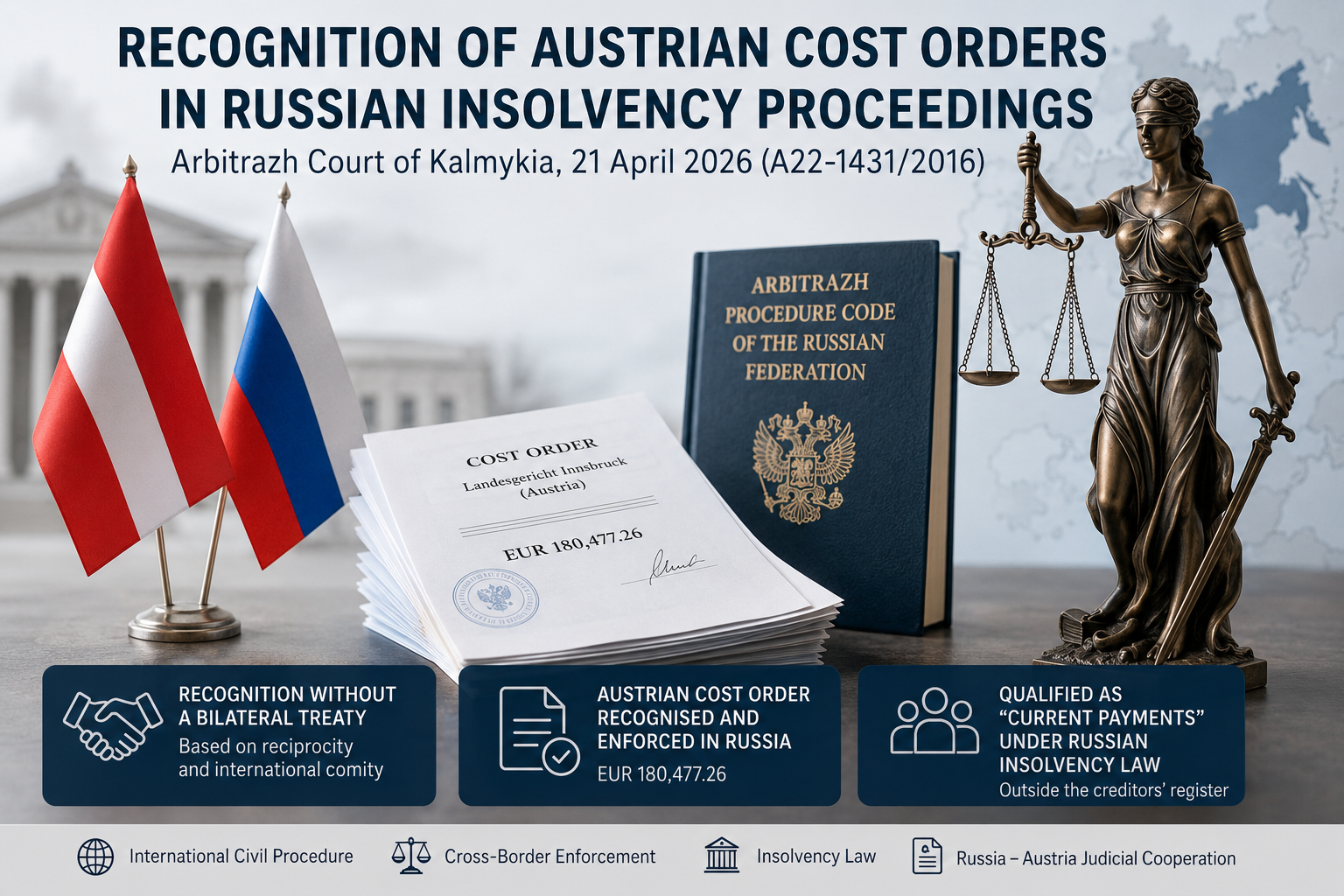
On 21 April 2026, the Arbitrazh Court of the Republic of Kalmykia ruled on the recognition and enforcement in Russia of a cost decision issued by the Regional Court of Innsbruck (Landesgericht Innsbruck, Austria) in favour of a Russian creditor, Elena Nikolaevna Baturina, against a Russian debtor, Viktor Nikolaevich Baturin, who was already subject to Russian personal insolvency proceedings.
The decision is noteworthy in two respects:
- It confirms that Austrian court decisions on litigation costs can be recognised and enforced in Russia even in the absence of a dedicated bilateral enforcement treaty, based on reciprocity and international comity (Interestingly, the court quoted art. 18 of the 1954 Hague Convention on Civil Procedure, but still based the recognition on general principles).
- It clarifies that such recognised cost claims may qualify as “current payments” (текущие платежи) under Russian insolvency law and thus fall outside the creditors’ register, with important consequences for distribution and procedural standing.
Against the background of ongoing debates on treaty performance in times of geopolitical tension, the ruling invites comparison with the German Federal Court of Justice (BGH) decision of 15 January 2026 (I ZB 53/25), which held that Russia’s war against Ukraine and the corresponding sanctions regime do not affect Germany’s obligations under the 1954 Hague Convention on Civil Procedure to exempt Russian claimants from security for costs.
2. Procedural Background in Russia
A. The Russian insolvency of Viktor Baturin
In August 2016, the Arbitrazh Court of Kalmykia declared the Russian citizen Viktor Baturin insolvent and opened the procedure of realisation of the debtor’s assets. Since 2016, several financial managers have been appointed and later released; as of October 2024, D. Pilchina had been confirmed as insolvency administrator.
The insolvency proceedings were not linear: a settlement with creditors was initially approved in 2019 and the case closed, but the settlement approval was later annulled on appeal and the bankruptcy proceedings were resumed and extended.
B. The Austrian litigation between Baturin and Baturina
On 7 August 2017, while the Russian insolvency case was already pending, Baturin sued Baturina before the Regional Court of Innsbruck. He sought rectification of allegedly unlawful statements, cessation of certain actions and reimbursement of legal costs.
On 29 April 2025, the Innsbruck court dismissed Baturin’s claims in full; that judgment became final on 31 May 2025. In a separate cost decision dated 10 December 2025, which became final on 10 January 2026, the court ordered Baturin to reimburse Baturina’s litigation expenses in the amount of EUR 180,477.26 within 14 days. Baturin did not pay these costs.
Baturina then turned to the Arbitrazh Court of Kalmykia, requesting:
- recognition and enforcement in Russia of the Austrian cost decision (EUR 180,477.26);
- reimbursement of Russian court fees of RUB 107,997.90; and
- inclusion of the cost claim (converted into RUB 13,499,301.99 at the exchange rate as of the opening of the asset realisation procedure) in the creditors’ register in Baturin’s insolvency.
3. Legal Basis for Recognition and Enforcement
A. Russian framework for foreign judgments
The court started by situating the case within the general framework of Russian law on insolvency and on recognition of foreign judicial decisions. Bankruptcy cases are governed by the Federal Law on Insolvency (Bankruptcy) and the Arbitrazh Procedure Code (APC), including the special rules of Chapter 31 APC on recognition and enforcement of foreign judgments.
Under Article 241 APC, Russian arbitrazh courts recognise and enforce foreign court decisions dealing with disputes arising from business or other economic activities if such recognition and enforcement are provided for by an international treaty of the Russian Federation and federal law.
Article 242 APC requires the application to be filed with the court at the debtor’s place of residence or, if unknown, at the place where the debtor’s property is located. In line with an information letter of the former Supreme Arbitrazh Court, the Kalmykia court also confirmed that where the debtor is subject to insolvency proceedings, the application for recognition of a foreign judgment must be dealt with within the insolvency case to ensure equal treatment of creditors.
B. International instruments and the Russia–Austria relationship
The court noted that there is no specific bilateral treaty between Russia and Austria on the mutual recognition and enforcement of state court judgments in civil matters. However, several multilateral and bilateral instruments govern civil procedure and judicial cooperation between the two states, including:
- the 1954 Hague Convention on Civil Procedure;
- the 1970 Agreement between the USSR and Austria on Matters of Civil Procedure, which was concluded in furtherance of the 1954 Hague Convention.
Relying on Article 9 of the 1970 Agreement and Article 18 of the 1954 Hague Convention, the court held that enforcement documents concerning litigation costs can be transmitted to the competent authorities of the other state and accepted by Russian arbitrazh courts using the mechanism of judicial assistance under Article 256 APC.
Furthermore, the court referred to Russian case law in which reciprocity vis‑à‑vis Austrian judgments had already been recognised. It cited, in particular, case A40‑45916/2018, where, after the Supreme Court of the Russian Federation had overturned earlier refusals, Russian courts recognised and enforced an Austrian judgment, including its provisions on costs.
In the Kalmykia court’s view, the absence of a dedicated enforcement treaty does not in itself justify refusing recognition. Instead, general principles of international law — reciprocity and international comity — may provide a sufficient basis for recognising foreign judgments, including Austrian cost decisions.
4. Examination of Grounds for Refusal
The court then turned to Article 244(1) APC, which lists exhaustive grounds for refusing recognition and enforcement. These include:
- lack of finality under the law of the state of origin;
- failure to properly notify the defendant or lack of opportunity to present a defence;
- exclusive jurisdiction of Russian courts;
- conflicting Russian judgments between the same parties, on the same subject and grounds;
- pending proceedings in Russia commenced earlier;
- expiry of the limitation period for enforcement;
- a conflict with the public policy (ordre public) of the Russian Federation.
Applying these criteria, the court found that:
- the Austrian cost decision of 10 December 2025 had become final on 10 January 2026;
- there was no evidence of improper notification or other procedural defects;
- there was no earlier or parallel Russian decision on the same dispute;
- no limitation issue had arisen;
- and enforcement did not conflict with Russian public policy.
Accordingly, none of the statutory grounds for refusal were met, and the Innsbruck cost decision was eligible for recognition and enforcement in Russia.
5. Decision on Recognition, Enforcement and Court Fees
On this basis, the Arbitrazh Court of Kalmykia granted Baturina’s application in part:
- It recognised and declared enforceable on Russian territory the cost decision of the Regional Court of Innsbruck of 10 December 2025 (final as of 10 January 2026) ordering Baturin to pay EUR 180,477.26 in litigation costs to Baturina.
- It ordered Baturin to reimburse Baturina the Russian state court fee of RUB 107,997.90.
To that extent, Baturina’s application was successful.
6. Treatment of the Recognised Claim in the Insolvency – “Current Payments”
The more intricate part of the decision concerns the status of the recognised cost claim in the ongoing insolvency proceedings.
A. Concept of “current payments” in Russian bankruptcy law
Under Article 5(1) of the Russian Insolvency Law, “current payments” are monetary obligations and mandatory payments that arise after the date on which the insolvency petition is accepted by the court. Article 5(2) stipulates that such current-payment claims are not included in the creditors’ register, and that creditors with current claims are not considered participants in the bankruptcy case for procedural purposes.
The Plenum of the former Supreme Arbitrazh Court clarified in its Resolution No. 63 of 23 July 2009 that the obligation to reimburse litigation costs (including counsel fees and court fees) arises, for the purposes of insolvency classification, when the judicial act ordering those costs becomes final.
In Baturin’s case, the insolvency petition was accepted on 6 June 2016.
B. Application to the Austrian cost claim
The court held that Baturin’s obligation to reimburse Baturina’s costs arose only upon the Austrian cost decision becoming final, i.e. on 10 January 2026 – well after the insolvency petition had been accepted in June 2016. As a result, the cost claim qualified as a “current payment” under Article 5 Insolvency Law.
This classification has central consequences:
- the claim cannot be entered into the register of creditors in the Baturin insolvency;
- the creditor does not acquire the status of a participating creditor in the insolvency proceedings;
- instead, the claim is to be satisfied as a current obligation in accordance with the separate ranking rules for current payments.
In line with Plenum Resolution No. 29 of 15 December 2004, the court therefore terminated the proceedings on Baturina’s request to have the claim entered into the register, pursuant to Article 150(1)(1) APC, because the claim was non‑registrable as a current payment.
The operative part of the decision explicitly states that the proceedings on Baturina’s application to include the amount of EUR 180,477.26 (RUB 13,499,301.99) in the creditors’ register are discontinued; no register entry is made.
7. The BGH’s Approach to Treaty Obligations in Times of War and Sanctions
The Kalmykia decision can be viewed alongside the German Federal Court of Justice’s ruling of 15 January 2026 (I ZB 53/25) and a similar decision by the Austrian OGH (OGH 3 Ob 6/24i judgement dated 31. January 2024 – BeckRS 2024, 2864.), which addressed the question whether Russia’s war against Ukraine and the corresponding EU sanctions affect Germany’s obligations under the 1954 Hague Convention on Civil Procedure.
In that case, a Russian company sought to enforce an arbitral award in Germany. The German respondent requested security for costs under § 110 German Code of Civil Procedure (ZPO), arguing that, due to war and sanctions, the treaty obligations flowing from the Hague Convention had effectively lapsed. They invoked Articles 62 and 63 of the Vienna Convention on the Law of Treaties and referred to Article 11 of EU Regulation No. 833/2014 (the “No‑Claims Clause”).
The BGH rejected these arguments and held that:
- Article 17 of the 1954 Hague Convention, which prohibits Germany from requiring security for costs from nationals of other contracting states (including Russia), remained binding;
- geopolitical developments and the cessation of diplomatic relations do not terminate or suspend the treaty unless Germany formally withdraws or takes appropriate steps under international law;
- the EU sanctions regime, and in particular the No‑Claims Clause, did not affect the claimant’s procedural right to litigate in Germany without posting security for costs.
The BGH also stressed that the theoretical possibility of enforcing a cost order in Russia sufficed to exempt the Russian claimant from security, regardless of practical enforcement difficulties.
See here a more detailed analysis of the BGH case: https://kdb.legal/en/no-cost-security-required-from-russian-claimant-despite-war-and-sanctions/
8. Comparative Perspective and Practical Takeaways
Both decisions – the Kalmykia ruling and the BGH’s I ZB 53/25 – point in a similar direction: courts remain reluctant to dilute or sidestep treaty‑based or established international procedural regimes solely due to geopolitical tensions and sanctions.
A. Continuity of treaty‑based procedural cooperation
The Arbitrazh Court of Kalmykia emphasises the continuing relevance of the 1954 Hague Convention and the 1970 USSR–Austria Agreement for the transmission and enforcement of foreign decisions on civil costs, and for an unknown reason did not use art. 18 of this Convention as basis for the recognition and enforcement of the cost order.
The BGH, for its part, underscores that Germany’s obligations under the 1954 Hague Convention towards Russian nationals remain in force and that war and sanctions do not automatically suspend such obligations without formal steps under international law.
B. Cost claims and insolvency classification
The Kalmykia decision also illustrates a specific insolvency‑law issue that arises across jurisdictions: how to classify foreign cost claims that crystallise after the opening of insolvency proceedings.
By treating the Austrian cost order as a “current payment” due to its finality date post‑dating the acceptance of the insolvency petition, the court:
- protects the equal treatment of pre‑insolvency creditors by preventing late‑arising cost claims from competing in the creditors’ register;
- at the same time, ensures that the foreign judgment is fully recognised and enforceable, but subject to the special distribution regime for current claims.
This dual approach – full recognition on the merits, paired with a careful internal allocation under insolvency law – is characteristic of many systems and underlines the importance of timing in cross‑border litigation when a party is already insolvent or close to insolvency.
9. Conclusion
The Arbitrazh Court of Kalmykia’s decision of 21 April 2026 shows that Russian courts remain open to recognising and enforcing Austrian cost order, relying on the 1954 Hague Convention, the 1970 USSR–Austria Agreement, and the principles of reciprocity and international comity. At the same time, the court strictly applies Russian insolvency rules on “current payments”, thereby excluding post‑petition cost claims from the creditors’ register while still granting them enforceability as current obligations.
In parallel, the BGH’s ruling in I ZB 53/25 and OGH in 3 Ob 6/24i confirm that, despite war and sanctions, Germany and Austria continue to honour their obligations under the 1954 Hague Convention, shielding Russian claimants from security for costs and maintaining access to German and Austria courts.