
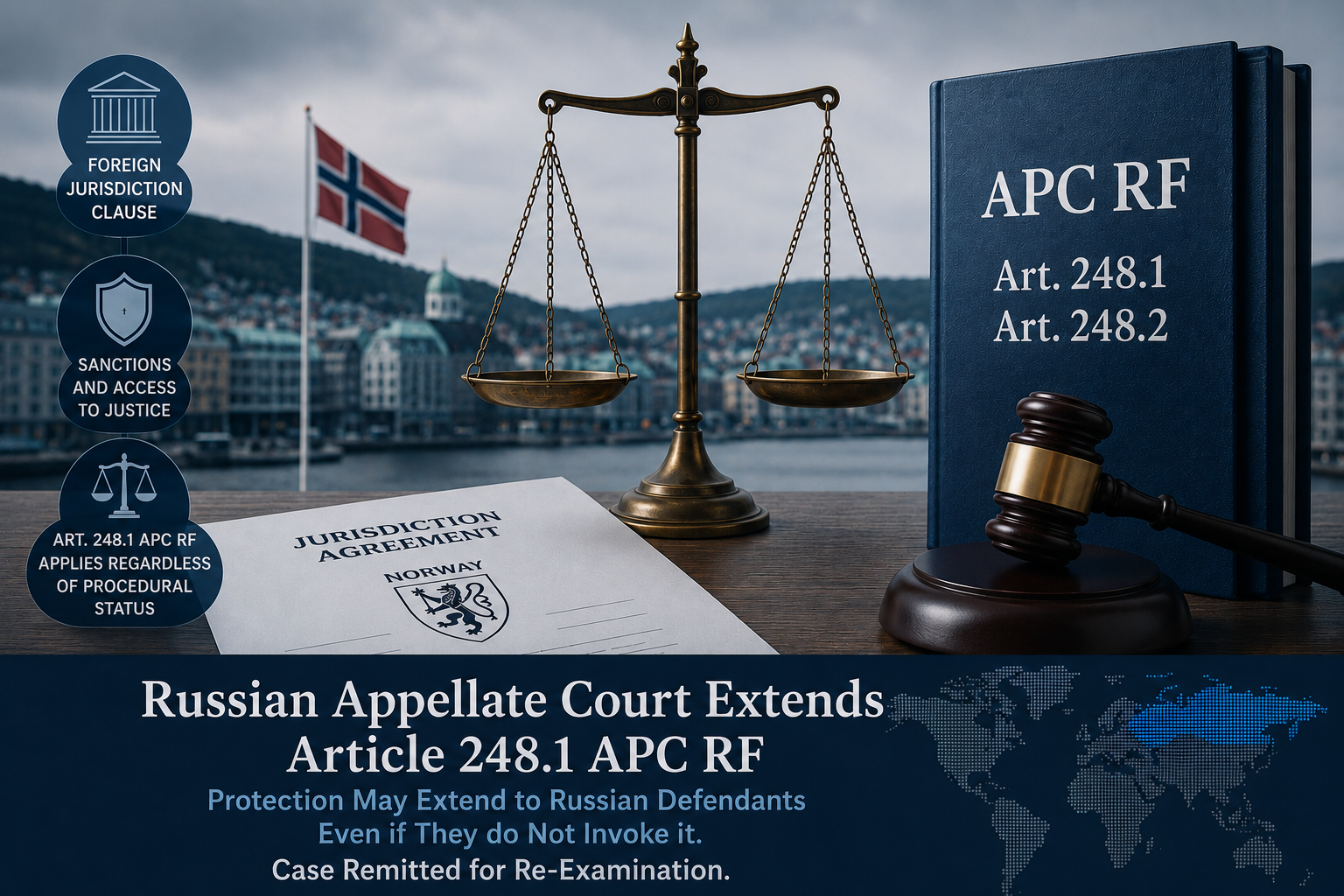
On 3 July 2026 the Eleventh Arbitrazh Court of Appeal (case no. A55-10205/2026) has issued a noteworthy decision on the application of Articles 248.1 and 248.2 of the Russian Arbitrazh Procedure Code (APC RF) – known as “Lugovoy Law“. In its judgment, the court set aside an order of the Arbitrazh Court of the Samara Region dated 7 May 2026 that had left a claim without consideration on the basis of a Norwegian jurisdiction clause and remitted the case for re-examination to the court of first instance.
The decision is noteworthy for two reasons. First, the appellate court confirmed that the protection afforded by Article 248.1 APC RF is not limited to situations where a Russian party appears as claimant. Secondly, and perhaps more interestingly, neither party relied on Articles 248.1 or 248.2 APC RF during the proceedings. Nevertheless, both courts examined the relevance of those provisions when assessing the effectiveness of the parties’ agreement conferring jurisdiction on the Norwegian courts.
Background
Seadar Ship Management S.A., a company incorporated in the Marshall Islands, brought proceedings before the Arbitrazh Court of the Samara Region against AO “United Insurance Company” seeking payment under an insurance policy.
The insurer objected to the jurisdiction of the Russian courts and requested that the claim be left without consideration, arguing that the insurance contract contained an exclusive jurisdiction clause in favour of the competent courts of Norway.
The claimant contested that objection. It argued that the Russian courts had jurisdiction under Articles 247 and 249 APC RF and maintained that the jurisdiction agreement had not been validly concluded because different contractual documents referred to different foreign courts.
Notably, the claimant did not invoke Articles 248.1 or 248.2 APC RF as the basis for Russian jurisdiction.
Equally, the Russian defendant did not seek to rely on Articles 248.1 or 248.2 APC RF. To the contrary, it consistently argued that the contractual jurisdiction clause should be respected and that the proceedings in Russia should be terminated.
The first-instance decision
Although neither party relied on the special sanctions jurisdiction introduced by Federal Law No. 171-FZ, the Arbitrazh Court of the Samara Region devoted a substantial part of its reasoning to Articles 248.1 and 248.2 APC RF.
The court reviewed the legislative purpose of the provisions, the Supreme Court’s guidance concerning sanctions-related jurisdiction, and the circumstances in which a foreign jurisdiction agreement may cease to be enforceable because access to justice abroad has been impaired.
The court ultimately concluded that the requirements for disregarding the Norwegian jurisdiction clause had not been established and therefore left the claim without consideration pursuant to Article 148 APC RF.
Importantly, the discussion of Articles 248.1 and 248.2 was not prompted by submissions of either party. Instead, the court considered their possible relevance as part of its assessment of the enforceability of the foreign jurisdiction agreement.
The appellate court
The Eleventh Arbitrazh Court of Appeal disagreed with the first-instance court’s approach and set aside the order.
Referring to recent Supreme Court authority, including Decision No. 305-ЭС24-13398 of 28 November 2024 and the Supreme Court’s 2026 Review concerning the application of legislation on special economic measures, the appellate court emphasised that the purpose of Article 248.1 APC RF is to ensure effective judicial protection where sanctions or related restrictions create substantial obstacles to litigating before the contractually agreed foreign court.
The court stressed that these obstacles are not limited to situations in which proceedings abroad are legally impossible. Practical and financial impediments may also be relevant when assessing whether a foreign jurisdiction agreement remains enforceable.
The appellate court further rejected an interpretation under which Article 248.1 APC RF could only operate where the Russian party appears as claimant. According to the court, the procedural status of the Russian party is not decisive. The protection afforded by Article 248.1 may also be relevant where the Russian party is defending proceedings initiated by a foreign claimant.
At the same time, the appellate court did not finally determine the jurisdictional issue. Instead, it concluded that the first-instance court had failed to assess the relevant circumstances in accordance with the Supreme Court’s recent case law. Accordingly, it set aside the order leaving the claim without consideration and remitted the case to the Arbitrazh Court of the Samara Region for renewed examination.
No reliance on Articles 248.1 or 248.2 by the parties
One of the most interesting procedural aspects of the case is that Articles 248.1 and 248.2 APC RF were not relied upon by either litigant.
The foreign claimant based Russian jurisdiction on the general jurisdictional provisions contained in Articles 247 and 249 APC RF.
The Russian defendant, meanwhile, did not invoke the special sanctions jurisdiction either. On the contrary, it sought enforcement of the contractual jurisdiction clause designating the Norwegian courts.
Nevertheless, both courts considered whether the sanctions jurisdiction established by Federal Law No. 171-FZ affected the enforceability of the parties’ jurisdiction agreement. The judgments therefore illustrate that Russian courts may examine the relevance of Articles 248.1 and 248.2 when determining jurisdiction, even where those provisions have not been expressly invoked by the parties.
Comment
The appellate judgment represents another step in the evolving jurisprudence on Articles 248.1 and 248.2 APC RF.
Rather than expanding the personal scope of the provisions, the court clarified their procedural operation. In particular, it rejected an interpretation under which Article 248.1 APC RF would be confined to proceedings brought by Russian claimants. According to the appellate court, the availability of the statutory protection does not depend on whether the Russian party appears as claimant or defendant.
Equally significant is what the decision does not say. The court did not find that AO “United Insurance Company” was itself a sanctioned entity, nor did it base its reasoning on the defendant’s inclusion in any sanctions list. Instead, the analysis focused on whether sanctions-related restrictions and the resulting practical obstacles could affect the enforceability of the agreed Norwegian forum and the parties’ effective access to justice.
By remitting the case, the appellate court left the ultimate jurisdictional question open. The judgment nevertheless signals a willingness to scrutinise foreign jurisdiction clauses in light of the evolving Supreme Court jurisprudence on Article 248.1 APC RF, even where neither party has sought to invoke the special sanctions jurisdiction established by that provision.


