
Introduction
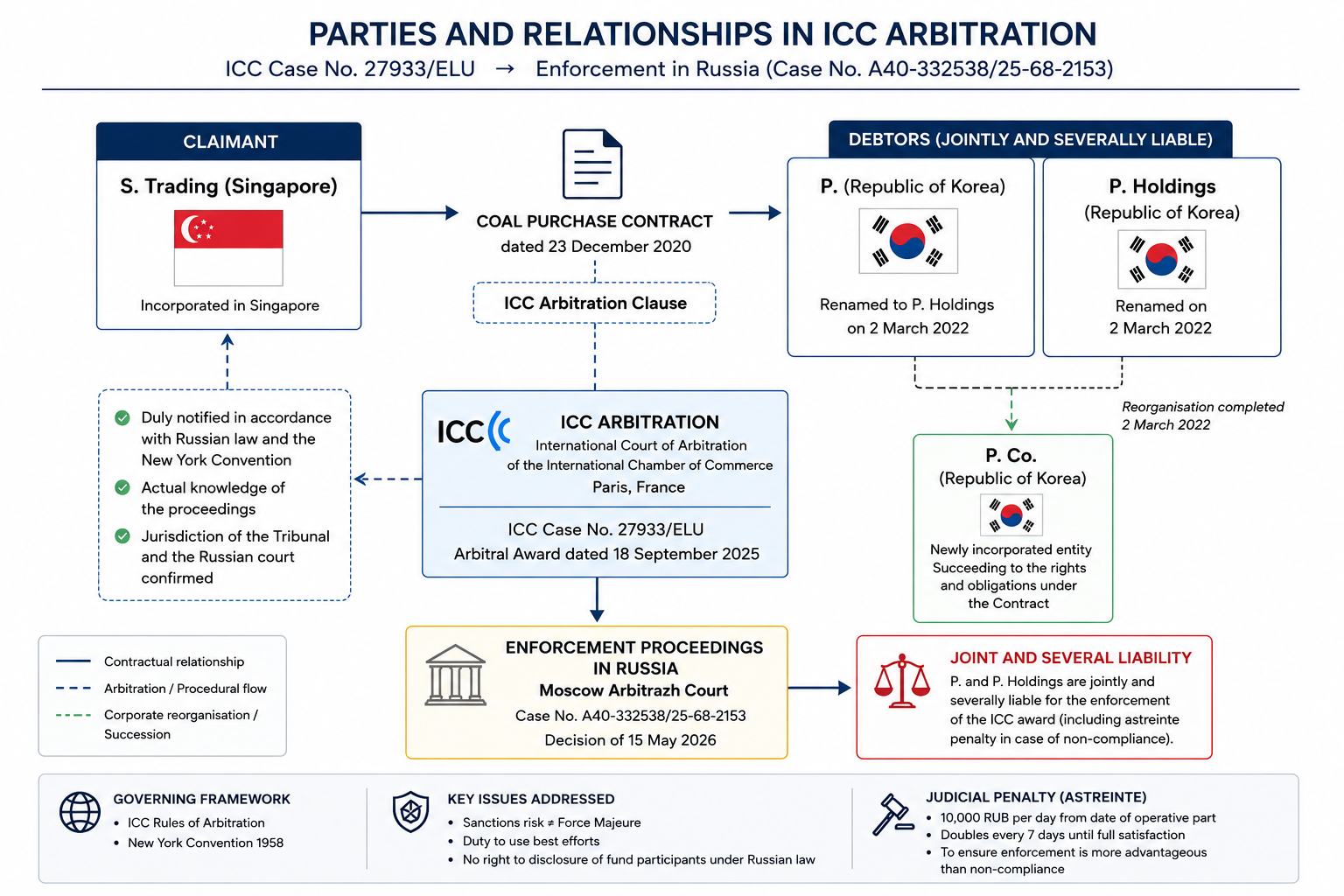
On 15 May 2026, the Moscow Arbitrazh Court rendered a decision in case No. А40-332538/25-68-2153, granting enforcement of an arbitral award rendered on 18 September 2025 by a Tribunal under the auspices of the International Court of Arbitration of the International Chamber of Commerce (ICC) in Paris (Case No. 27933/ELU). The decision addresses the enforcement of the award issued in favour of S. Trading (Singapore) against P. and P. Holdings (Republic of Korea), and engages with issues of sanctions, force majeure, and complex debtor reorganization.
Key Findings of the Tribunal and the Court
1. Notification, Participation, and Jurisdiction
The Court established that P. and P. Holdings had been duly notified in accordance with Russian procedural requirements and the New York Convention. Notification was effected at corporate addresses in Korea and Russia, with translated documents, and there was factual evidence that both entities had actual knowledge of the Russian proceedings. The arbitration clause in the coal purchase contract dated 23 December 2020 was found to be valid and enforceable, supporting both the ICC Tribunal’s and the Russian court’s jurisdiction over the dispute and subsequent enforcement.
2. Sanctions, Force Majeure, and Best Efforts
One of the central issues addressed was whether the existence or risk of international sanctions could constitute a force majeure event excusing P. and P. Holdings from payment. The ICC Tribunal’s findings, closely followed by the Moscow court, included:
- No proof was adduced that S. Trading was owned or controlled by a party appearing on the SDN (Specially Designated Nationals) list.
- The perceived risk of SDN-related exposure—even with severe potential consequences—did not amount to force majeure or otherwise excuse or suspend payment.
- The debtors did not prove that sanctions actually prevented them from fulfilling contractual obligations or that they had taken all reasonable steps (including using alternative payment channels or consenting to assignment) to mitigate or avoid the effects of sanctions.
- Arguments about the inability to obtain disclosure of fund participants were rejected: Russian law—confirmed by the Central Bank—does not provide S. Trading with such a right.
The tribunal underscored the parties’ duty to take all reasonable and feasible actions to satisfy contractual obligations, and that mere assertion of sanctions risk was insufficient.
3. Debtor Reorganization and Joint Liability
The Court took note of significant corporate changes: following a reorganisation completed on 2 March 2022, POSCO was renamed P. Holdings and a new entity, P. Co., was incorporated, succeeding to the rights and obligations under the original contract. Both entities were held jointly and severally liable for the arbitral debt, particularly because of the reallocation of assets within the group in the period just prior to the ICC award, which the Court viewed as indicative of bad faith. References were made to prior Russian case law regarding restructuring and avoidance of liability.
Astreinte (Daily Penalty)
A prominent feature of the Moscow Arbitrazh Court’s decision is the imposition of a judicial penalty mechanism closely resembling the French “astreinte.” In this case, the Court ordered that in the event of non-compliance with the enforcement order:
- P. and P. Holdings are jointly and severally liable to pay a penalty of 10,000 Russian roubles (RUB) per day from the date the operative part of the court’s decision was announced until full satisfaction of the enforcement order.
- This daily penalty doubles every seven calendar days until the obligation is performed, leading to an exponentially increasing financial burden for continued non-compliance.
- The rationale given by the Court is that the astreinte (judicial penalty) is necessary to ensure enforcement is unequivocally more advantageous than non-compliance, particularly given the context of foreign debtors from so-called “unfriendly” jurisdictions as classified under Russian government decree No. 430-r of 5 March 2022.
Such an escalating penalty mechanism is highly unusual by international comparison and significantly raises the pressure on the debtor to perform voluntarily and swiftly, even if there should only be limited assets available in Russia.


