In its judgment of 4 June 2026 in Costa Crociere (Case C-629/24), the Court of Justice of the European Union (CJEU) addressed an important question concerning the interaction between EU package travel law and the special liability regime governing passenger transport by sea.

I. Introduction
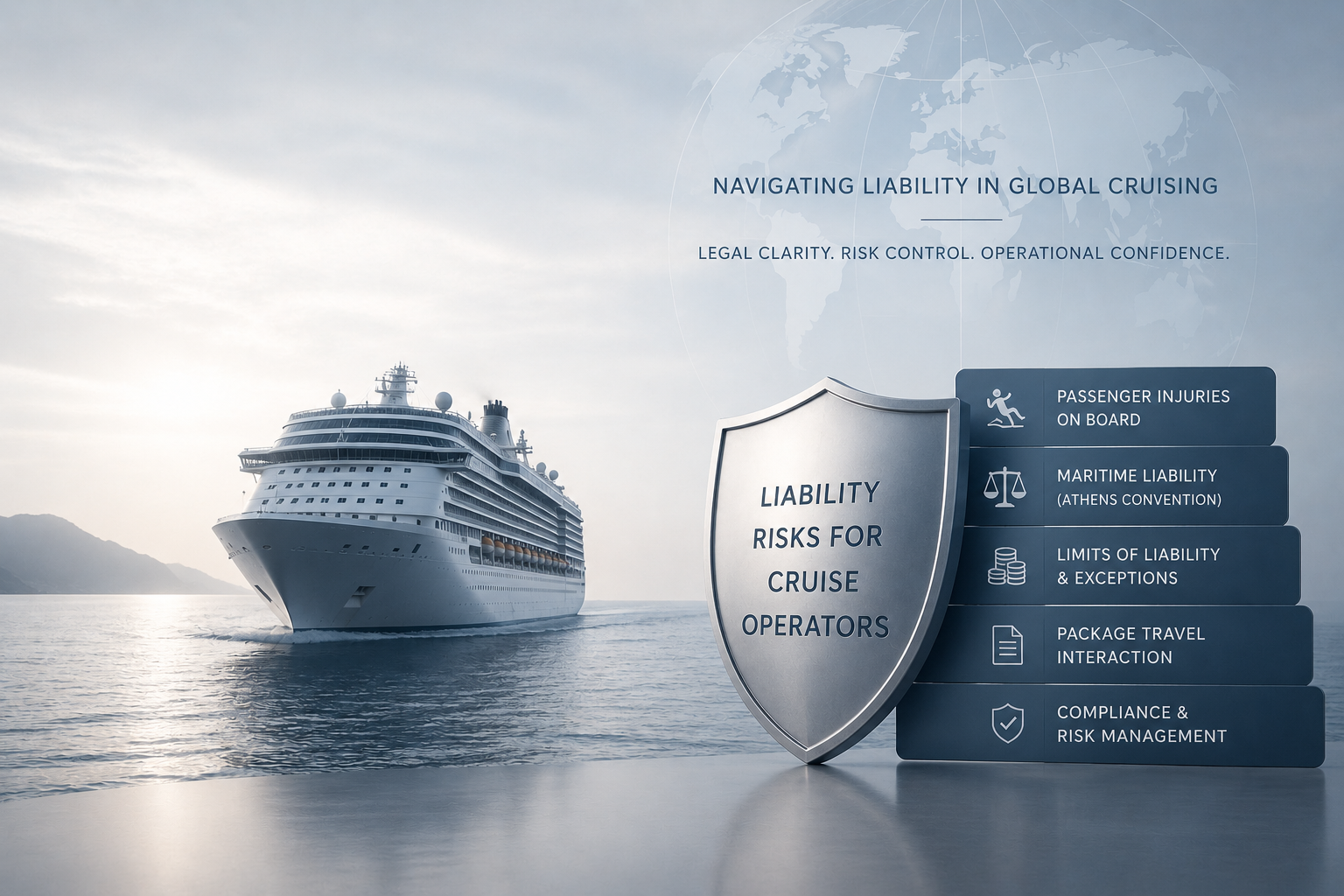
The case concerned passengers who suffered personal injuries while on cruise holidays marketed and sold as package travel arrangements. The referring French court sought clarification as to whether claims arising from such injuries should be governed by the liability rules applicable to package travel organisers or by the specific maritime liability regime established by Regulation No 392/2009 and the Athens Convention relating to the Carriage of Passengers and their Luggage by Sea.
The judgment provides welcome guidance for cruise operators, tour operators, insurers and practitioners dealing with passenger injury claims in the maritime tourism sector.
II. Background of the Dispute
The request for a preliminary ruling arose from two separate French proceedings involving cruises operated by Costa Crociere.
The MH Case
In the first case, a passenger booked a cruise from Chile to Australia through a travel agency. During the voyage, she got out of bed during the night without switching on the cabin light, fell and suffered a serious shoulder injury.
The passenger brought proceedings against both the travel agency and Costa Crociere, claiming compensation for her injuries. The French courts reached different conclusions regarding liability, resulting in an appeal before the French Cour de cassation.
The DI Case
The second case involved a passenger who was injured while serving herself at a buffet on board a Costa Crociere vessel. According to the facts established by the national courts, she was pushed by an unknown person and sustained a fracture before the cruise had effectively begun.
The injured passenger and her husband sued both the cruise operator and the travel agency that had sold the cruise package. Again, the French courts disagreed on whether the claim should be assessed under package travel legislation or under the maritime passenger liability regime.
These conflicting approaches led the French Supreme Court to seek guidance from the CJEU.
III. The Legal Framework
National Package Travel Rules
At the time relevant to the dispute, package holidays were governed by Directive 90/314/EEC on package travel, incorporated to French law by the Code du tourisme (in the following jointly the “Directive”).
Under the Directive, organisers and retailers of package travel are generally liable to consumers for the proper performance of contractual obligations, even where services are carried out by third-party providers. This liability regime is designed to provide a high level of consumer protection and simplifies claims for travellers by allowing them to pursue the organiser directly.
Maritime Passenger Liability
Passenger transport by sea is subject to a distinct liability regime under Regulation No 392/2009, which incorporates key provisions of the Athens Convention.
The Athens Convention establishes detailed rules regarding:
- liability for passenger death or personal injury;
- burdens of proof;
- contributory negligence;
- limitation of liability;
- circumstances in which liability limits may be lost; and
- mandatory passenger information requirements.
For personal injury claims, the Convention distinguishes between injuries resulting from a shipping incident and injuries caused by other events. Different liability standards apply depending on the nature of the incident.
Importantly, the Convention also imposes monetary limits on a carrier’s liability, subject to certain exceptions involving intentional or reckless conduct.
IV. The Questions Referred to the CJEU
The French court essentially asked whether the maritime liability regime applies when a passenger suffers personal injury during a cruise that simultaneously qualifies as package travel.
A further issue was whether the maritime regime applies only when the injury is connected with the transportation function of the cruise or whether it also extends to injuries arising from accommodation, leisure activities or other services provided on board.
The Court’s Analysis
The CJEU began by recognising that a cruise can simultaneously constitute:
- a package holiday within the meaning of the Directive; and
- a maritime transport service within the meaning of Regulation 392/2009.
The Court emphasised that the Directive creates a system of contractual liability for organisers. However, the Directive itself expressly allows compensation for certain losses to be limited in accordance with international conventions applicable to the relevant service.
The Athens Convention is one such convention.
According to the Court, once Regulation 392/2009 became fully applicable throughout the European Union, Member States were no longer free to disregard the liability limitations established by the Athens Convention in situations falling within its scope.
No Distinction Between Transport and On-Board Services
One of the most significant aspects of the judgment is the Court’s rejection of a distinction between transportation services and other services provided on board a cruise vessel.
Some commentators had argued that injuries connected to accommodation, catering or leisure activities should fall exclusively under package travel rules rather than maritime liability rules.
The Court disagreed.
It held that the decisive factor is whether the injury occurred during the period of “carriage” as defined by the Athens Convention. Since carriage includes the period during which a passenger is on board the ship, personal injuries sustained on board are covered by the maritime liability regime regardless of whether they arise from transportation activities, accommodation services, catering facilities or leisure arrangements.
As a result, the applicable liability framework cannot depend on categorising the precise service that gave rise to the injury.
The Passenger’s Available Claims
The Court explained that an injured passenger may pursue two different avenues of redress.
First, the passenger may bring a claim against the package travel organiser under the Directive.
Second, the passenger may bring a direct claim against the maritime carrier under Regulation 392/2009 and the Athens Convention.
However, the liability limitations established by the Athens Convention remain relevant in both contexts. A package travel organiser may rely on those limitations when responding to claims arising from injuries sustained during maritime carriage.
The Court further noted that any compensation awarded under one claim must be taken into account when assessing compensation under the other in order to prevent double recovery.
V. Conclusion
The CJEU concluded that where a passenger suffers personal injury on board a cruise ship during maritime carriage, the liability regime established by Regulation No 392/2009 and the Athens Convention applies, even if the cruise was sold as a package holiday.
The Court further confirmed that this conclusion applies irrespective of whether the injury arises from transport services, accommodation, catering or leisure activities provided on board. The determining factor is that the injury occurred during the period of carriage.
The judgment provides important guidance on the allocation of risk and liability in the cruise sector and will likely become a leading authority in future passenger injury litigation involving package travel and maritime transport.
VI. Practical Significance of the Judgment
The judgment has substantial implications for the cruise industry and the travel sector.
For cruise operators, it confirms that the harmonised maritime liability regime applies broadly to personal injuries occurring on board vessels during carriage. This provides greater legal certainty and ensures consistent application of liability limitations throughout the European Union.
For travel organisers selling cruises as package holidays, the decision confirms that they remain liable to consumers under package travel law. Nevertheless, they may invoke the liability limitations available under the Athens Convention where the underlying injury falls within the scope of maritime carriage.
For passengers, the judgment clarifies the available routes for compensation while simultaneously defining the limits of recoverable damages.
The ruling therefore establishes a coherent relationship between package travel legislation and maritime passenger protection rules, ensuring that both frameworks operate together rather than in competition.