
Summary
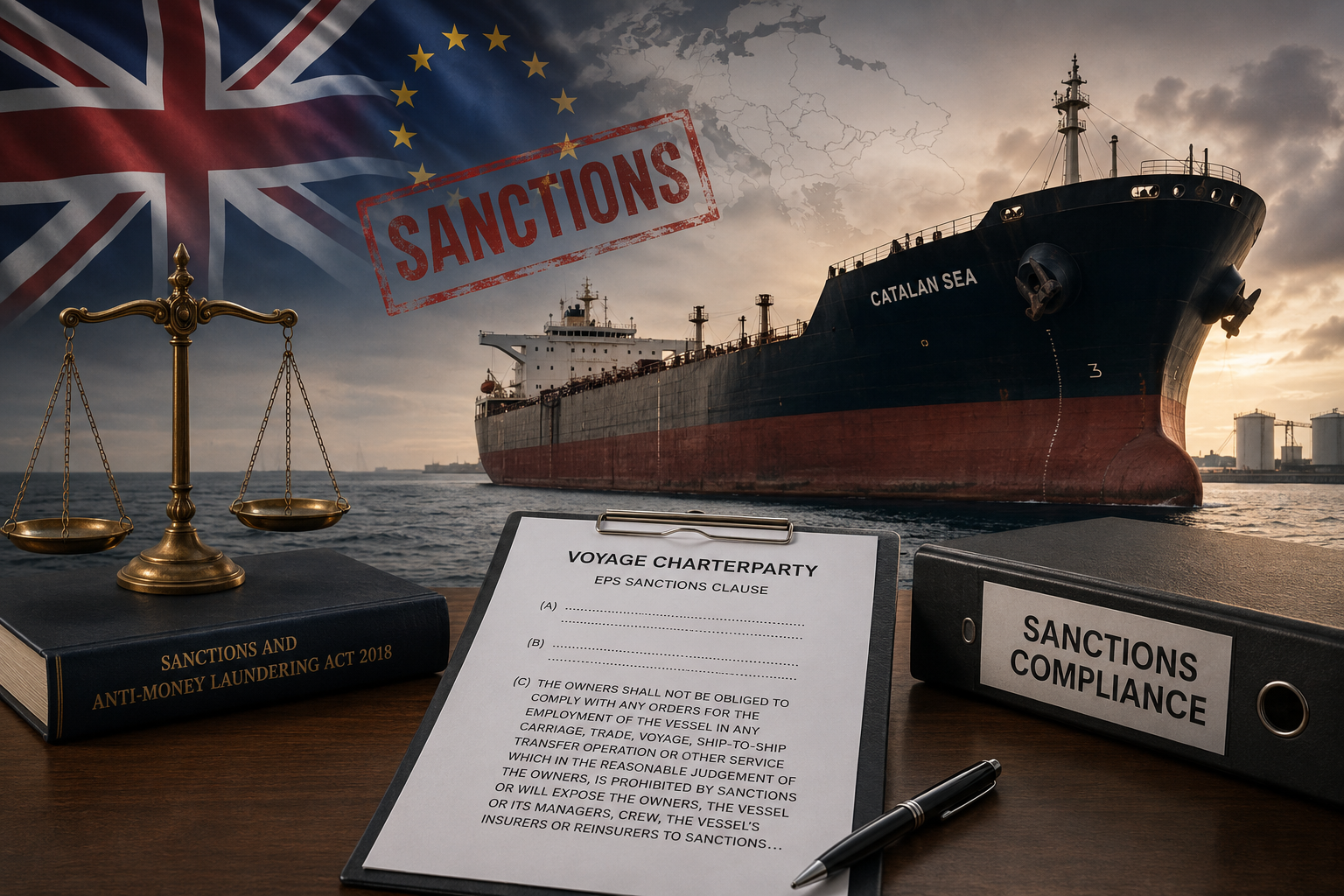
In a recent decision published on 22 May 2026 “Tonzip Maritime (Singapore) Pte Ltd v 2 Rivers Pte Ltd” the Court of Appeal of England and Wales, Civil Division [2026] EWCA Civ 641 – case no. CA-2025-002537, has allowed the appeal of the owners of the MV CATALAN SEA in a dispute arising from their refusal to load crude oil shipped by a Russian oil company. The owners relied on an amended sanctions clause in an ExxonMobil VOY2005 voyage charterparty, arguing that performance would expose them, the vessel, managers, crew, insurers or reinsurers to sanctions risk.
The Court held that the relevant clause did not require the owners to prove that sanctions would more likely than not be breached. It was sufficient that the owners had reached a reasonable judgment that performance would give rise to a real risk of sanctions liability.
This is a significant decision for maritime operators, charterers, insurers and sanctions-compliance teams. It confirms that, where a charterparty permits owners to refuse orders that would “expose” them to sanctions, the relevant question may be whether there is a real and objectively reasonable risk of sanctions exposure, not whether an actual breach of sanctions can be established on the balance of probabilities.
The sanctions clause
The Court of Appeal set out the relevant EPS Sanctions clause as follows:
“(A) THE CHARTERERS HEREBY WARRANT AND REPRESENT TO THE OWNERS THAT NEITHER THE CHARTERERS NOR ANY PERSON OR ENTITY ON WHOSE BEHALF OR UNDER WHOSE DIRECTION THE CHARTERERS ACT OR ASSIST, OR WHO DIRECTLY OR INDIRECTLY OWNS OR CONTROLS THE CHARTERERS, NOR, TO THEIR KNOWLEDGE, ANY PERSON OR ENTITY AT ANY TIME HAVING AN INTEREST IN ANY OF CARGO CARRIED UNDER THIS CHARTERPARTY, ARE DESIGNATED OR SUBJECT TO ANY NATIONAL, INTERNATIONAL OR SUPRANATIONAL LAW OR REGULATION IMPOSING TRADE AND ECONOMIC SANCTIONS, PROHIBITIONS OR RESTRICTIONS (‘SANCTIONS’) AND THAT ENTRY INTO AND PERFORMANCE OF THIS CHARTERPARTY IS NOT AND WILL NOT BE PROHIBITED OR RESTRICTED BY, AND WILL NOT EXPOSE THE OWNERS, THE VESSEL OR ITS MANAGERS, CREW, THE VESSEL’S INSURERS OR RE-INSURERS TO SANCTIONS.
(B) THE OWNERS HEREBY WARRANT AND REPRESENT TO THE CHARTERERS THAT NEITHER THE OWNERS NOR ANY PERSON OR ENTITY ON WHOSE BEHALF OR UNDER WHOSE DIRECTION THE OWNERS ACT OR ASSIST, OR WHO DIRECTLY OR INDIRECTLY OWNS OR CONTROLS THE OWNERS, ARE SUBJECT TO SANCTIONS AND THAT ENTRY INTO AND PERFORMANCE OF THIS CHARTERPARTY IS NOT AND WILL NOT BE PROHIBITED OR RESTRICTED BY, AND WILL NOT EXPOSE THE CHARTERERS TO SANCTIONS.
(C) THE OWNERS SHALL NOT BE OBLIGED TO COMPLY WITH ANY ORDERS FOR THE EMPLOYMENT OF THE VESSEL IN ANY CARRIAGE, TRADE, VOYAGE, SHIP-TO-SHIP TRANSFER OPERATION OR OTHER SERVICE WHICH IN THE REASONABLE JUDGEMENT OF THE OWNERS, IS PROHIBITED BY SANCTIONS OR WILL EXPOSE THE OWNERS, THE VESSEL OR ITS MANAGERS, CREW, THE VESSEL’S INSURERS OR REINSURERS TO SANCTIONS. IN THE EVENT THAT SUCH RISK ARISES IN RELATION TO A VOYAGE THE VESSEL IS PERFORMING, THE OWNERS SHALL BE ENTITLED TO REFUSE FURTHER PERFORMANCE AND THE CHARTERERS SHALL BE OBLIGED TO PROVIDE ALTERNATIVE VOYAGE ORDERS”. </div>
Facts of the case
The dispute arose under a voyage charterparty dated 5 November 2021. The charterers had chartered the MV CATALAN SEA to carry crude oil from a Russian Black Sea port in the Ust-Luga to Primorsk range to the Mediterranean, with Aliaga, Turkey, as the intended destination.
The cargo was to be shipped by Neftisa, a Russian oil company associated with Mr Mikhail Gutseriev. Mr Gutseriev had been sanctioned by the EU in June 2021 and by the UK in August 2021 due to his links with the Lukashenko regime in Belarus.
Before the voyage was performed, information became available suggesting that Mr Gutseriev had transferred ownership interests in Neftisa to his brother, Mr Sait-Salam Gutseriev. However, the owners considered that there remained a real risk that Mr Gutseriev continued to exercise de facto control over Neftisa, or that sanctions authorities might view the transfer as ineffective or as an attempt to circumvent sanctions.
The owners carried out sanctions checks using commercial information sources, including Refinitiv World-Check. They also received material from the charterers, including a letter from Neftisa and legal opinions from Herbert Smith Freehills and Baker McKenzie. Those materials sought to support the view that Mr Gutseriev no longer controlled Neftisa, but they were based on factual assumptions and information provided by or on behalf of Neftisa.
The owners refused to load the cargo and called on the charterers to provide alternative voyage orders. The charterers refused and purported to cancel the charterparty. The owners treated that cancellation as a repudiatory breach.
The parties’ arguments
The owners argued that they were entitled to refuse the voyage orders under sub-clause C of the sanctions clause. They contended that the words “will expose” did not require proof that sanctions would actually be breached. Instead, the clause protected owners where, in their reasonable judgment, compliance would create a real risk of sanctions exposure.
The charterers argued that the clause required more than a perceived or possible risk. In their submission, the owners needed to form a reasonable judgment that performance would in fact be prohibited by sanctions or would in fact expose them to sanctions. They also relied on the fact that Neftisa itself was not designated and that legal opinions had been provided suggesting that Mr Gutseriev did not control Neftisa.
At first instance, the Commercial Court accepted the owners’ interpretation of the clause in principle but held that, on the facts, the owners’ apprehension of sanctions risk was not reasonable. The owners appealed.
The Court of Appeal’s reasoning
The Court of Appeal focused on the meaning of the words “expose … to sanctions”. It held that those words were materially different from the words “prohibited by sanctions”. The latter concerned whether the voyage would actually be prohibited. The former concerned exposure to sanctions risk.
A central point in the Court’s reasoning was the second sentence of sub-clause C, which refers to “such risk”. The Court considered that wording to be strong support for the owners’ interpretation. The clause itself treated the relevant sanctions exposure as a form of risk.
The Court also emphasised the commercial context. Shipowners often have to make sanctions decisions quickly, with incomplete information, in circumstances where ownership, control and beneficial interests may be opaque. Sanctions regimes are broad, complex and designed to prevent circumvention. In that environment, it would be commercially unrealistic to require shipowners to prove, on the balance of probabilities, that sanctions would be breached before they could refuse orders.
The Court therefore confirmed that sub-clause C was engaged where the owners formed a reasonable judgment that compliance would give rise to a real risk of sanctions liability.
Application to the facts
The Court of Appeal disagreed with the Commercial Court’s conclusion that the owners’ decision was not objectively reasonable.
The available information showed that Mr Gutseriev had previously held a significant ownership interest in Neftisa and that, following his designation, that interest was said to have been transferred to his brother and long-term business partner. The Court considered that such a transfer could reasonably raise concerns about whether control had genuinely been relinquished or whether the arrangement might be viewed as cosmetic.
The materials provided by the charterers did not eliminate that risk. The legal opinions depended heavily on assumptions about factual matters, including whether Mr Gutseriev continued to influence Neftisa or his brother. The Baker McKenzie memorandum itself acknowledged that EU competent authorities could potentially come to a different view on control.
The Court held that a reasonable owner could conclude that loading the cargo involved a real risk of sanctions liability. The owners did not need to prove that Mr Gutseriev in fact controlled Neftisa. They only needed to show that their judgment as to sanctions exposure was objectively reasonable.
Applicable legal norms
The sanctions clause referred to sanctions imposed under national, international or supranational law. In the case, the relevant sanctions regimes included UK and EU measures, including the UK’s sanctions framework under the Sanctions and Anti-Money Laundering Act 2018 and sanctions measures relating to Belarus.
The legal issue was not simply the external sanctions law itself, but the contractual allocation of sanctions risk under the charterparty. The Court interpreted the clause according to ordinary principles of contractual construction, taking account of the wording, structure and commercial purpose of the provision.
The key legal distinction was between:
actual prohibition, where performance is prohibited or restricted by sanctions; and
sanctions exposure, where performance creates a real risk of sanctions liability.
The Court held that the word “expose” belonged to the second category.
Practical implications for maritime law
This judgment is highly relevant for voyage charterparties, sanctions clauses, tanker trades, Russian-origin cargoes, and transactions involving opaque ownership or control structures.
For owners, the decision confirms that carefully drafted sanctions clauses can provide meaningful protection where there is a real sanctions risk, even if the sanctioned status of a counterparty or cargo interest cannot be conclusively established.
For charterers, the decision underlines the importance of providing robust, independent and verifiable evidence where sanctions concerns arise. Letters from the cargo interest or legal opinions based on assumptions may not be sufficient to compel performance if the underlying factual risk remains unresolved.
For the market more generally, the judgment reinforces the need for clear sanctions clauses that specify the threshold for refusal, the role of the owner’s judgment, and the consequences of sanctions risk arising before or during performance.